Investment Strategy

Here’s Why Your Diversified Portfolio is Underperforming The Market

photo of person holding black pen

Photo by rawpixel.com on Pexels.com

How global returns and proper diversification are affecting overall returns.

Your Portfolio vs. the S&P 500

“Why is my portfolio underperforming the market?” This question may be on your mind. It is a question that investors sometimes ask after stocks shatter records or return exceptionally well in a quarter.

The short answer is that while the U.S. equities market has realized significant gains in 2018, international markets and intermediate and long-term bonds have underperformed and exerted a drag on overall portfolio performance. A little elaboration will help explain things further.

A diversified portfolio necessarily includes a range of asset classes.

This will always be the case, and while investors may wish for an all-equities portfolio when stocks are surging, a 100% stock allocation is obviously fraught with risk.

Because of this long bull market, some investors now have larger positions in equities than they originally planned. A portfolio once evenly held in equities and fixed income may now have a majority of its assets held in stocks, with the performance of stock markets influencing its return more than in the past.(1)

Yes, stock markets – as in stock markets worldwide.

Today, investors have more global exposure than they once did. In the 1990s, international holdings represented about 5% of an individual investor’s typical portfolio. Today, that has risen to about 15%. When overseas markets struggle, it does impact the return for many U.S. investors – and struggle they have. A strong dollar, the appearance of tariffs – these are considerable headwinds. (2,3)

In addition, a sudden change in sector performance can have an impact.

At one point in 2018, tech stocks accounted for 25% of the weight of the S&P 500. While the recent restructuring of S&P sectors lowered that by a few percentage points, portfolios can still be greatly affected when tech shares slide, as investors witnessed in fall 2018. (4)

How about the fixed-income market?

Well, this has been a weak year for bonds, and bonds are not known for generating huge annual returns to start with. (3)

This year, U.S. stocks have been out in front.

A portfolio 100% invested in the U.S. stock market would have a 2018 return like that of the S&P 500. But who invests entirely in stocks, let alone without any exposure to international and emerging markets? (3)

Just as an illustration, assume there is a hypothetical investor this year who is actually 100% invested in equities, as follows: 50% domestic, 35% international, 15% emerging markets. In the first two-thirds of 2018, that hypothetical portfolio would have advanced just 3.6%. (3)

Your portfolio is not the market – and vice versa.

Your investments might be returning 3% or less so far this year. Yes – this year. Will the financial markets behave in this exact fashion next year? Will the sector returns or emerging market returns of 2018 be replicated year after year for the next 10 or 15 years? The chances are remote.

The investment markets are ever-changing.

In some years, you may get a double-digit return. In other years, your return is much smaller. When your portfolio is diversified across asset classes, the highs may not be so high – but the lows may not be so low, either. When things turn volatile, diversification may help insulate you from some of the ups and downs you go through as an investor.
MI-GTM_4Q18_November_HIGH_RES-60

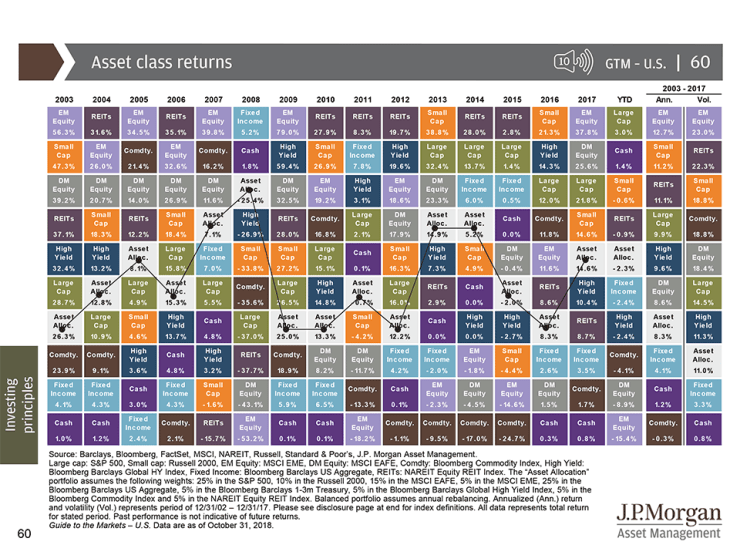
Asset class returns

This chart shows the historical performance and volatility of different asset classes, as well as an annually rebalanced asset allocation portfolio. The asset allocation portfolio incorporates the various asset classes shown in the chart and highlights that balance and diversification can help reduce volatility and enhance returns. (5)

Sources:

  1. seattletimes.com/business/5-steps-to-take-if-the-bull-market-run-has-you-thinking-of-unloading-stocks/
  2. forbes.com/sites/simonmoore/2018/08/05/how-most-investors-get-their-international-stock-exposure-wrong/
  3. thestreet.com/investing/stocks/dear-financial-advisor-why-is-my-portfolio-performing-so-14712955
  4. cnbc.com/2018/04/20/tech-dominates-the-sp-500-but-thats-not-always-a-bad-omen.html
  5. https://am.jpmorgan.com/us/en/asset-management/gim/protected/adv/insights/guide-to-the-markets/viewer

This material was prepared by MarketingPro, Inc., and does not necessarily represent the views of the presenting party, nor their affiliates. This information has been derived from sources believed to be accurate. Please note – investing involves risk, and past performance is no guarantee of future results. The publisher is not engaged in rendering legal, accounting or other professional services. If assistance is needed, the reader is advised to engage the services of a competent professional. This information should not be construed as investment, tax or legal advice and may not be relied on for avoiding any Federal tax penalty. This is neither a solicitation nor recommendation to purchase or sell any investment or insurance product or service, and should not be relied upon as such. All indices are unmanaged and are not illustrative of any particular investment.

Why You’ll Need to Tolerate Some Risk When Investing

ImageExample

When financial markets have a bad day, week, or month, discomforting headlines and data can swiftly communicate a message to retirees and retirement savers alike: equity investments are risky things, and Wall Street is a risky place.


Use this tool to determine your Risk Number: http://bit.ly/WFGYourRiskNumber


All true. If you want to accumulate significant retirement savings or try and grow your wealth through the opportunities in the markets, this is a reality you cannot avoid.

Regularly, your investments contend with assorted market risks. They never go away. At times, they may seem dangerous to your net worth or your retirement savings, so much so that you think about getting out of equities entirely.

If you are having such thoughts, think about this: in the big picture, the real danger to your retirement could be being too risk averse.

Is it possible to hold too much in cash?

Yes. Some pre-retirees do. (Even some retirees, in fact.) They have six-figure savings accounts, built up since the Great Recession and the last bear market. It is a prudent move. A dollar will always be worth a dollar in America, and that money is out of the market and backed by deposit insurance.

This is all well and good, but the problem is what that money is earning. Even with interest rates rising, many high-balance savings accounts are currently yielding less than 0.5% a year. The latest inflation data shows consumer prices advancing 2.3% a year. That money in the bank is not outrunning inflation, not even close. It will lose purchasing power over time. (1,2)

Consider some of the recent yearly advances of the S&P 500.

In 2016, it gained 9.54%; in 2017, it gained 19.42%. Those were the price returns; the 2016 and 2017 total returns (with dividends reinvested) were a respective 11.96% and 21.83%. (3,4)

Yes, the broad benchmark for U.S. equities has bad years as well.

Historically, it has had about one negative year for every three positive years. Looking through relatively recent historical windows, the positives have mostly outweighed the negatives for investors. From 1973-2016, for example, the S&P gained an average of 11.69% per year. (The last 3-year losing streak the S&P had was in 2000-02.) (5)

Your portfolio may not return as well as the S&P does in a given year, but when equities rally, your household may see its invested assets grow noticeably.

When you bring in equity investment account factors like compounding and tax deferral, the growth of those invested assets over decades may dwarf the growth that could result from mere checking or savings account interest.

At some point, putting too little into investments and too much in the bank may become a risk – a risk to your retirement savings potential.

At today’s interest rates, the money you are saving may end up growing faster if it is invested in some vehicle offering potentially greater reward and comparatively greater degrees of risk to tolerate.

Having a big emergency fund is good.

You can dip into that liquid pool of cash to address sudden financial issues that pose risks to your financial equilibrium in the present.

Having a big retirement fund is even better.

When you have one of those, you may confidently address the biggest financial risk you will ever face: the risk of outliving your money in the future.

MI-GTM_4Q18-HIGH-RES-14

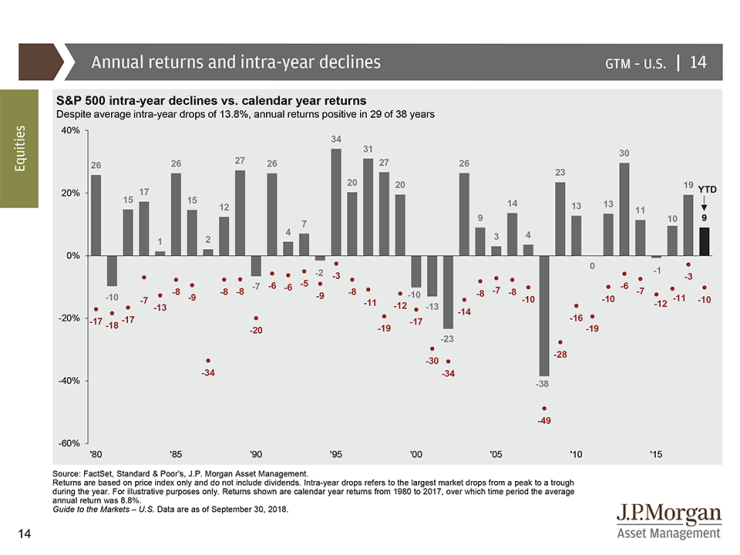
Annual returns and intra-year declines

This chart shows intra-year stock market declines (red dot and number), as well as the market’s return for the full year (gray bar). What is clear is that the market is capable of recovering from intra-year drops and finishing the year in positive territory, which should encourage investors to stay the course when markets get choppy.

Sources

  1. valuepenguin.com/average-savings-account-interest-rates
  2. investing.com/economic-calendar/
  3. money.cnn.com/data/markets/sandp/
  4. ycharts.com/indicators/sandp_500_total_return_annual
  5. thebalance.com/stock-market-returns-by-year-2388543

This material was prepared by MarketingPro, Inc., and does not necessarily represent the views of the presenting party, nor their affiliates. This information has been derived from sources believed to be accurate. Please note – investing involves risk, and past performance is no guarantee of future results. The publisher is not engaged in rendering legal, accounting or other professional services. If assistance is needed, the reader is advised to engage the services of a competent professional. This information should not be construed as investment, tax or legal advice and may not be relied on for avoiding any Federal tax penalty. This is neither a solicitation nor recommendation to purchase or sell any investment or insurance product or service, and should not be relied upon as such. All indices are unmanaged and are not illustrative of any particular investment.

How the Sequence of Investment Returns Can Negatively Impact Retirees

silver and gold coins

Photo by Pixabay on Pexels.com

A look at how variable rates of return do (and do not) impact investors over time.

What exactly is the “sequence of returns”?

The phrase simply describes the yearly variation in an investment portfolio’s rate of return. Across 20 or 30 years of saving and investing for the future, what kind of impact do these deviations from the average return have on a portfolio’s final value?

The answer: no impact at all.

Once an investor retires, however, these ups and downs can have a major effect on portfolio value – and retirement income.

During the accumulation phase, the sequence of returns is ultimately inconsequential.

Yearly returns may vary greatly or minimally; in the end, the variance from the mean hardly matters. (Think of “the end” as the moment the investor retires: the time when the emphasis on accumulating assets gives way to the need to withdraw assets.)

An analysis from BlackRock bears this out.

The asset manager compares three model investing scenarios: three investors start portfolios with lump sums of $1 million, and each of the three portfolios averages a 7% annual return across 25 years. In two of these scenarios, annual returns vary from -7% to +22%. In the third scenario, the return is simply 7% every year. In all three scenarios, each investor accumulates $5,434,372 after 25 years – because the average annual return is 7% in each case. (1)

Here is another way to look at it.

The average annual return of your portfolio is dynamic; it changes, year-to-year. You have no idea what the average annual return of your portfolio will be when “it is all said and done,” just like a baseball player has no idea what his lifetime batting average will be four seasons into a 13-year playing career. As you save and invest, the sequence of annual portfolio returns influences your average yearly return, but the deviations from the mean will not impact the portfolio’s final value. It will be what it will be. (1)

When you shift from asset accumulation to asset distribution, the story changes.

You must try to protect your invested assets against sequence of returns risk.

This is the risk of your retirement coinciding with a bear market (or something close). Even if your portfolio performs well across the duration of your retirement, a bad year or two at the beginning could heighten concerns about outliving your money.

For a classic illustration of the damage done by sequence of returns risk, consider the awful 2007-2009 bear market. Picture a couple at the start of 2008 with a $1 million portfolio, held 60% in equities and 40% in fixed-income investments. They arrange to retire at the end of the year. This will prove a costly decision. The bond market (in shorthand, the S&P U.S. Aggregate Bond Index) gains 5.7% in 2008, but the stock market (in shorthand, the S&P 500) dives -37.0%. As a result, their $1 million portfolio declines to $800,800 in just one year. (2)

Here is a good chart from investmentmoats.com which helps visually explain what how early negative returns in retirement could potentially impact final portfolio value:

jlFIqYt

If you are about to retire, do not dismiss this risk.

If you are far from retirement, keep saving and investing knowing that the sequence of returns will have its greatest implications as you make your retirement transition.

Sources

  1. blackrock.com/pt/literature/investor-education/sequence-of-returns-one-pager-va-us.pdf
  2. kiplinger.com/article/retirement/T047-C032-S014-is-your-retirement-income-in-peril-of-this-risk.html
  3. http://investmentmoats.com/budgeting/retirement-planning/explaining-sequence-of-return-risk-and-possible-solutions/
  4. https://retireone.com/sequence-of-returns/

This material was prepared by MarketingPro, Inc., and does not necessarily represent the views of the presenting party, nor their affiliates. This information has been derived from sources believed to be accurate. Please note – investing involves risk, and past performance is no guarantee of future results. The publisher is not engaged in rendering legal, accounting or other professional services. If assistance is needed, the reader is advised to engage the services of a competent professional. This information should not be construed as investment, tax or legal advice and may not be relied on for the purpose of avoiding any Federal tax penalty. This is neither a solicitation nor recommendation to purchase or sell any investment or insurance product or service, and should not be relied upon as such. All indices are unmanaged and are not illustrative of any particular investment.

How to Balance Portfolio Risk and Reward as You Get Closer to Retirement

jeremy-thomas-75753-unsplash.jpg

As you approach retirement, it may be time to pay more attention to investment risk.

If you are an experienced investor, you have probably fine-tuned your portfolio through the years in response to market cycles or in pursuit of a better return. As you approach or enter retirement, is another adjustment necessary?

Some investors may think they can approach retirement without looking at their portfolios. Their investment allocations may be little changed from what they were 10 or 15 years ago. Because of that inattention (and this long bull market), their invested assets may be exposed to more risk than they would like.

Rebalancing your portfolio with your time horizon in mind is only practical.

Consider the nature of equity investments: they lose or gain value according to the market climate, which at times may be fear driven. The larger your equities position, the larger your losses could be in a bear market or market disruption. If this kind of calamity happens when you are newly retired or two or three years away from retiring, your portfolio could be hit hard if you are holding too much stock. What if it takes you several years to recoup your losses? Would those losses force you to compromise your retirement dreams?

As certain asset classes outperform others over time, a portfolio can veer off course.

The asset classes achieving the better returns come to represent a greater percentage of the portfolio assets. The intended asset allocations are thrown out of alignment.1

Just how much of your portfolio is held in equities today? Could the amount be 70%, 75%, 80%? It might be, given the way stocks have performed in this decade. As a StreetAuthority comparison notes, a hypothetical portfolio weighted 50/50 in equities and fixed-income investments at the end of February 2009 would have been weighted 74/26 in favor of stocks by the end of February 2018. (1)

Ideally, you reduce your risk exposure with time.

With that objective in mind, you regularly rebalance your portfolio to maintain or revise its allocations. You also may want to apportion your portfolio, so that you have some cash for distributions once you are retired.

Rebalancing could be a good idea for other reasons.

Perhaps you want to try and stay away from market sectors that seem overvalued. Or, perhaps you want to find opportunities. Maybe an asset class or sector is doing well and is underrepresented in your investment mix. Alternately, you may want to revise your portfolio in view of income or capital gains taxes.

Rebalancing is not about chasing the return, but reducing volatility.

The goal is to manage risk exposure, and with less risk, there may be less potential for a great return. When you reach a certain age, though, “playing defense” with your invested assets becomes a priority.

Sources

  1. nasdaq.com/article/how-to-prepare-your-income-portfolio-for-volatility-cm939499

This material was prepared by MarketingPro, Inc., and does not necessarily represent the views of the presenting party, nor their affiliates. This information has been derived from sources believed to be accurate. Please note – investing involves risk, and past performance is no guarantee of future results. The publisher is not engaged in rendering legal, accounting or other professional services. If assistance is needed, the reader is advised to engage the services of a competent professional. This information should not be construed as investment, tax or legal advice and may not be relied on for the purpose of avoiding any Federal tax penalty. This is neither a solicitation nor recommendation to purchase or sell any investment or insurance product or service, and should not be relied upon as such. All indices are unmanaged and are not illustrative of any particular investment.


What is the Yield Curve, and Why is the Financial Media Concerned About it?

Wall Street sign in New York City

Why are investors and economists getting nervous about Treasury yields? Here is a brief explanation, starting with a clarification.

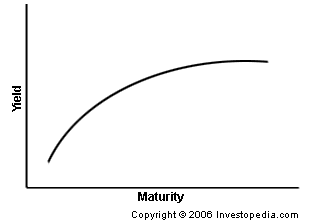
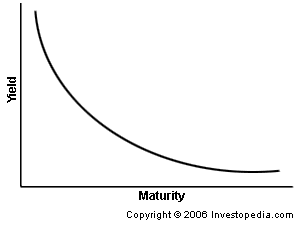
A yield curve is really an X-Y graph projecting expected rates of return for equivalent-quality bonds with different maturity dates.

But it is not just any yield curve that matters. When investors, commentators, and economists talk about “the yield curve,” they are talking about the graph plotting the interest rates of Treasuries: 3-month, 2-year, 5-year, 10-year, and 30-year notes. The “curve” is the line connecting their projected future yields. This Treasury yields snapshot is authoritatively referred to as: “the yield curve.” (1,2)

The yield curve normally slopes upward.

(Think “rise over run.”) In other words, the projected yields on the short-term Treasuries (at the left of the X-Y graph) are small compared to the projected returns on the 10-year and 30-year Treasuries. (2)

NORMAL YIELD CURVE

normalyieldcurve_r

When the economy is booming, the slope of the yield curve is often steep.

A thriving economy typically has significant inflation, and when investors see rising inflation, they assume the Federal Reserve will start raising interest rates. That belief leaves them cold on longer-term bonds, so the prices of those bonds begin to fall, and their yields correspondingly rise. (2)

The yield curve usually flattens when the Fed tightens.

It has been flattening lately, and some economists wonder if it will invert. When the yield curve inverts, interest rates on short-term Treasuries exceed interest rates on longer-term Treasuries. (2,3)

Inverted yield curves are strongly correlated with recessions.

In fact, every recession America has experienced in the last 50 years has been preceded by an inverted yield curve. Three times in the 1950s, however, an inverted yield curve failed to presage a downturn. (2,3)

INVERTED YIELD CURVE

Invertedyieldcurve_r-1

Right now, the 10s-2s gap is being closely watched.

This is the difference between 10-year and 2-year Treasury yields. It has been steadily declining since December 2015 (when the Fed began tightening), and it narrowed to less than 0.5% this spring. (2)

Looking back over the last half-century, the 10s-2s gap has slimmed to less than 0.5% five other times, with an inversion of the yield curve – and a recession – following each time.

Those recessions took time to arrive, though. On average, they began nearly two years after the yield curve inverted. (2)

Wall Street analysts have noticed a relationship between bear markets and recessions – the former tends to herald the latter.

As some study the flattening yield curve, they not only see a recession risk, but an accompanying risk of a stock market downturn, as well. (2)

Could their fears be overblown?

As MarketWatch noted, the flattening yield curve has been promoted by pension funds buying up greater quantities of zero-coupon Treasuries. The Fed, too, may have affected things due to its quantitative easing and ongoing forward guidance. (4)

Is a flatter yield curve a new normal, as former Fed chair Janet Yellen argued in 2017?

She felt the latest gradual flattening was actually a product of a changing relationship between the yield curve and the business cycle. If that is correct, investors could worry a little less about the Fed’s determination to maintain its pace of rate hikes. (Its latest dot-plot projects four interest rate increases in 2018.) The New York Fed recently put the chance of a 2019 recession based on the slope of the yield curve at 11%; in comparison, the chance was 40% on the eve of the Great Recession. (3,5)

Sources

  1. investopedia.com/terms/y/yieldcurve.asp
  2. schwab.com/resource-center/insights/content/eye-on-indicators-what-does-yield-curve-tell-us
  3. brookings.edu/blog/up-front/2018/04/16/the-hutchins-center-explains-the-yield-curve-what-it-is-and-why-it-matters/
  4. marketwatch.com/story/how-pension-funds-could-be-muddying-the-predictive-power-of-this-recession-indicator-2018-06-13
  5. bloomberg.com/news/articles/2018-06-13/fed-raises-rates-officials-boost-outlook-to-four-hikes-in-2018

This material was prepared by MarketingPro, Inc., and does not necessarily represent the views of the presenting party, nor their affiliates. All information is believed to be from reliable sources; however we make no representation as to its completeness or accuracy. Please note – investing involves risk, and past performance is no guarantee of future results. The publisher is not engaged in rendering legal, accounting or other professional services. If assistance is needed, the reader is advised to engage the services of a competent professional. This information should not be construed as investment, tax or legal advice and may not be relied on for the purpose of avoiding any Federal tax penalty. This is neither a solicitation nor recommendation to purchase or sell any investment or insurance product or service, and should not be relied upon as such. All indices are unmanaged and are not illustrative of any particular investment.

What an Investment Policy Statement is and Why You Should Have One

adult book business cactus

An “Investment Policy Statement” is a document that forms the foundation for an investor’s portfolio.

A good IPS outlines your entire investment plan

An IPS includes the asset allocation, the asset management approach, and your objectives, time horizon, risk tolerance, expected return, liquidity requirements, income needs, and tax concerns.

If you are a value investor, a growth investor, or a conservative investor, your IPS defines a strategy to invest your assets among diverse asset classes in a way that suits your preferred investment style.

Think of your IPS as long-term GPS for your portfolio.

The goal is to set the asset allocation in a way that can potentially give you the highest possible rate of return corresponding to an acceptable level of risk.

Your IPS keeps you from getting “off track” when it comes to investing.

You and your advisor should keep an eye on your portfolio to see that your invested assets stay within the allocation boundaries set by your IPS. This is why regular reviews are so essential.

Periodically, your portfolio may need to be rebalanced.

Here’s why. As months go by, the ups and downs of the investment markets will throw your asset allocation slightly or dramatically out of whack. As an extremely simple example, let’s say you start out with 25% of your assets in U.S. large caps, 15% in U.S. mid caps, 15% in U.S. small caps, 20% in foreign shares and 25% in bonds. Suddenly, small cap stocks have a great quarter, and thanks to the great returns, you wind up with 21% of your assets invested in small caps and only 19% in bonds. Great, right?

No. What’s actually happened is that your risk has increased along with your return. A greater percentage of your assets are now held in the comparatively risky stock market, removed from the bond market. So while the short-term gains have been great, it’s time to rebalance according to the parameters set by your IPS so that you can help reduce your risk exposure.

Rebalancing in Tax-Deferred Accounts

For tax-deferred investment accounts, this is easily done: you simply transfer assets among accounts to restore the target allocations. Future contributions occur according the IPS parameters.

Rebalancing in Taxable Accounts

When it comes to taxable investment accounts, it is usually best to ramp up future contributions to the underweighted funds rather than sell portions of a fund and trigger taxes.

Maintaining Balance

As a balanced investor your IPS should be designed to help you invest in a consistent, appropriate way, a way that matches your preferred investment style. Without an IPS, you invite impulse, emotion and a short-term focus into the picture.

This material was prepared by MarketingPro, Inc., and does not necessarily represent the views of the presenting party, nor their affiliates. This information has been derived from sources believed to be accurate. Please note – investing involves risk, and past performance is no guarantee of future results. The publisher is not engaged in rendering legal, accounting or other professional services. If assistance is needed, the reader is advised to engage the services of a competent professional. This information should not be construed as investment, tax or legal advice and may not be relied on for the purpose of avoiding any Federal tax penalty. This is neither a solicitation nor recommendation to purchase or sell any investment or insurance product or service, and should not be relied upon as such. All indices are unmanaged and are not illustrative of any particular investment.
What a Target-Date Retirement Mutual Fund Is and How to Use It Properly

time-calendar-saturday-weekend-60032.jpeg

Photo by Pixabay on Pexels.com

Are these low-maintenance investments vital to retirement planning, or overrated?

Do target-date funds represent smart choices, or just convenient ones?

These funds have become ubiquitous in employer-sponsored retirement plans and their popularity has soared in the past decade. According to Morningstar, net inflows into target-date funds tripled during 2007-13. Asset management analysts Cerulli Associates project that 63% of all 401(k) contributions will be directed into TDFs by 2018. (1,2)

Fans of target-date funds praise how they have simplified investing for retirement. Still, they have a central problem: their leading attribute may also be their biggest drawback.

How do TDFs work?

The idea behind a target-date fund is to make investing and saving for retirement as low-maintenance as possible. TDFs feature gradual, automatic adjustment of asset allocations in light of an expected retirement date, along with diversification across a wide range of asset classes. An investor can simply “set it and forget it” and make ongoing contributions to the fund with the confidence that its balance of equity and fixed-income investments will become more risk-averse as retirement nears.

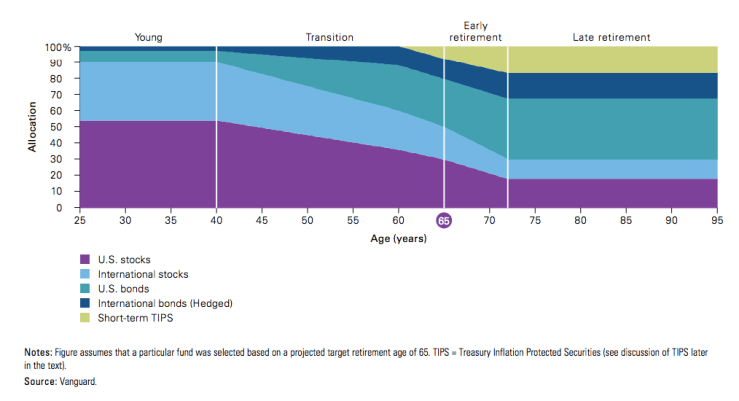
In a sense, a TDF starts out as one style of fund for an investor and mutates into another. When he or she is young, it is an aggressive growth fund, with as much as 90% of the inflows assigned to equities. By the time the envisioned retirement date rolls around, the allocation to equities and fixed-income investments may be split closer to 50/50. (2)

With such long time horizons, TDFs are truly buy-and-hold investments.

That has definite appeal for people who lack the time or inclination to take a hands-on approach to retirement planning. TDFs also usually have low turnover, with some distributions taxed as long-term capital gains. (1)

Are pre-retirees relying too heavily on TDFs?

Putting retirement investing on “autopilot” can have a downside – and that may be worth an alarm or two, given Vanguard’s forecast that 58% of its retirement plan participants (and 80% of its new plan participants) will have all of their retirement plan assets in TDFs by 2018. So in noting the merits of TDFs, we must also look at their demerits. (2)

The asset allocation of a target-date fund is not exactly dynamic.

As it is geared to a time horizon rather than current market conditions, TDF investors may wince when a severe bear market arrives – it could be a case of “set it & regret it.” They will need the patience to ride such downturns out. If they sell, they defeat the purpose of owning their TDF in the first place.

Additionally, some investors are conservative well before they reach retirement age.

A fortysomething risk-averse investor might not like having a clear majority of his or her TDF assets held in equities.

An investor will not be able to perform any tax loss harvesting with assets invested in a TDF (that is, selling “losers” in a portfolio to offset gains made by “winners”) and if all of his or her retirement savings happen to be in the TDF, you have to pull money out of the TDF to put it in other types of investments that might generate tax savings. (1)

Fees can be high

Because most TDFs are funds of funds – that is, multiple mutual funds brought together into one giant one – it may mean two layers of fees. (2)

The glide path is very important.

All TDFs have a glide path, the glide path being the rate or pace at which the asset allocation changes from aggressive toward conservative. With some TDFs, the glide path ends at retirement and the asset allocation approaches 100% cash. With others, the fund keeps gliding past a retirement date with the result that the retiree maintains a foot in the equities market – potentially very useful in the face of longevity risk, or as it is popularly known, the risk of outliving your money. The glide path of the TDF should be agreeable to the investor. The problem is that an investor may agree with it more at age 40 than at age 60. (1)

Here is a sample equity glide path for Vanguard’s target date funds:

Screen Shot 2018-06-05 at 8.59.23 PM

One feature can make TDFs even more appealing.

In 2014, the IRS and the Treasury Department permitted TDFs held in 401(k) plans to add a lifetime income option. That let a TDF investor receive a pension-like income beginning at the fund’s target date. Companies sponsoring 401(k)s can even elect to make such TDFs the default plan investment; that is, employees who wanted to direct their money into other investment vehicles would have to inform their employers that they were opting out.

Younger retirement savers should take a look at TDFs.

If you are not enrolled in one already, you may want to weigh their pros and cons. While not exactly “the cure” for America’s retirement savings problem, they are deservedly popular.

Source

  1. money.usnews.com/money/blogs/the-smarter-mutual-fund-investor/2015/04/07/3-questions-to-ask-before-choosing-target-date-funds
  2. time.com/money/3616433/retirement-income-401k-new-solution/
  3. nextavenue.org/article/2015-02/target-date-funds-pros-and-cons
  4. https://www.vanguard.com/pdf/s167.pdf

This material was prepared by MarketingPro, Inc., and does not necessarily represent the views of the presenting party, nor their affiliates. This information has been derived from sources believed to be accurate. Please note – investing involves risk, and past performance is no guarantee of future results. The publisher is not engaged in rendering legal, accounting or other professional services. If assistance is needed, the reader is advised to engage the services of a competent professional. This information should not be construed as investment, tax or legal advice and may not be relied on for the purpose of avoiding any Federal tax penalty. This is neither a solicitation nor recommendation to purchase or sell any investment or insurance product or service, and should not be relied upon as such. All indices are unmanaged and are not illustrative of any particular investment.
Worrying About Your Portfolio? Why You Need to Know Your Risk Tolerance [VIDEO]

Knowing your Risk Tolerance or Risk Profile is important for smart investors. Below you’ll learn what it signifies AND why you need to know it.

Which Model Portfolio is Right For You?

If you work with an advisor they often use a few model portfolios which they’ll adapt for the unique needs of each client. Your risk profile indicates which of these model portfolios might become a good basis for your own, custom portfolio.

TYPES OF INVESTORS

  • Conservative

  • Moderate

  • Aggressive

Investors are usually categorized as “conservative”, “moderate” or “aggressive”, with in-between categories of “moderately aggressive” and “moderately conservative” which are based on your questionnaire responses.

The Conservative Investor

If you absolutely do not want to risk losing money, or if your first priority is consistent income to live on, you are a conservative investor. If these are your concerns and you are retired or about to retire, you should probably avoid high-risk investments.

If you retire with an aggressive portfolio and your investments tank, it could take (many) years to rebuild your savings, years you might not have.

The Moderately Conservative Investor

However, many pre-retirees and new retirees are moderately conservative: they are cautious with money in their lives and don’t want to take on a risky portfolio, but they still have a need to accumulate assets because they have either started saving for the future too late or lost assets as a result of market downturns or poor or unfortunate financial decisions.

The Aggressive Investor &

Moderately Aggressive Investor

Aggressive and moderately aggressive investors commonly want to match or beat the markets. Or, they are looking to save for retirement at a highly accelerated rate.

Some are “market junkies” who watch Wall Street on a daily basis. Most of them are expecting to build substantial wealth someday.

They tend to be young investors or in the middle stage of life. Most of have NOT been hit hard financially as a result of investing, and many of them have substantial income or savings.

The moderately aggressive investor is willing to wait a bit longer to reach his or her goals, while the aggressive investor tends to be in a hurry by comparison.

The Moderate Investor

Typically, the moderate investor starts investing roughly about the time of major life events – that first stable job with a corresponding 401(k), a marriage, the start of a family.

Often, the moderate investor is a younger investor saving or investing for long-term goals (usually their child’s college education and retirement). These midlife investors frequently have a “balanced” portfolio, with a mix of conservative and riskier investments across varied investment classes. These investors are willing to accept some losses and risks and are pragmatic and usually educated about the realities of investing and their investment options. Some moderate investors are retired or nearly retired, having either retained their investment stance out of necessity (they need to continue accumulating assets in retirement) or out of preference (they do not want to “miss out” when the bulls run on Wall Street).

These midlife investors frequently have a “balanced” portfolio, with a mix of conservative and riskier investments across varied investment classes. They are willing to accept some losses and risks and are understand the realities of investing and their investment options.

Some moderate investors are retired or nearly retired, having either kept their investment stance out of necessity (they need to continue accumulating assets in retirement) or out of preference (they do not want to “miss out” when the bulls run on Wall Street).

What’s your risk number?

Now that you know all this it’s time to figure out your risk tolerance. You can use our free tool to learn what your risk number is. It’s great information to help you build the best portfolio for your goals.


Source:
This material was prepared, in part, by MarketingPro, Inc.


Why It’s Wise To Diversify Your Portfolio

We all seem to know a day trader or two, someone constantly hunting for the next hot stock. That’s not what I’d consider smart investing. Here’s why it’s wise to diversify your portfolio:

Diversification Helps You Manage Risk

We all want a terrific ROI, but risk management matters just as much in investing, perhaps more. That is why diversification is so important. There are two great reasons to invest across a range of asset classes, even when some are clearly outperforming others.

REASON #1:

Potentially Capture Gains in Different Market Climates

If you allocate your invested assets across the breadth of asset classes, you will at least have some percentage of your portfolio assigned to the market’s best-performing sectors on any given trading day. If your portfolio is too heavily weighted in one asset class, or in one stock, its return is riding too heavily on its performance.

Your portfolio is like a garden. A good gardener will plant a variety of flowers to ensure something is always blooming. The gardener knows that some flowers eventually die off or may not grow well but if there is enough diversity the overall picture will still look good.

REASON #2:

Potentially Less Financial Pain if Stocks Tank

If you have a lot of money in growth stocks and aggressive growth funds (and some people do), what happens to your portfolio in a correction or a bear market? You’ve got a bunch of losers on your hands. Tax loss harvesting can ease the pain only so much.

Diversification gives your portfolio a kind of “buffer” against market volatility and drawdowns. Without it, your exposure to risk is magnified.

ADVICE:

Don’t put all your eggs in one basket!

Believe the cliché: don’t put all your eggs in one basket. Wall Street is hardly uneventful and the behavior of the market sometimes leaves even seasoned analysts scratching their heads. We can’t predict how the market will perform; we can diversify to address the challenges presented by its ups and downs. 


Sources

  1. usatoday30.usatoday.com/money/perfi/retirement/story/2011-12-08/investment-diversification/51749298/1 [12/8/11]
  2. This material was prepared, in part, by MarketingPro, Inc.

The 3 Most Important Questions to Answer When Investing [VIDEO]

Every investment decision involves both risk and reward. You invest your money with the hope that you’ll be rewarded with a profitable return over time. But, the fact is there are few guarantees in life. Most Investments are exposed to risk, which is the potential for loss of assets. To reduce risk, most smart investors diversify their portfolio. It’s a strategy to help reduce vulnerability to market changes in one investment category.

Most Investments are exposed to risk, which is the potential for loss of assets.

3 Questions to Answer

An efficient diversification strategy for you depends on:

  1. What are you saving for?
  2. How much time do you have?
  3. How do you feel about handling risk?

An investment approach to pay for a child’s college education may be different than saving for your retirement. The difference in your time horizon often affects your investment decisions and how you feel about assuming risk. To find your risk tolerance profile you can use our free tool here.

How Do You Feel About Risk?

Some investors are risk-averse and prefer a conservative approach while others are willing to invest aggressively to reach their objectives. Over time your investments will grow or decrease along with market conditions.

The Importance of Rebalancing

A portfolio may need to be rebalanced to maintain diversification or adjusted to reflect the change of your investment goals. Your portfolio might have assets spread across a number of investment types matching your risk tolerance and your time horizon. Regardless, your portfolio should be monitored and adjusted along the way. You should create an investment roadmap to help you achieve your personal goals. Feel free to reach out if you need assistance creating a portfolio appropriate for you.

Your portfolio should be monitored and adjusted along the way.

For more financial planning tips, download my free report: “8 Steps to Organize and Optimize Your Financial Life”. Thanks for reading!