Retirement Planning

How to Think About Risk in Retirement

Photo by Rachel Claire on Pexels.com

At some point, a different kind of question starts to surface:

“How much risk should I be taking?”

It sounds like it should be a technical decision. In reality, it’s more nuanced and more personal than most people expect.

It’s Not Just About the Market

When people hear “risk,” they often think about market ups and downs.

That’s part of it. But in retirement, risk is broader than just volatility.

It also includes:

  • The risk of running out of money
  • The risk of spending too conservatively
  • The risk of unexpected expenses
  • The risk of needing income during a downturn

A thoughtful plan considers all of these, not just how investments perform in a given year.

Risk Changes Once You Stop Working

During your working years, you’re adding to your portfolio.

In retirement, you’re drawing from it.

That shift matters.

Market declines can feel different when you’re no longer contributing and are instead relying on your portfolio for income. Timing, withdrawals, and flexibility all start to play a larger role.

This is why risk in retirement isn’t just about how much your portfolio moves. It’s about how those movements interact with your spending.

It’s About Alignment, Not Maximization

Many investors are used to thinking in terms of maximizing returns.

In retirement, the goal is different.

The focus shifts toward aligning your investments with your needs:

  • How much income you’ll need
  • When you’ll need it
  • How flexible your spending is
  • What margin of safety you want

In general, an appropriate level of risk is one that supports your plan, not the one that looks best on paper.

Stability Has Value

It’s easy to overlook the value of stability.

A portfolio that experiences less volatility may not always produce the highest long-term return, but it can make it easier to stick with a plan, especially during uncertain periods.

That consistency can be an important factor compared to trying to optimize for every possible outcome.

Diversification helps manage risk, though it doesn’t eliminate it. The goal is to create a structure that can weather a range of conditions over time.

If you’d like a broader view of how the pieces fit together, you can read more here:
What a Good Retirement Plan Actually Looks Like

Flexibility Is a Form of Risk Management

One of the most underappreciated tools in retirement planning is flexibility.

For example:

  • Adjusting spending slightly during market declines
  • Delaying large expenses when needed
  • Re-evaluating withdrawal strategies over time

Small adjustments can influence outcomes over time.

A rigid plan can increase risk. A flexible one can help absorb it.

A Plan Helps Put Risk in Context

Without a plan, risk can feel abstract or even unsettling.

With a plan, it becomes something you can evaluate more clearly.

You can begin to answer questions like:

  • How much variability can my plan handle?
  • What happens if markets are weaker early in retirement?
  • How does my income hold up across different scenarios?

No strategy can fully protect against loss, but a thoughtful plan can help you understand and manage the tradeoffs.

If you’d like a deeper look at how income and investments work together, you can read more here:
Planning for Retirement Income

Bringing It Together

Risk in retirement isn’t something to eliminate.

It’s something to understand and manage.

The goal isn’t to avoid every downturn. It’s to build a plan that can support your lifestyle across a range of outcomes and help you stay consistent in your decisions over time.

If You’d Like Help Thinking This Through

If you’re approaching retirement or already there and want help thinking through how risk fits into your overall plan and income strategy, you can schedule a brief, complimentary call.

No pressure. Just a chance to see if it makes sense to talk further.

Schedule a 15-Minute Call

Understanding the Shift from Accumulation to Retirement Income

Photo by Anastasia Shuraeva on Pexels.com

A Different Phase of Planning

For much of your working life, the focus is straightforward: save and grow.

You contribute regularly.
You invest for the long term.
You measure progress by how your portfolio grows over time.

But as retirement approaches, the goal begins to change.

It’s no longer just about accumulation.

It’s about turning what you’ve built into a strategy to support your lifestyle.

What Changes in Retirement

The shift from saving to spending isn’t just a financial adjustment—it’s a structural one.

Instead of asking “How do I grow this?”, the question becomes:

“How do I use this in a way that can be maintained over time?”

That introduces a different set of considerations:

  • How spending levels may affect your plan over time
  • Where that income should come from
  • How to balance stability with long-term growth
  • How taxes affect what you actually keep

These decisions are connected.

And the way they’re coordinated can be more impactful than any single choice on its own.

Why This Shift Can Feel Uncertain

Many people enter retirement with a solid level of savings—but less clarity on how to use it.

That’s because accumulation and income planning require different frameworks.

During your working years:

  • Volatility is often something to ride through
  • Contributions are ongoing
  • Time is a key advantage

In retirement:

  • Withdrawals are happening
  • Timing matters more
  • Decisions can have longer-lasting effects

Without a clear structure, it can feel like you’re making important decisions one at a time, without a cohesive plan.

For a broader view of how these pieces fit together, you can read more here:
What a Good Retirement Plan Actually Looks Like

What a Thoughtful Income Plan Looks Like

A thoughtfully structured retirement income plan brings together a few key elements:

Income Strategy
How your spending is funded—from which accounts, and in what order

Investment Approach
How your portfolio is positioned to support withdrawals while managing risk

Tax Planning
How withdrawals and timing decisions affect your long-term tax picture

These aren’t independent decisions.

They are typically more effective when aligned around a clear plan.

For a deeper look at how income planning works in practice, you can read more here:
Planning for Retirement Income: A Different Way to Think About It

How a Plan Helps You Navigate the Transition

A good plan doesn’t try to predict markets or eliminate uncertainty.

It provides a framework for making decisions.

That can help you:

  • Better understand how much flexibility you may have in your spending
  • Make informed withdrawal decisions
  • Adjust as circumstances or markets change
  • Stay consistent during periods of uncertainty

Over time, that consistency can play an important role in how outcomes unfold over time.

Bringing It Together

The transition from accumulation to income is one of the most important shifts in retirement planning.

It’s not only about how much you’ve accumulated.

It’s about how everything works together once you begin to rely on your portfolio.

With a clear structure in place, decisions become more connected—and easier to navigate with greater clarity.

If You’d Like Help Thinking This Through

If you’re approaching retirement and want help thinking through how to build a retirement income plan from your savings, you can schedule a brief introductory call.

No pressure. Just a chance to see if it makes sense to talk further.

Schedule a 15-Minute Call

When Should You Retire?

Photo by Simeon Maryska on Pexels.com

At some point, the question comes into focus:

“When should I retire?”

It sounds like it should have a clear answer. In reality, the timing is more personal and flexible than most people expect.

It’s Not Just a Financial Decision

Money is obviously part of the equation. It’s important to understand whether your savings can support your lifestyle.

But retirement isn’t just a financial milestone. It’s a life transition.

The question isn’t only whether you can retire. It’s also whether you’re ready to.

What “Ready” Really Means

Retirement changes how you spend your time, how you structure your days, and how you think about work and purpose.

Some people are eager for that shift. Others find it harder than expected.

A thoughtful plan typically considers both sides. It looks at the financial readiness and the personal readiness together.

There’s a Range, Not a Perfect Date

Many people look for a specific target date and try to plan everything around it.

In practice, there’s often a range of time where retirement makes sense.

You might retire a little earlier, a little later, or even transition gradually depending on your situation.

Having that flexibility can make the decision feel less rigid and more manageable.

Income Plays a Key Role

One of the biggest factors in timing is how your income will work once you stop working.

That includes:

  • Social Security
  • Investment accounts
  • Retirement plans like IRAs or 401(k)s
  • Possibly a pension

Understanding how these sources fit together can help inform your retirement timing.

If you’d like a deeper look at that side of the decision, you can read more here: Planning for Retirement Income.

Health, Family, and Priorities Matter Too

Retirement timing is rarely just about numbers, and outcomes can vary based on personal circumstances.

Health, family needs, and personal priorities often play an equally important role.

For example, you might decide to retire earlier to spend more time with family, or later because you enjoy your work and want to continue.

These are personal decisions, and a good plan makes room for them.

A Plan Helps You Evaluate Tradeoffs

Retiring earlier may mean drawing from your portfolio sooner or adjusting your spending.

Working longer may strengthen your financial position and give your investments more time in the market.

A thoughtful plan helps you understand these tradeoffs so you can make a decision with clarity.

If you want a broader view of how all of these pieces come together, you can read more here: What a Good Retirement Plan Actually Looks Like.

Bringing It Together

There isn’t one “right” retirement date.

There’s a range of choices, each with tradeoffs.

The goal is to choose a timing that aligns with your financial situation and the kind of life you want to live.

If You’d Like Help Thinking This Through

If you’re approaching retirement and want help thinking through your timing, you can schedule a brief, complimentary call.

No pressure. Just a chance to see if it makes sense to talk further.

Schedule a 15-Minute Call

How Much Can I Spend in Retirement?

Photo by Connor Scott McManus on Pexels.com

At some point, almost everyone asks the same question:

“How much can I spend in retirement?”

It sounds like it should have a clear answer. In reality, it’s a bit more flexible than that.

It’s Not a Single Number

It’s natural to want a specific number to plan around each year, but retirement doesn’t work that way.

Spending can change over time. Markets don’t move in straight lines, and your priorities may shift as the years go on. A thoughtful plan doesn’t rely on one fixed number. It is designed to allow for adjustment.

Income and Spending Work Together

In retirement, your spending is funded by your income sources.

That might include:

  • Social Security
  • Investment accounts
  • Retirement plans like IRAs or 401(k)s
  • Possibly a pension

The key is understanding how these sources fit together over time.

If you’d like a deeper look at how that works, you can read more here: Planning for Retirement Income.

Flexibility Matters More Than Precision

Instead of trying to find the “perfect” spending number, it’s often more helpful to think in ranges.

Some years, you may spend more, and other years you may spend less. That flexibility can help your plan adapt more effectively over time, especially during periods of market volatility.

Your Spending Will Likely Change

Spending in retirement is rarely flat.

For example:

  • Early years may include more travel or activity
  • Later years may shift toward different priorities
  • Unexpected expenses can arise

A good plan accounts for these changes rather than assuming everything stays the same.

A Plan Provides Guardrails

A thoughtful retirement plan helps you understand what level of spending may be appropriate, how adjustments can be made over time, and how your income aligns with your lifestyle.

It’s less about finding an exact answer and more about having a framework to make decisions.

If you want a broader view of how all of this fits together, you can read more here: What a Good Retirement Plan Actually Looks Like.

Bringing It Together

“How much can I spend?” is an important question, but the better question is:

“How can I spend in a way that aligns with the life I want, while staying flexible over time?”

That’s where planning plays an important role.

If You’d Like Help Thinking This Through

If you’re approaching retirement and want help understanding how your spending fits into your overall plan, you can schedule a brief, complimentary call.

No pressure. Just a chance to see if it makes sense to talk further.

Schedule a 15-Minute Call

Planning for Retirement Income: A Different Way to Think About It

Photo by Anastasia Shuraeva on Pexels.com

For most of your working life, the goal is straightforward: save and invest as much as you reasonably can. Over time, those savings grow and progress is easy to measure.

At some point, though, the question changes. It’s no longer just about how much you’ve saved. It becomes about how to use those savings to support your spending needs.

That shift—from saving to spending—is where retirement planning becomes more nuanced.

The Shift Many People Underestimate

Saving for retirement and living off your savings are fundamentally different.

When you’re working, you’re adding to your portfolio and have time to recover from market declines. In retirement, you’re drawing from those assets, and the timing of returns starts to matter more.

That doesn’t mean investing becomes more complicated. But it does mean your plan often needs to adjust.

It’s Not Just About “The Number”

Many people focus on reaching a certain number and assume that means they’re ready.

In reality, that number is only part of the picture.

What matters just as much is how that money translates into spending—how much you plan to use, how flexible that spending can be, and how your income sources fit together. Two people with similar savings can have very different retirements depending on how those pieces line up.

Where Income Comes From

For most retirees, income is a combination of:

  • Social Security
  • Investment accounts
  • Retirement plans like IRAs or 401(k)s
  • Sometimes a pension

A thoughtful plan focuses on how these pieces work together over time, not just investment returns.

Flexibility Matters

It’s natural to want a clear answer to how much you can withdraw each year.

In practice, it’s less about a fixed number and more about flexibility. Spending can adjust over time, markets won’t move in straight lines, and plans often need to adapt.

What a Good Plan Does

A thoughtful retirement income plan can help you you think through:

  • How much you can reasonably spend
  • Where income should come from
  • How to adjust during market declines
  • What changes over time

It’s not about getting everything exactly right upfront. It’s about making more informed decisions over time.

Bringing It Together

Planning for retirement income isn’t a one-time decision. It’s an ongoing process.

The goal isn’t just to have saved enough. It’s to use those savings in a way that aligns with the life you want to live.

If You’d Like Help Thinking This Through

If you’re approaching retirement and want help thinking through how your savings can be structured into a retirement income plan, you can schedule a brief, complimentary call.

No pressure. Just a chance to see if it makes sense to talk further.

Schedule a 15-Minute Call

2022 Contribution Limits: Is it Time to Contribute More?

Photo by Suzy Hazelwood on Pexels.com

Preparing for retirement just got a little more financial wiggle room. The Internal Revenue Service (IRS) announced new contribution limits for 2022.

401(k) & 403(b)

For workplace retirement accounts (i.e. 401(k), 403(b), amongst others), the contribution limit rises $1,000 to $20,500. Catch-up contributions remain at $6,500. (1)

Traditional IRA

Staying put for 2022 are traditional Individual Retirement Accounts (IRAs), with the limit remaining at $6,000. The catch-up contribution for traditional IRAs remains $1,000 as well. (1)

Roth IRA

Eligibility for Roth IRA contributions has increased, as well. These have bumped up to $129,000 to $144,000 for single filers and heads of households, and $204,000 to $214,000 for those filing jointly as married couples. (1)

SIMPLE IRA

Another increase was for SIMPLE IRA Plans (SIMPLE is an acronym for Savings Incentive Match Plan for Employees), which increases from $13,500 to $14,000. (1)

If these increases apply to your retirement strategy, a financial professional may be able to help make some adjustments to your contributions.

Contribution Limits (3,4)20222021Change
401(k) & 403(b) maximum employee elective deferral$20,500$19,500+$1,000
401(k)s 403(b), etc. employee catch-up contribution
(if age 50 or older by year-end)*
$6,500$6,500None
Traditional IRA & Roth IRA$6,000$6,000None
Traditional IRA & Roth IRA catch-up contributions
(if age 50 or older by year-end)*
$1.000$1,000None
SIMPLE IRA$14,000$13,500+$500

RMDs Explained

Once you reach age 72, you must begin taking required minimum distributions from a Traditional Individual Retirement Account (IRA) or Savings Incentive Match Plan for Employees IRA in most circumstances. Withdrawals from Traditional IRAs are taxed as ordinary income and, if taken before age 59½, may be subject to a 10% federal income tax penalty.

Once you reach age 72, you must begin taking required minimum distributions from your 401(k), 403(b), or other defined-contribution plans in most circumstances. Withdrawals from your 401(k) or other defined-contribution plans are taxed as ordinary income and, if taken before age 59½, may be subject to a 10% federal income tax penalty.

5-Year Holding Period for Roth IRAs

To qualify for the tax-free and penalty-free withdrawal of earnings, Roth IRA distributions must meet a five-year holding requirement and occur after age 59½. Tax-free and penalty-free withdrawal can also be taken under certain other circumstances, such as the owner’s death. The original Roth IRA owner is not required to take minimum annual withdrawals.

Sources

  1. CNBC.com, November 5, 2021
  2. https://www.investopedia.com/retirement/401k-contribution-limits/
  3. https://www.irs.gov/pub/irs-drop/n-21-61.pdf
  4. https://www.irs.gov/retirement-plans/401k-plans-deferrals-and-matching-when-compensation-exceeds-the-annual-limit

This material was prepared by MarketingPro, Inc., and does not necessarily represent the views of the presenting party, nor their affiliates. This information has been derived from sources believed to be accurate. Please note – investing involves risk, and past performance is no guarantee of future results. The publisher is not engaged in rendering legal, accounting or other professional services. If assistance is needed, the reader is advised to engage the services of a competent professional. This information should not be construed as investment, tax or legal advice and may not be relied on for the purpose of avoiding any Federal tax penalty. This is neither a solicitation nor recommendation to purchase or sell any investment or insurance product or service, and should not be relied upon as such. All indices are unmanaged and are not illustrative of any particular investment.

Required Minimum Distribution (RMD) Rules: 4 Key Things Every Retiree Should Know

Photo by Kampus Production on Pexels.com

Most people worry about not having enough money for retirement. But did you also know that there is such a thing as having too much money? Too much money may not necessarily be a bad thing, but you do need to worry about required minimum distributions (RMDs). Here’s what you need to know about RMDs.

RMDs Depend on Your Age

The main point of RMDs is to keep money from staying tax-free forever. The government gave a temporary tax break to encourage you to save for retirement, but it still wants that tax money. A required minimum distribution is a required withdrawal from your retirement account. It counts in your taxable income just like any other withdrawal in retirement.

Currently, RMDs start when you hit age 72 (or 70½ if you turned 70½ prior to January 1, 2020) and they are calculated to empty your retirement account within your expected life expectancy. (1) Each year, you need to withdraw a certain percentage of your account with the percentage going up as you age. However, it’s important to realize that you do not have to spend all of this money. You can also reinvest it into a taxable account.

Not Taking the RMD Can Mean Big Penalties

Thinking about skipping RMDs to avoid taxes? Think again. Not only do you still have to pay the taxes on the RMD amount, but you’ll also owe a 50 percent penalty.

For example, if you were supposed to withdraw $10,000 but didn’t, the IRS will charge you an extra $5,000. The penalty repeats every year until you catch up on your RMDs from previous years.

RMDs Can Throw a Wrench in Your Tax Planning

There are many reasons why you might want to reduce your taxable income in retirement. These can include qualifying for things like Medicaid subsidies, avoiding taxes on your Social Security benefits, trying to stay in a lower capital gains tax bracket, or just wanting to pay fewer taxes.

Required minimum distributions can throw a major wrench in your tax planning because not only are they not avoidable, they can suddenly increase if the market surges. If you’re using a tax strategy that requires reducing your income to a certain level, it’s important to build in flexibility for your RMDs.

RMDs Can Be Avoided

There are still ways to reduce or even avoid RMDs altogether. The main idea is to get the money out of your retirement account when you want to not when the IRS wants you to.

One method is to make extra withdrawals at the end of the year. In December, you can estimate your taxes for the year. If you still have room in a lower tax bracket or below the income you need to stay under, you can withdraw additional money. When next year’s RMDs are calculated, it will be on a lower account balance.

You can also convert to a Roth IRA instead of taxing the money out of a tax-advantaged account. Roth IRAs don’t have RMDs because the money has already been taxed. When you make the conversion, you pay ordinary income tax rates on the amount you converted. There are no penalties even if you do the conversion before you turn 59 1/2.

▼ Download

Sources

  1. https://www.irs.gov/retirement-plans/plan-participant-employee/retirement-topics-required-minimum-distributions-rmds

This content is developed from sources believed to be providing accurate information, and provided by Twenty Over Ten. It may not be used for the purpose of avoiding any federal tax penalties. Please consult legal or tax professionals for specific information regarding your individual situation. The opinions expressed and material provided are for general information, and should not be considered a solicitation for the purchase or sale of any security.

What to Be Thinking About In Preparation for Retirement

Photo by Sora Shimazaki on Pexels.com

How do you picture your future?

If you are like many contemplating retirement, your view is likely pragmatic compared to that of your parents. That doesn’t mean you must have a “plain vanilla” tomorrow. Even if your retirement savings are not as great as you would prefer, you still have great potential to design the life you want.

With that in mind, here are some things to think about.

What do you absolutely need to accomplish?

If you could only get four or five things done in retirement, what would they be? Answering this question might lead you to compile a “short list” of life goals, and while they may have nothing to do with money, the financial decisions you make may be integral to achieving them.

What would revitalize you?

Some people retire with no particular goals at all, and others retire burnt out. After weeks or months of respite, ambition inevitably returns. They start to think about what pursuits or adventures they could embark on to make these years special. Others have known for decades what dreams they will follow … and yet, when the time to follow them arrives, those dreams may unfold differently than anticipated and may even be supplanted by new ones.

In retirement, time is really your most valuable asset. With more free time and opportunity for reflection, you might find your old dreams giving way to new ones. You may find yourself called to volunteer as never before or motivated to work again in a new context.

Who should you share your time with?

Here is another profound choice you get to make in retirement. The quick answer to this question for many retirees would be “family.” Today, we have nuclear families, blended families, extended families; some people think of their friends or their employees as family. You may define it as you wish and allocate more or less of your time to your family as you wish (some people do want less family time when they retire).

Regardless of how you define “family” or whether or not you want more “family time” in retirement, you probably don’t want to spend your time around “dream stealers.” They do exist. If you have a grand dream in mind for retirement, you may meet people who try to thwart it and urge you not to pursue it. (Hopefully, they are not in close proximity to you.) Reducing their psychological impact on your retirement may increase your happiness.

How much will you spend?

We can’t control all retirement expenses, but we can control some of them. The thought of downsizing may have crossed your mind. While only about 10% of people older than 60 sell homes and move following retirement, it can potentially lead to more manageable mortgage payments. You could also lose one or more cars (and the insurance that goes with them) and live in a neighborhood with extensive, efficient public transit. Ditching landlines and premium cable TV (or maybe all cable TV) can bring more savings. Garage sales and donations can have financial benefits as well as helping you get rid of clutter, with either cash or a federal tax deduction.1

This article is for informational purposes only and is not a replacement for real-life advice, so make sure to consult your tax, legal, and accounting professionals before modifying your overall tax strategy.

Could you leave a legacy?

Many of us would like to give our kids or grandkids a good start in life, but given some of the economic realities of today, leaving an inheritance can be trickier than many realize.

Consider a couple with, for example, $285,000 in retirement savings. If that couple follows the 4% rule, the old maxim that you should withdraw about 4% of your retirement savings per year, subsequently adjusted for inflation – then you are talking about $11,400 withdrawn to start. When you combine that $11,400 with Social Security and other potential investment income, that couple isn’t exactly rich. Sustaining and enhancing income becomes the priority, and legacy preparations may have to take a backseat. On the other hand, a recent survey showed that 92% of all respondents believe it is important to leave money and other assets to their children.2

How are you preparing for retirement?

This is the most important question of all. If you feel you need to prepare more for the future or reexamine your existing strategy in light of recent changes in your life, conferring with a financial professional experienced in retirement approaches may be a smart move.

Changes in lifestyle

As households transition into retirement, time that had been spent working now is available for other pursuits. Individuals often enter retirement having spent too little time determining how they plan to spend this time – and run the risk of spending valuable time and money pursuing activities that may not prove to be as fulfilling as they had anticipated. For those who continue to work, they work fewer hours per day. Watching more television is a concerning trend. While a slightly higher percentage of people volunteer at older ages, it is important to note that the time spent volunteering remains about the same.

Sources

  1. IRS.gov, March 14, 2019
  2. Bankofamerica.com, Spring 2019
  3. https://am.jpmorgan.com/us/en/asset-management/protected/adv/insights/retirement-insights/guide-to-retirement/#

This material was prepared by MarketingLibrary.Net Inc., and does not necessarily represent the views of the presenting party, nor their affiliates. All information is believed to be from reliable sources; however we make no representation as to its completeness or accuracy. Please note – investing involves risk, and past performance is no guarantee of future results. The publisher is not engaged in rendering legal, accounting or other professional services. If assistance is needed, the reader is advised to engage the services of a competent professional. This information should not be construed as investment, tax or legal advice and may not be relied on for the purpose of avoiding any Federal tax penalty. This is neither a solicitation nor recommendation to purchase or sell any investment or insurance product or service, and should not be relied upon as such. All indices are unmanaged and are not illustrative of any particular investment.

Retirement Questions to Consider That Have Nothing to Do With Money

Image by RitaE from Pixabay

Retirement Planning is Not Entirely Financial

Your degree of happiness in your “second act” may depend on some factors that don’t come with an obvious price tag. Here are some non-monetary factors to consider as you plan your retirement.

What Will You Do With Your Time?

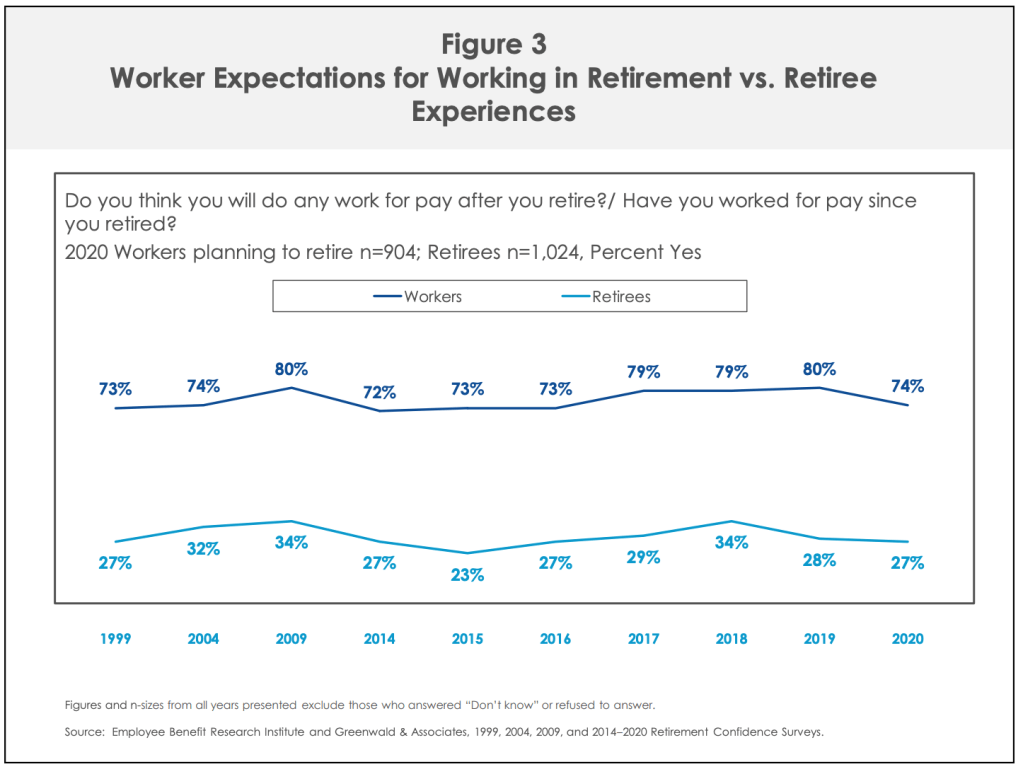
Too many people retire without any idea of what their retirement will look like. They leave work, and they cannot figure out what to do with themselves, so they grow restless. It’s important to identify what you want your retirement to look like and what you see yourself doing. Maybe you love your career, and can’t imagine not working during your retirement. There’s no hard and fast rule to your dream retirement, so it’s important to be honest with yourself. An EBRI retirement confidence survey shows that almost 74% of retirees plan to work for pay, whereas just 27% of retirees report that they’ve actually worked for pay. (1)

While this concept doesn’t have a monetary value, having a clear vision for your retirement may help you align your financial goals. It’s important to remember that your vision for retirement may change—like deciding you don’t want to continue working after all.

Where Will You Live?

This is another factor in retirement happiness. If you can surround yourself with family members and friends whose company you enjoy, in a community where you can maintain old friendships and meet new people with similar interests or life experience, that is a definite plus. If all this can occur in a walkable community with good mass transit and senior services, all the better. Moving away from the life you know to a spread-out, car-dependent suburb where anonymity seems more prevalent than community may not be the best decision for you.

How Are You Preparing to Get Around in Your Eighties and Nineties?

The actuaries at Social Security project that the average life expectancy for men is 84 years old, and the life expectancy for women is 86.5 years. Some will live longer. Say you find yourself in that group. What kind of car would you want to drive at 85 or 90? At what age would you cease driving? Lastly, if you do stop driving, who would you count on to help you go where you want to go and get out in the world? (2)

How Will You Keep Up Your Home?

At 45, you can tackle that bathroom remodel or backyard upgrade yourself. At 75, you will probably outsource projects of that sort, whether or not you stay in your current home. You may want to move out of a single-family home and into a townhome or condo for retirement. Regardless of the size of your retirement residence, you will probably need to fund minor or major repairs, and you may need to find reliable and affordable sources for gardening or landscaping.

These are the non-financial retirement questions that no pre-retiree should dismiss. Think about them as you prepare and invest for the future.

▲Working for Pay in Retirement

“Nearly 3 in 4 workers (74 percent) plan to work for pay in retirement, compared with just 27 percent of retirees who report they have actually worked for pay in retirement. In fact, the RCS has consistently found that workers are far more likely to plan to work for pay in retirement than retirees are to have actually worked (Figure 3). In the 2019 RCS, among retirees who worked for pay in retirement reported why they worked for pay in retirement and almost all gave a positive reason for doing so, saying they continued to work because they wanted to stay active and involved (91 percent), they enjoyed working (89 percent), or a job opportunity came along (58 percent). a Retirees could have retired for more than one reason. However, they reported that financial reasons also played a role in that decision, such as wanting money to buy extras (75 percent), needing money to make ends meet (37 percent), a decrease in the value of their savings or investments (28 percent), or keeping health insurance or other benefits (16 percent). *Retirees could have worked for pay in retirement for more than one reason.” (1)

Sources

  1. EBRI/Greenwald Retirement Confidence Survey, 2020
  2. SSA.gov

This material was prepared by MarketingPro, Inc., and does not necessarily represent the views of the presenting party, nor their affiliates. This information has been derived from sources believed to be accurate. Please note – investing involves risk, and past performance is no guarantee of future results. The publisher is not engaged in rendering legal, accounting or other professional services. If assistance is needed, the reader is advised to engage the services of a competent professional. This information should not be construed as investment, tax or legal advice and may not be relied on for the purpose of avoiding any Federal tax penalty. This is neither a solicitation nor recommendation to purchase or sell any investment or insurance product or service, and should not be relied upon as such. All indices are unmanaged and are not illustrative of any particular investment.

How Much Do You Really Know About Extended Care? Fact vs. Myth

Photo by Andrea Piacquadio on Pexels.com

How much does eldercare cost, and how do you arrange it when it is needed? The average person might have difficulty answering those two questions, for the answers are not widely known. For clarification, here are some facts to dispel some myths.

True or False:
Medicare will pay for your mom or dad’s nursing home care.

FALSE. Medicare is not extended care insurance. (1)

Medicare Part A will pay the bill for up to 20 days of skilled nursing facility (SNF) care, but after that, you or your parents may have to cover some costs out-of-pocket. After 100 days in a SNF, you will have to cover all costs out of pocket. The only way to “reset the clock” for Medicare coverage of these services is if the patient can somehow go without skilled nursing care for 30 or 60 days or if they require a hospital stay of three full days or longer.

True or False:
A semi-private room in a skilled nursing facility costs about $35,000 a year.

FALSE. The median cost of a semi-private room is now $89,297. A private room in an assisted living facility has a median annual cost of $100,375 annually. A home health aide could run you up to $4,385 per month for full-time care. Even if you just need someone to help mom or dad with activities of daily living (ADLs), such as eating, bathing, or getting dressed, the median hourly expense is not cheap: non-medical home aides run about $23 per hour, which at 10 hours a week, means nearly $12,000 a year. (2,3)

True or False:
Only around 40% of Americans aged 65 and older are expected to need extended care.

FALSE. Someone turning 65 today has a 70% chance of needing extended care. That means that by 2030, it’s estimated that around 24 million Americans will need extended care. This is double the current number already receiving care. (4,5)

True or False:
The earlier you buy extended care insurance, the more manageable the premiums.

TRUE. Younger policyholders may pay lower premiums.

The best time to consider extended care insurance is when you are healthy. While you may be paying a premium for a longer amount of time, the expense may pale in comparison to paying for unexpected medical costs out of pocket. (6)

True or False:
Medicaid can pay nursing home costs.

TRUE. The question is, do you really want that to happen? While Medicaid rules vary by state, in most instances, a person may only qualify for Medicaid if they have no more than $2,000 in “countable” assets ($3,000 for a couple). A homeowner can even be disqualified from Medicaid for having too much home equity. A primary residence, a primary motor vehicle, personal property, and household items, burial funds of less than $1,500, and tiny life insurance policies (with face values of less than $1,500) are not countable. So, yes, under these economic circumstances, Medicaid may end up paying extended care expenses. (7)

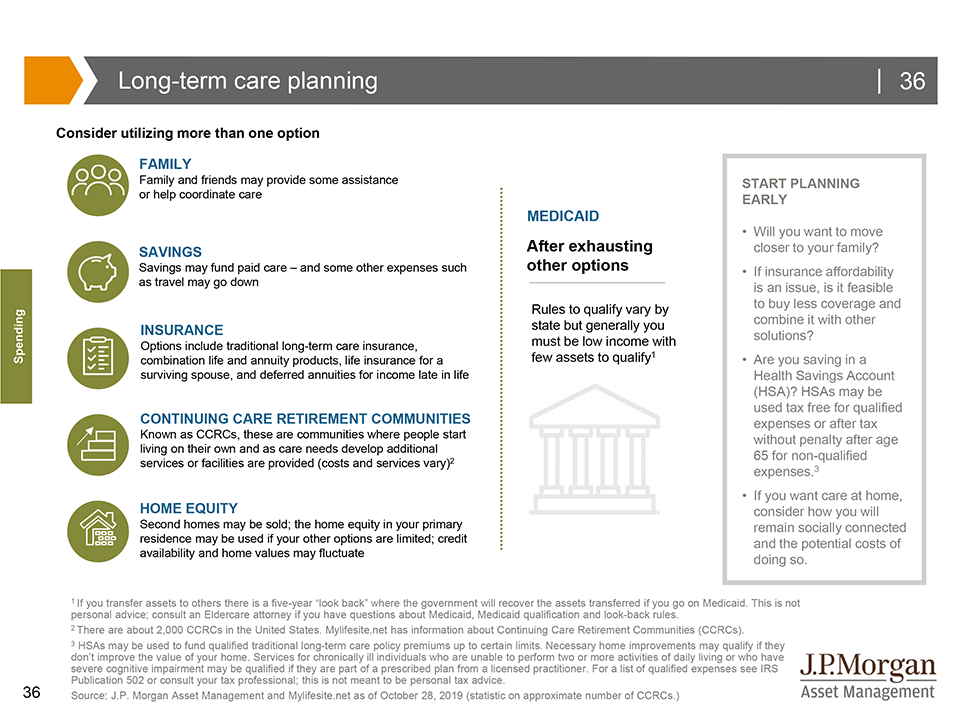
▲Long-term care planning solutions

When planning for long-term care, consider multiple solutions that may be utilized including family assistance, income, savings, home equity, life insurance for a surviving spouse, and other insurance options that range from traditional long-term care insurance to combination products to annuities. Continuing Care Retirement Communities (CCRCs) are also a possibility for those who can afford them. Types of CCRCs vary – see MyLifeSite.net for more information. Medicaid may be a last resort; and if Medicaid is utilized, you may have less control of type of care and care setting. For specifics regarding Medicaid qualification in your area, consult with an eldercare attorney.

Sources

  1. Medicare.gov, March 26, 2020
  2. SeniorLiving.org, June 24, 2020
  3. APlaceForMom.com, May 11, 2020
  4. AmericanActionForum.org, February 18, 2020
  5. LongTermCare.gov, July 23, 2020
  6. Forbes.com, April 17, 2020
  7. LongTermCare.ACL.gov, July 23, 2020
  8. https://am.jpmorgan.com/us/en/asset-management/gim/protected/adv/insights/guide-to-retirement

This material was prepared by MarketingPro, Inc., and does not necessarily represent the views of the presenting party, nor their affiliates. This information has been derived from sources believed to be accurate. Please note – investing involves risk, and past performance is no guarantee of future results. The publisher is not engaged in rendering legal, accounting or other professional services. If assistance is needed, the reader is advised to engage the services of a competent professional. This information should not be construed as investment, tax or legal advice and may not be relied on for the purpose of avoiding any Federal tax penalty. This is neither a solicitation nor recommendation to purchase or sell any investment or insurance product or service, and should not be relied upon as such. All indices are unmanaged and are not illustrative of any particular investment.