Investing

How Fixed-Income Can Help Protect Your Retirement Savings During Market Volatility

person holding pink piggy coin bank

Photo by rawpixel.com on Pexels.com

When stocks soar, fixed-income investments have comparatively little allure.

Investors hungry for double-digit returns may regard them as bland, vanilla securities saddled with an opportunity cost, geared to risk-averse retirees who are “playing not to lose.”

An investment earning a consistent rate of return on a fixed schedule is not a negative. Fixed-income investments are something you may want as part of your portfolio, particularly when stocks fall.

Fixed-income investments have a steadiness that stocks lack.

Most are simple debt instruments: an investor transfers or pays money to a government or financial institution in exchange for a promise of recurring payments and eventual return of principal. (1)

Corporate and government bonds are popular fixed-income investments. U.S. Treasury bills, bonds, and notes, all backed by the federal government, pay interest based on the duration and nature of the security. States and municipalities also issue bonds to generate funds for infrastructure projects. Corporate bonds usually have 10-year or 20-year durations; the interest on them may exceed that of Treasuries and state and muni bonds, but the degree of risk is greater for the bondholder. Firms with subpar credit ratings issue bonds that are junk rated, offering a relatively higher return and higher risk. (1)

There are bond funds that also pay a set rate of return. Some of these funds trade like stocks and can be bought and sold during a trading day, not merely after the close. They typically contain a wide variety of both corporate and government bonds. (2)

Additionally, there are money market funds and money market accounts. They do differ. A money market fund is a managed investment fund made up of assorted fixed-income debt securities. A money market account is simply a high-yield bank account insured by the Federal Deposit Insurance Corporation (FDIC). (3)

Consider certificates of deposit as well. Banks create these debt securities to generate pools of capital to use for their business and personal loans. Some CDs have terms of less than a year; many are multiyear. Typically, the longer the commitment a CD investor makes, the greater the coupon (annual interest rate) on the CD. These investments are FDIC-insured up to $250,000. (1,3)

At some point, you might want less of your portfolio in equities. That realization might be prompted by a consideration of the markets or simply by where you are in life.

When the financial markets turn volatile, the last thing you want is to have all your investments moving in the same direction at the same time.

If your portfolio includes a balance of investments from different asset classes, some with little or no correlation to the stock market, then you may take less of a loss than someone whose portfolio is overloaded in equities.

The risk is, this “someone” could be you. Across a long bull market, the equity investments within your portfolio will usually outgain the non-equity investments. That can throw your original asset allocations out of whack and leave you mostly invested in stocks. If stocks plunge, the value of your portfolio can drop rapidly. (4)

The conventional wisdom is to lessen your equity position as you age. You may currently hold stocks across many sectors of the S&P 500, but that is not diversification. True diversification uses multiple asset classes – and conservative, fixed-income investments – to try to minimize risk.

Fixed-income investments may not always return as spectacularly as equity investments, but they are also less prone to spectacular losses. They are designed to provide some stability for an investor, and as you get older, stability becomes increasingly important.

MI-GTM_3Q19_August_High-Res-60

▲ Asset class returns

This chart shows the historical performance and volatility of different asset classes, as well as an annually rebalanced asset allocation portfolio. The asset allocation portfolio incorporates the various asset classes shown in the chart and highlights that balance and diversification can help reduce volatility and enhance returns. (5)

Sources

  1. thestreet.com/investing/fixed-income/what-is-fixed-income-investment-14758617
  2. investopedia.com/articles/investing/041615/pros-cons-bond-funds-vs-bond-etfs.asp
  3. thebalance.com/certificates-of-deposit-versus-money-markets-356054
  4. fool.com/investing/2018/01/29/heres-how-bull-markets-can-be-bad-for-your-portfol.aspx
  5. https://am.jpmorgan.com/us/en/asset-management/gim/protected/adv/insights/guide-to-the-markets/viewer

This material was prepared by MarketingPro, Inc., and does not necessarily represent the views of the presenting party, nor their affiliates. This information has been derived from sources believed to be accurate. Please note – investing involves risk, and past performance is no guarantee of future results. The publisher is not engaged in rendering legal, accounting or other professional services. If assistance is needed, the reader is advised to engage the services of a competent professional. This information should not be construed as investment, tax or legal advice and may not be relied on for avoiding any Federal tax penalty. This is neither a solicitation nor recommendation to purchase or sell any investment or insurance product or service, and should not be relied upon as such. All indices are unmanaged and are not illustrative of any particular investment.


Why Portfolio Diversification Is Important During Volatile Markets

brown eggs in brown wicker basket

Photo by Julian Schwarzenbach on Pexels.com

A multiple asset class portfolio prevents having all your investment eggs in one basket.

Diversification Helps You Manage Risk

We all want a terrific ROI, but risk management matters just as much in investing, perhaps more. That is why diversification is so important. There are two great reasons to invest across a range of asset classes, even when some are clearly outperforming others.

REASON #1:

Potentially Capture Gains in Different Market Climates

If you allocate your invested assets across the breadth of asset classes, you will at least have some percentage of your portfolio assigned to the market’s best-performing sectors on any given trading day. If your portfolio is too heavily weighted in one asset class, or in one stock, its return is riding too heavily on its performance.

Your portfolio is like a garden. A good gardener will plant a variety of flowers to ensure something is always blooming. The gardener knows that some flowers eventually die off or may not grow well but if there is enough diversity the overall picture will still look good.

REASON #2:

Potentially Less Financial Pain if Stocks Decline

If you have a lot of money in growth stocks and aggressive growth funds (and some people do), what happens to your portfolio in a correction or a bear market? You’ve got a bunch of losers on your hands. Tax loss harvesting can ease the pain only so much.

Diversification gives your portfolio a kind of “buffer” against market volatility and drawdowns. Without it, your exposure to risk is magnified.

ADVICE:

Don’t put all your eggs in one basket!

Believe the cliché: don’t put all your eggs in one basket. Wall Street is hardly uneventful and the behavior of the market sometimes leaves even seasoned analysts scratching their heads. We can’t predict how the market will perform; we can diversify to address the challenges presented by its ups and downs.

MI-GTM_3Q19_August_High-Res-60

▲ Asset class returns

This chart shows the historical performance and volatility of different asset classes, as well as an annually rebalanced asset allocation portfolio. The asset allocation portfolio incorporates the various asset classes shown in the chart and highlights that balance and diversification can help reduce volatility and enhance returns. (2)


Sources

  1. usatoday30.usatoday.com/money/perfi/retirement/story/2011-12-08/investment-diversification/51749298/1
  2. https://am.jpmorgan.com/us/en/asset-management/gim/protected/adv/insights/guide-to-the-markets/viewer
  3. This material was prepared, in part, by MarketingPro, Inc.

How to Value the Value of Working With a Financial Advisor

jeff-sheldon-guH91yuPaMk-unsplash.jpg

Photo by Jeff Sheldon on Unsplash

A good professional provides important guidance and insight through the years.

What kind of role can a financial professional play for an investor?

The answer: a very important one. While the value of such a relationship is hard to quantify, the intangible benefits may be significant and long-lasting.

There are certain investors who turn to a financial professional with one goal in mind: the “alpha” objective of beating the market, quarter after quarter. Even Wall Street money managers fail at that task – and they fail routinely.

At some point, these investors realize that their financial professional has no control over what happens in the market. They come to understand the real value of the relationship, which is about strategy, coaching, and understanding.

A good financial professional can help an investor interpret today’s financial climate, determine objectives, and assess progress toward those goals. Alone, an investor may be challenged to do any of this effectively. Moreover, an uncoached investor may make self-defeating decisions. Today’s steady stream of instant information can prompt emotional behavior and blunders.

No investor is infallible

Investors can feel that way during a great market year, when every decision seems to work out well. Overconfidence can set in, and the reality that the market has occasional bad years can be forgotten.

This is when irrational exuberance creeps in. A sudden Wall Street shock may lead an investor to sell low today, buy high tomorrow, and attempt to time the market.

Market timing may be a factor in the following divergence: according to investment research firm DALBAR, U.S. stocks gained 10% a year on average from 1988-2018, yet the average equity investor’s portfolio returned just 4.1% annually in that period. (1)

A good financial professional helps an investor commit to staying on track

Through subtle or overt coaching, the investor learns to take short-term ups and downs in stride and focus on the long term. A strategy is put in place, based on a defined investment policy and target asset allocations with an eye on major financial goals. The client’s best interest is paramount.

As the investor-professional relationship unfolds, the investor begins to notice the intangible ways the professional provides value. Insight and knowledge inform investment selection and portfolio construction. The professional explains the subtleties of investment classes and how potential risk often relates to potential reward.

Perhaps most importantly, the professional helps the client get past the “noise” and “buzz” of the financial markets to see what is really important to his or her financial life.

The investor gains a new level of understanding, a context for all the investing and saving. The effort to build wealth and retire well is not merely focused on “success,” but also on significance.

This is the value a financial professional brings to the table. You cannot quantify it in dollar terms, but you can certainly appreciate it over time.MI-GTM_3Q19_August_High-Res-64

▲ Diversification and the average investor

The top chart shows the powerful effects of portfolio diversification. It illustrates the difference in movements between the S&P 500, a 60/40 portfolio and a 40/60 portfolio indicating when each respective portfolio would have recovered its original value at the peak of the market in 2007 from the market bottom in 2009. It shows that the S&P 500 fell far more than either of the two diversified portfolio and also took two or more years longer to recover its value. The bottom chart shows 20-year annualized returns by asset class, as well as how an “average investor” would have fared. The average investor asset allocation return is based on an analysis by Dalbar, which utilizes the net of aggregate mutual fund sales, redemptions and exchanges each month as a measure of investor behavior.

Sources

  1. cnbc.com/2019/07/31/youre-making-big-financial-mistakes-and-its-your-brains-fault.html
  2. https://am.jpmorgan.com/us/en/asset-management/gim/adv/insights/guide-to-the-markets/viewer

This material was prepared by MarketingPro, Inc., and does not necessarily represent the views of the presenting party, nor their affiliates. This information has been derived from sources believed to be accurate. Please note – investing involves risk, and past performance is no guarantee of future results. The publisher is not engaged in rendering legal, accounting or other professional services. If assistance is needed, the reader is advised to engage the services of a competent professional. This information should not be construed as investment, tax or legal advice and may not be relied on for the purpose of avoiding any Federal tax penalty. This is neither a solicitation nor recommendation to purchase or sell any investment or insurance product or service, and should not be relied upon as such. All indices are unmanaged and are not illustrative of any particular investment.

How the Sequence of Portfolio Returns Could Impact Your Retirement

game

A look at how variable rates of return do (and do not) impact investors over time.

What exactly is the “sequence of returns”?

The phrase simply describes the yearly variation in an investment portfolio’s rate of return. Across 20 or 30 years of saving and investing for the future, what kind of impact do these deviations from the average return have on a portfolio’s final value?

The answer: no impact at all.

Once an investor retires, however, these ups and downs can have a major effect on portfolio value – and retirement income.

During the accumulation phase, the sequence of returns is ultimately inconsequential.

Yearly returns may vary greatly or minimally; in the end, the variance from the mean hardly matters. (Think of “the end” as the moment the investor retires: the time when the emphasis on accumulating assets gives way to the need to withdraw assets.)

An analysis from BlackRock bears this out. The asset manager compares three model investing scenarios: three investors start portfolios with lump sums of $1 million, and each of the three portfolios averages a 7% annual return across 25 years. In two of these scenarios, annual returns vary from -7% to +22%. In the third scenario, the return is simply 7% every year. In all three scenarios, each investor accumulates $5,434,372 after 25 years – because the average annual return is 7% in each case. (1)

Here is another way to look at it.

The average annual return of your portfolio is dynamic; it changes, year-to-year. You have no idea what the average annual return of your portfolio will be when “it is all said and done,” just like a baseball player has no idea what his lifetime batting average will be four seasons into a 13-year playing career. As you save and invest, the sequence of annual portfolio returns influences your average yearly return, but the deviations from the mean will not impact the portfolio’s final value. It will be what it will be. (1)

When you shift from asset accumulation to asset distribution, the story changes.

You must try to protect your invested assets against sequence of returns risk.

This is the risk of your retirement coinciding with a bear market (or something close).

Even if your portfolio performs well across the duration of your retirement, a bad year or two at the beginning could heighten concerns about outliving your money.

For a classic illustration of the damage done by sequence of returns risk, consider the awful 2007-2009 bear market. Picture a couple at the start of 2008 with a $1 million portfolio, held 60% in equities and 40% in fixed-income investments. They arrange to retire at the end of the year. This will prove a costly decision. The bond market (in shorthand, the S&P U.S. Aggregate Bond Index) gains 5.7% in 2008, but the stock market (in shorthand, the S&P 500) dives 37.0%. As a result, their $1 million portfolio declines to $800,800 in just one year. (2)

If you are about to retire, do not dismiss this risk.

If you are far from retirement, keep saving and investing knowing that the sequence of returns will have its greatest implications as you make your retirement transition.

FINAL-2019-GTR-2_22_HIGH-RES-40

▲ Sequence of return risk – saving for and spending in retirement

Poor returns have the biggest impact on outcomes when wealth is greatest. Using the three sequence of return scenarios – Great start/bad end in blue, steadily average in grey and bad start/great end in green – this chart shows outcomes assuming someone is saving for retirement in the top chart and spending in retirement in the bottom chart.

  • The top chart assumes that someone starts with $0 and begins saving $10,000 per year. In the early years of saving, the return experience makes very little difference across sequence of return scenarios. The most powerful impact to the portfolio’s value is the savings behavior. However, the sequence of return experienced at the end of the savings timeframe when wealth is greatest produces very different outcomes.
  • The bottom chart shows the impact of withdrawals from a portfolio to fund a retirement lifestyle. If returns are poor early in retirement, the portfolio is what we call ‘ravaged’ because more shares are sold at lower prices thereby exacerbating the poor returns that the portfolio is experiencing. This results in the portfolio being depleted in 23 years – or 7 years before the 30 year planning horizon. If, instead, a great start occurs the beginning of retirement and the same spending is assumed, the portfolio value is estimated to be $1.7M after 30 years.

The key takeaway to understand is how important it is to have the right level of risk prior to as well as just after retirement because that is when you may have the most wealth at risk. You should consider to mitigate sequence of return risk through diversification, investments that use options strategies for defensive purposes or annuities that offer principal protection or protected income.

Sources

  1. blackrock.com/pt/literature/investor-education/sequence-of-returns-one-pager-va-us.pdf
  2. kiplinger.com/article/retirement/T047-C032-S014-is-your-retirement-income-in-peril-of-this-risk.html
  3. https://am.jpmorgan.com/us/en/asset-management/gim/protected/adv/insights/guide-to-retirement

This material was prepared by MarketingPro, Inc., and does not necessarily represent the views of the presenting party, nor their affiliates. This information has been derived from sources believed to be accurate. Please note – investing involves risk, and past performance is no guarantee of future results. The publisher is not engaged in rendering legal, accounting or other professional services. If assistance is needed, the reader is advised to engage the services of a competent professional. This information should not be construed as investment, tax or legal advice and may not be relied on for the purpose of avoiding any Federal tax penalty. This is neither a solicitation nor recommendation to purchase or sell any investment or insurance product or service, and should not be relied upon as such. All indices are unmanaged and are not illustrative of any particular investment.

Don’t Let Emotions Influence Your Investment Decisions

man in blue and brown plaid dress shirt touching his hair

Photo by Nathan Cowley on Pexels.com

Are your choices based on evidence or emotion?

Information vs. instinct.

When it comes to investing, many people believe they have a “knack” for choosing good investments. But what exactly is that “knack” based on? The fact is, the choices we make with our assets can be strongly influenced by factors, many of them emotional, that we may not even be aware of.

Deal du jour.

You’ve heard the whispers, the “next greatest thing” is out there, and you can get on board, but only if you hurry. Sound familiar? The prospect of being on the ground floor of the next big thing can be thrilling. But while there really are great new opportunities out there once in a while, those “hot new investments” can often go south quickly. Jumping on board without all the information can be a bit like gambling in Vegas: the payoff could be huge, but so could the loss. A shrewd investor will turn away from spur-of-the-moment trends and seek out solid, proven investments with consistent returns.

Risky business.

Many people claim not to be risk-takers, but that isn’t always the case. Most proficient investors aren’t reluctant to take a risk, they’re reluctant to accept a loss. Yes, there’s a difference. The first step is to establish what constitutes an acceptable risk by determining what you’re willing to lose. The second step is to always bear in mind the final outcome. If taking a risk could help you retire five years sooner, would you take it? What if the loss involved working an extra ten years before retiring; is it still a good risk? By weighing both the potential gain and the potential loss, while keeping your final goals in mind, you can more wisely assess what constitutes an acceptable risk.

You can’t always know what’s coming.

Some investors attempt to predict the future based on the past. As we all know, just because a stock rose yesterday, that doesn’t mean it will rise again today. We know this, but often we “shrug off” this knowledge in favor of hunches. Instead of stock picking, you can exercise a little caution and seek out investments with the potential for consistent returns.

The gut-driven investor.

Some investors tend to pull out of investments the moment they lose money, then invest again once they feel “driven” to do so. While they may do some research, they are ultimately acting on impulse. This method of investing may result in huge losses.

Eliminating emotion.

Many investors “stir up” their investments when major events happen, including births, marriages, or deaths. They seem to get a renewed interest in their stocks and/or begin to second-guess the effectiveness of their long-term plans. It’s a case of action-reaction: they invest in response to short-term needs instead of their long-term financial goals. The more often this happens, the more incoherent their so-called “financial strategy” becomes. If the financial changes they make are really dramatic, it can lead to catastrophe. Many times, there is no need to fix what isn’t broken or turn away from what they’ve done right. By enlisting the assistance of a qualified financial professional (and relying on their skill and expertise), you can be sure that investment decisions are based on facts and made to suit your long-term objectives rather than your personal, changing emotions or short-term needs.

This material was prepared by MarketingPro, Inc., and does not necessarily represent the views of the presenting party, nor their affiliates. This information has been derived from sources believed to be accurate. Please note – investing involves risk, and past performance is no guarantee of future results. The publisher is not engaged in rendering legal, accounting or other professional services. If assistance is needed, the reader is advised to engage the services of a competent professional. This information should not be construed as investment, tax or legal advice and may not be relied on for the purpose of avoiding any Federal tax penalty. This is neither a solicitation nor recommendation to purchase or sell any investment or insurance product or service, and should not be relied upon as such. All indices are unmanaged and are not illustrative of any particular investment.

What’s the Difference Between a Mutual Fund and an ETF?

apple-1868383_1280

An investment company creates a new company, into which it moves a block of shares to pursue a specific investment objective. For example, an investment company may move a block of shares to track performance of the Standard & Poor’s 500. The investment company then sells shares in this new company. ETFs trade like stocks and are listed on stock exchanges and sold by broker-dealers.

Mutual Funds

Mutual funds, on the other hand, are not listed on stock exchanges and can be bought and sold through a variety of other channels — including financial advisors, brokerage firms, and directly from fund companies.

The price of an ETF is determined continuously throughout the day.

It fluctuates based on investor interest in the security, and may trade at a “premium” or a “discount” to the underlying assets that comprise the ETF. Most mutual funds are priced at the end of the trading day. So, no matter when you buy a share during the trading day, its price will be determined when most U.S. stock exchanges typically close.

Tax Differences.

There are tax differences as well. Since most mutual funds are allowed to trade securities, the fund may incur a capital gain or loss and generate dividend or interest income for its shareholders. With an ETF, you may only owe taxes on any capital gains when you sell the security. (An ETF also may distribute a capital gain if the makeup of the underlying assets is adjusted.)

Determining whether an ETF or a mutual fund is appropriate for your portfolio may require an in-depth knowledge of how both investments operate. In fact, you may benefit from including both investment tools in your portfolio.

Amounts in mutual funds and ETFs are subject to fluctuation in value and market risk. Shares, when redeemed, may be worth more or less than their original cost.

At a glance.

Mutual funds and exchange-traded funds have similarities — and many differences. The lists below give a quick rundown.

Mutual funds:

  • Bought and sold through many channels
  • Not listed on stock exchanges.
  • Priced to the end of the trading day.
  • Capital gains within the funds distributed to shareholders.
  • Dividends may be automatically reinvested.

Exchange-traded funds:

  • Bought and sold through broker-dealers.
  • Listed on stock exchanges.
  • Price continuously determined during the trading day.
  • Capital gains within the ETF reinvested, and the ETF may distribute a capital gain if the make-up of the underlying assets is adjusted.
  • Dividends generally distributed to brokerage account.

Source

  1. ici.org/pdf/2018_factbook.pdf

This material was prepared by MarketingPro, Inc., and does not necessarily represent the views of the presenting party, nor their affiliates. This information has been derived from sources believed to be accurate. Please note – investing involves risk, and past performance is no guarantee of future results. The publisher is not engaged in rendering legal, accounting or other professional services. If assistance is needed, the reader is advised to engage the services of a competent professional. This information should not be construed as investment, tax or legal advice and may not be relied on for the purpose of avoiding any Federal tax penalty. This is neither a solicitation nor recommendation to purchase or sell any investment or insurance product or service, and should not be relied upon as such. All indices are unmanaged and are not illustrative of any particular investment.

Mutual funds and exchange-traded funds are sold only by prospectus. Please consider the charges, risks, expenses, and investment objectives carefully before investing. A prospectus containing this and other information about the investment company can be obtained from your financial professional. Read it carefully before you invest or send money.

The Standard & Poor’s 500 Composite Index is an unmanaged index that is generally considered representative of the U.S. stock market. Index performance is not indicative of the past performance of a particular investment. Past performance does not guarantee future results. Individuals cannot invest directly in an index.

What’s the Difference Between an IRA and a 401(k) for Retirement Savings?

piggy-2889044_1920

Comparing their features, merits, and demerits.

How do you save for retirement?

Two options probably come to mind right away: the IRA and the 401(k). Both offer you relatively easy ways to build a retirement fund. Here is a look at the features, merits, and demerits of each account, starting with what they have in common.

SIMILARITIES:

1. Taxes are deferred on money held within IRAs and 401(k)s.

That opens the door for tax-free compounding of those invested dollars – a major plus for any retirement saver. (1)

2. IRAs and 401(k)s also offer you another big tax break.

It varies depending on whether the account is traditional or Roth in nature. When you have a traditional IRA or 401(k), your account contributions are tax deductible, but when you eventually withdraw the money for retirement, it will be taxed as regular income. When you have a Roth IRA or 401(k), your account contributions are not tax deductible, but if you follow Internal Revenue Service rules, your withdrawals from the account in retirement are tax free. (1)

3. Generally, the I.R.S. penalizes withdrawals from these accounts before age 59½.

Distributions from traditional IRAs and 401(k)s prior to that age usually trigger a 10% federal tax penalty, on top of income tax on the withdrawn amount. Roth IRAs and Roth 401(k)s allow you to withdraw a sum equivalent to your account contributions at any time without taxes or penalties, but early distributions of the account earnings are taxable and may also be hit with the 10% early withdrawal penalty. (1)

4. You must make annual withdrawals from 401(k)s and traditional IRAs after age 70½.

Annual withdrawals from a Roth IRA are not required during the owner’s lifetime, only after his or her death. Even Roth 401(k)s require annual withdrawals after age 70½. (2)

DIFFERENCES:

1.Annual contribution limits for IRAs and 401(k)s differ greatly.

You may direct up to $18,500 into a 401(k) in 2018; $24,500, if you are 50 or older. In contrast, the maximum 2018 IRA contribution is $5,500; $6,500, if you are 50 or older. (1)

2. Your employer may provide you with matching 401(k) contributions.

This is free money coming your way. The match is usually partial, but certainly nothing to disregard – it might be a portion of the dollars you contribute up to 6% of your annual salary, for example. Do these employer contributions count toward your personal yearly 401(k) contribution limit? No, they do not. Contribute enough to get the match if your company offers you one.1

3. An IRA permits a wide variety of investments, in contrast to a 401(k).

The typical 401(k) offers only about 20 investment options, and you have no control over what investments are chosen. With an IRA, you have a vast range of potential investment choices. (1,3)

4. You can contribute to a 401(k) no matter how much you earn.

Your income may limit your eligibility to contribute to a Roth IRA; at certain income levels, you may be prohibited from contributing the full amount, or any amount. (1)

5. If you leave your job, you cannot take your 401(k) with you.

It stays in the hands of the retirement plan administrator that your employer has selected. The money remains invested, but you may have less control over it than you once did. You do have choices: you can withdraw the money from the old 401(k), which will likely result in a tax penalty; you can leave it where it is; you can possibly transfer it to a 401(k) at your new job; or, you can roll it over into an IRA. (4,5)

6. You cannot control 401(k) fees.

Some 401(k)s have high annual account and administrative fees that effectively eat into their annual investment returns. The plan administrator sets such costs. The annual fees on your IRA may not nearly be so expensive. (1)

All this said, contributing to an IRA or a 401(k) is an excellent idea.

In fact, many pre-retirees contribute to both 401(k)s and IRAs at once. Today, investing in these accounts seems all but necessary to pursue retirement savings and income goals.

JP-GTR-2018-18

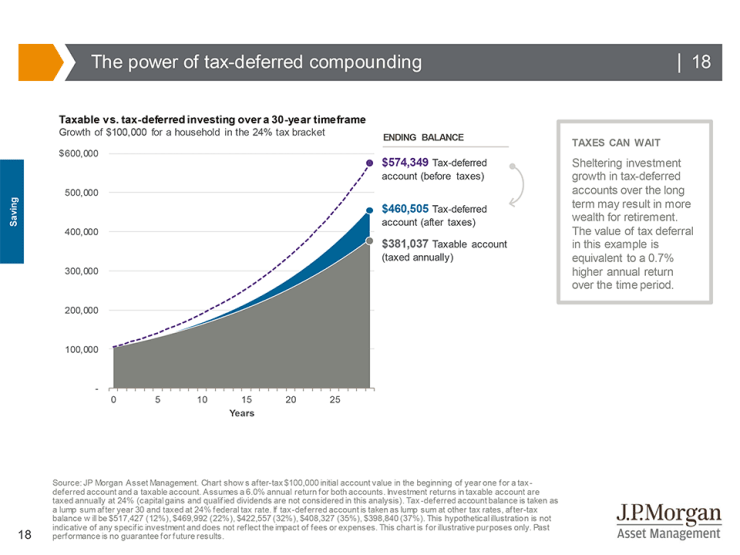
▲The power of tax-deferred compounding

Deferring the tax on investment earnings, such as dividends, interest or capital gains, may help accumulate more after-tax wealth over time than earning the same return in a taxable account. This is known as tax-deferred compounding. This chart shows an initial $100,000 after-tax investment in either a taxable or tax-deferred account that earns a 6% return (assumed to be subject to ordinary income taxes). Assuming an income tax rate of 24%, the value of the tax-deferred account (net of taxes owed) after 30 years accumulates over $79,000 more than if the investment return had been taxed 24% each year. (6)

Sources:

  1. nerdwallet.com/article/ira-vs-401k-retirement-accounts
  2. irs.gov/retirement-plans/retirement-plans-faqs-regarding-required-minimum-distributions
  3. tinyurl.com/y77cjtfz
  4. finance.zacks.com/tax-penalty-moving-401k-ira-3585.html
  5. cnbc.com/2018/04/26/what-to-do-with-your-401k-when-you-change-jobs.html
  6. https://am.jpmorgan.com/us/en/asset-management/gim/protected/adv/insights/guide-to-retirement

This material was prepared by MarketingPro, Inc., and does not necessarily represent the views of the presenting party, nor their affiliates. This information has been derived from sources believed to be accurate. Please note – investing involves risk, and past performance is no guarantee of future results. The publisher is not engaged in rendering legal, accounting or other professional services. If assistance is needed, the reader is advised to engage the services of a competent professional. This information should not be construed as investment, tax or legal advice and may not be relied on for avoiding any Federal tax penalty. This is neither a solicitation nor recommendation to purchase or sell any investment or insurance product or service, and should not be relied upon as such. All indices are unmanaged and are not illustrative of any particular investment.

Which Retirement Savings Vehicle Should You Use: Traditional IRA or Roth IRA?

money-2724241_1920

Perhaps both traditional and Roth IRAs can play a part in your retirement plans.

IRAs can be an important tool in your retirement savings belt, and whichever you choose to open could have a significant impact on how those accounts might grow.

IRAs, or Individual Retirement Accounts, are investment vehicles used to help save money for retirement. There are two different types of IRAs: traditional and Roth. Traditional IRAs, created in 1974, are owned by roughly 35.1 million U.S. households. And Roth IRAs, created as part of the Taxpayer Relief Act in 1997, are owned by nearly 24.9 million households. (1)

Both kinds of IRAs share many similarities, and yet, each is quite different. Let’s take a closer look.

  1. Up to certain limits, traditional IRAs allow individuals to make tax-deductible contributions into the retirement account. Distributions from traditional IRAs are taxed as ordinary income, and if taken before age 59½, may be subject to a 10% federal income tax penalty. For individuals covered by a retirement plan at work, the deduction for a traditional IRA in 2019 has been phased out for incomes between $103,000 and $123,000 for married couples filing jointly and between $64,000 and $74,000 for single filers. (2,3)
  2. Also, within certain limits, individuals can make contributions to a Roth IRA with after-tax dollars. To qualify for a tax-free and penalty-free withdrawal of earnings, Roth IRA distributions must meet a five-year holding requirement and occur after age 59½. Like a traditional IRA, contributions to a Roth IRA are limited based on income. For 2019, contributions to a Roth IRA are phased out between $193,000 and $203,000 for married couples filing jointly and between $122,000 and $137,000 for single filers. (2,3)
  3. In addition to contribution and distribution rules, there are limits on how much can be contributed to either IRA. In fact, these limits apply to any combination of IRAs; that is, workers cannot put more than $6,000 per year into their Roth and traditional IRAs combined. So, if a worker contributed $3,500 in a given year into a traditional IRA, contributions to a Roth IRA would be limited to $2,500 in that same year. (4)
  4. Individuals who reach age 50 or older by the end of the tax year can qualify for annual “catch-up” contributions of up to $1,000. So, for these IRA owners, the 2019 IRA contribution limit is $7,000. (4)

If you meet the income requirements, both traditional and Roth IRAs can play a part in your retirement plans. And once you’ve figured out which will work better for you, only one task remains: opening an account.

jp-gtr-2018-19

▲  Evaluate a Roth at different life stages

The decision to make a pre-tax/deductible contribution to a Traditional 401(k) or IRA or an after-tax contribution to a Roth 401(k) or Roth IRA is based on the income tax rate of the individual at the time of making the contribution, and his/her anticipated tax rate in the future. The difference in tax rates can be caused by an investor’s personal situation and/or tax policy over time. This chart shows a typical wage curve and the general “rule of thumb” about what type of contribution may be most appropriate based on current income and the bracket in retirement. An additional consideration is to maintain a healthy mix of taxable, tax-free (Roth) and tax-deferred accounts so that you can have greater flexibility to manage your income taxes. The numbers on the chart specify situations in which contributing to a Roth option should be carefully considered. (5)

Sources

  1. https://www.ici.org/pdf/per23-10.pdf
  2. https://www.marketwatch.com/story/gearing-up-for-retirement-make-sure-you-understand-your-tax-obligations-2018-06-14
  3. https://money.usnews.com/money/retirement/articles/new-401-k-and-ira-limits
  4. https://www.irs.gov/retirement-plans/plan-participant-employee/retirement-topics-ira-contribution-limits
  5. https://am.jpmorgan.com/us/en/asset-management/gim/protected/adv/insights/guide-to-retirement

This material was prepared by MarketingPro, Inc., and does not necessarily represent the views of the presenting party, nor their affiliates. This information has been derived from sources believed to be accurate. Please note – investing involves risk, and past performance is no guarantee of future results. The publisher is not engaged in rendering legal, accounting or other professional services. If assistance is needed, the reader is advised to engage the services of a competent professional. This information should not be construed as investment, tax or legal advice and may not be relied on for the purpose of avoiding any Federal tax penalty. This is neither a solicitation nor recommendation to purchase or sell any investment or insurance product or service, and should not be relied upon as such. All indices are unmanaged and are not illustrative of any particular investment.

The Importance of Matching Your Investments to Your Risk Tolerance

Screen Shot 2018-11-21 at 3.32.22 PM

When turbulence hits Wall Street, are you stressed out?

If you have taken on too much risk in your portfolio – which can happen through intention or inattention – stock market volatility may make you anxious. So from time to time, it is a good idea to review how your assets are invested. Your asset allocation should correspond to your tolerance for risk, and if it doesn’t, it should be adjusted.

A balanced portfolio may help you come out of stock market dips in better shape. Stocks and stock funds aren’t the only investment classes you can choose from, and you won’t be alone if you decide to examine other investment options.

Treasuries, bonds and bond funds become attractive to investors when Wall Street turns especially volatile. Certain forms of alternative investments gain attention as well, particularly those with low or no correlation to the equities markets. Bonds tend to maintain their strength when stocks perform poorly. Some cautious investors maintain a cash position in all stock market climates, even raging bull markets.

Downside risk can particularly sting investors who have devoted too much of their portfolios to momentum/expensive stocks. A stock with a price-earnings ratio above 20 may be particularly susceptible to downside risk. (1)

Underdiversification risk can also prove to be an Achilles heel. Some portfolios contain just a few stocks – in the classic example, someone has invested too heavily in company stock and a few perceived “winners.” If a large chunk of the portfolio’s assets are devoted to five or six stocks, the portfolio’s value may be impacted if shares of even one of those companies plummet. This is why it is wise to own a variety of stocks across different sectors. The same principle applies to stock funds. If the S&P 500 corrects (that is, drops 10% or more in a short interval), the possibility grows that an aggressive growth mutual fund may dive. (1)

Are you retired, or retiring?

If you are, this is all the more reason to review and possibly even revise your portfolio. Frequently, people approach or enter retirement with portfolios that haven’t been reviewed in years. The asset allocation that seemed wise ten years ago may be foolhardy today.

Many people in their fifties and sixties do need to accumulate more money for retirement; you may be one of them. That sentiment should not lead you to accept extreme risk in your portfolio. You’ll likely want consistent income and growth in the absence of a salary, however, and therein lies the appeal of a balanced investment approach designed to manage risk while encouraging an adequate return.

Review the risk in your portfolio?

You may find that you have a mix of investments that matches your risk tolerance. Or, your portfolio may need minor or major adjustments. The right balance may help you insulate your assets to a greater degree when stock market turbulence occurs.

Sources

  1. fc.standardandpoors.com/sites/client/wfs2/wfs/article.vm?topic=6064&siteContent=8339
  2. https://youtu.be/ylJSorjN9PY

This material was prepared by MarketingPro, Inc., and does not necessarily represent the views of the presenting party, nor their affiliates. This information has been derived from sources believed to be accurate. Please note – investing involves risk, and past performance is no guarantee of future results. The publisher is not engaged in rendering legal, accounting or other professional services. If assistance is needed, the reader is advised to engage the services of a competent professional. This information should not be construed as investment, tax or legal advice and may not be relied on for the purpose of avoiding any Federal tax penalty. This is neither a solicitation nor recommendation to purchase or sell any investment or insurance product or service, and should not be relied upon as such. All indices are unmanaged and are not illustrative of any particular investment.
The Risks of Putting Too Much Money Into an Annuity

women s in gray turtleneck sweater pointing white contract paper

Photo by rawpixel.com on Pexels.com

Although annuities can be a useful piece of a retirement strategy these private income contracts do have potential flaws.

It may not be good to have all your eggs in an annuity basket.

Or even a majority of your eggs, financially speaking.

Fundamentally, an annuity contract means handing over your money to an insurer.

In turn, the insurer pays out an income stream to you from that lump sum (or from the years of purchase payments you have made). The insurance company holds the money; you do not. From one standpoint, this arrangement has some merit; it relieves you of the burden of having to manage that money. From another standpoint, it has a few significant drawbacks. (1,2)

Annuities are often illiquid.

If you run into a situation where you need cash in retirement (a major home repair, a legal settlement, big medical expenses), do not expect to withdraw that cash from your annuity. If you have owned the annuity for some time, you may have to pay a hefty withdrawal penalty to access the money. From the insurer’s point of view, you are violating a contract. Should you have buyer’s remorse and decide you want out of your annuity contract soon after its inception, you will probably face a surrender charge. If you back out after the initial year of the contract, the surrender charge is commonly about 7% of your account value; it usually declines by a percentage point for each subsequent year you have spent in the annuity contract before surrendering.(2)

Annuities come with high annual fees.

A yearly management fee of 1.25% or more is not uncommon. Then there are mortality and expense (M&E) fees, fees for add-ons and guarantees, and up-front charges. If you have a variable annuity, throw in investment management fees as well. The “fee drag” for variable annuities may effectively eat away at their annual returns. (2)

Annuity joint-and-survivor income provisions may not be as beneficial as they seem.

Many annuities feature this payment structure, whereby the income payments continue to a surviving spouse after the death of one spouse. The downside of this arrangement: from the start, the income payments are less than what they ordinarily would be. If you are the annuity holder and you think your spouse may pass away before you do or are already confident that your spouse will be in a good financial position after your death, then a joint-and-survivor annuity payment structure may be nice, but not really necessary. (3)

If you do not yet own an annuity, consider that you may not need one.

The federal government basically gives you the equivalent of a deferred annuity: Social Security. Like an annuity, Social Security provides you with a reliable income stream – and your Social Security income is adjusted for inflation. (4)

Think of an annuity as one potential piece of a retirement strategy.

See it as a component or a supplement of that strategy, not the core.

JP-GTR-2018-48

▲Understanding annuities: Which annuity may be right for you?

Annuities come in all shapes and sizes, which can often confuse investors. This chart helps to identify the type of annuity that aligns to specific income needs and tolerance for investment risk, and provides information about how the annuity growth and payout amounts are determined, as well as other key characteristics to know.

Sources

  1. tinyurl.com/y9mukmp3
  2. annuitieshq.com/articles/annuities-good-bad-depends-actually
  3. forbes.com/sites/forbesfinancecouncil/2018/03/29/five-reasons-not-to-buy-an-annuity/
  4. ssa.gov/oact/cola/latestCOLA.html
  5. https://am.jpmorgan.com/us/en/asset-management/gim/protected/adv/insights/guide-to-retirement

This material was prepared by MarketingPro, Inc., and does not necessarily represent the views of the presenting party, nor their affiliates. This information has been derived from sources believed to be accurate. Please note – investing involves risk, and past performance is no guarantee of future results. The publisher is not engaged in rendering legal, accounting or other professional services. If assistance is needed, the reader is advised to engage the services of a competent professional. This information should not be construed as investment, tax or legal advice and may not be relied on for the purpose of avoiding any Federal tax penalty. This is neither a solicitation nor recommendation to purchase or sell any investment or insurance product or service, and should not be relied upon as such. All indices are unmanaged and are not illustrative of any particular investment.