Retirement Planning

The Major Retirement Planning Mistakes and How to Avoid Them

Much is out there about the classic financial mistakes that plague start-ups, family businesses, corporations, and charities. Aside from these blunders, some classic financial missteps plague retirees.

Calling them “mistakes” may be a bit harsh, as not all of them represent errors in judgment. Yet whether they result from ignorance or fate, we need to be aware of them as we plan for and enter retirement.

1) Leaving Work Too Early

As Social Security benefits rise about 8% for every year you delay receiving them, waiting a few years to apply for benefits can position you for higher retirement income. Filing for your monthly benefits before you reach Social Security’s Full Retirement Age (FRA) can mean comparatively smaller monthly payments. Meanwhile, if you can delay claiming Social Security, that positions you for more significant monthly benefits. (1)

2) Underestimating Medical Bills

In its latest estimate of retiree health care costs, the Center for Retirement Research at Boston College says that the average retiree will need at least $4,300 per year to pay for future health care costs. Medicare will not pay for everything. That $4,300 represents out-of-pocket costs, which includes dental, vision, and long-term care. (2)

3) Taking the Potential For Longevity Too Lightly

Actuaries at the Social Security Administration project that around a third of today’s 65-year-olds will live to age 90, with about one in seven living 95 years or longer. The prospect of a 20- or 30-year retirement is not unreasonable, yet there is still a lingering cultural assumption that our retirements might duplicate the relatively brief ones of our parents. (3)

4) Withdrawing Too Much Each Year

You may have heard of the “4% rule,” a guideline stating that you should take out only about 4% of your retirement savings annually. Many cautious retirees try to abide by it.

So, why do others withdraw 7% or 8% a year? In the first phase of retirement, people tend to live it up; more free time naturally promotes new ventures and adventures and an inclination to live a bit more lavishly.

5) Ignoring Tax Efficiency & Fees

It can be a good idea to have both taxable and tax-advantaged accounts in retirement. Assuming your retirement will be long, you may want to assign this or that investment to its “preferred domain.” What does that mean? It means the taxable or tax-advantaged account that may be most appropriate for it as you pursue a better after-tax return for the whole portfolio.

Many younger investors chase the return. Some retirees, however, find a shortfall when they try to live on portfolio income. In response, they move money into stocks offering significant dividends or high-yield bonds – something you might regret in the long run. Taking retirement income off both the principal and interest of a portfolio may give you a way to reduce ordinary income and income taxes.

6) Avoiding Market Risk

Equity investment does invite risk, but the reward may be worth it. In contrast, many fixed-rate investments offer comparatively small yields these days.

7) Retiring With Heavier Debts.

It is hard to preserve (or accumulate) wealth when you are handing portions of it to creditors.

8) Putting College Costs Before Retirement Costs

There is no “financial aid” program for retirement. There are no “retirement loans.” Your children have their whole financial lives ahead of them. Try to refrain from touching your home equity or your IRA to pay for their education expenses.

9) Retiring With No Plan or Investment Strategy

An unplanned retirement may bring terrible financial surprises; the absence of a strategy can leave people prone to market timing and day trading.

These are some of the classic retirement planning mistakes. Why not plan to avoid them? Take a little time to review and refine your retirement strategy in the company of the financial professional you know and trust.
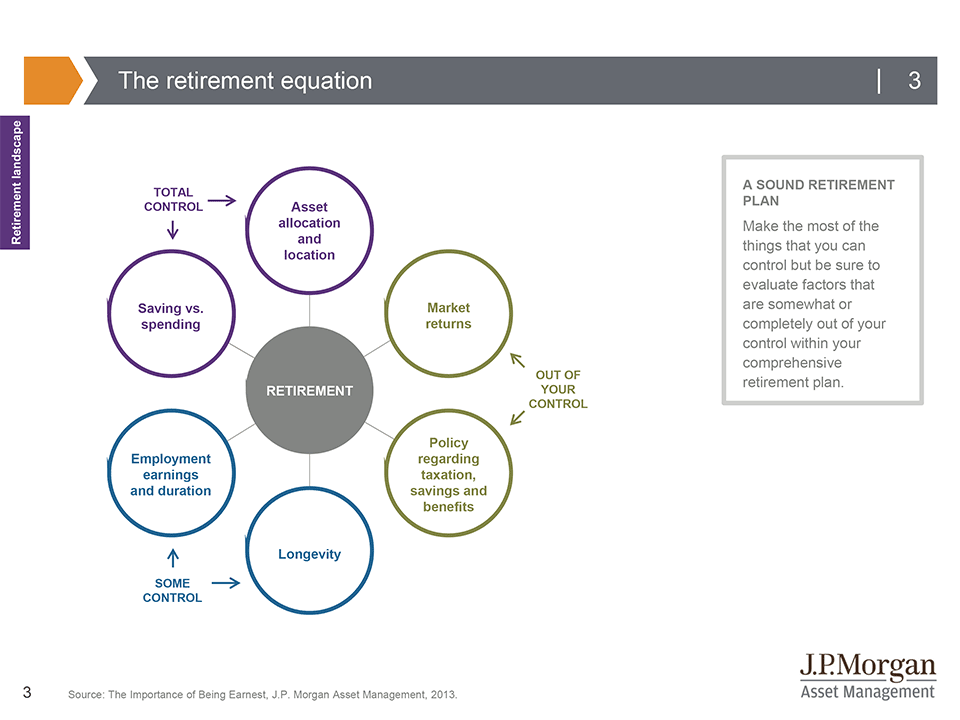
▲ The retirement equation

Planning for retirement can be overwhelming as individuals navigate various retirement factors over which we have varying levels of control. There are challenges in retirement planning over which we have no control, like the future of tax policy and market returns, and factors over which we have limited control, like longevity and how long we plan to work. The best way to achieve a secure retirement is to develop a comprehensive retirement plan and to focus on the factors we can control: maximize savings, understand and manage spending and adhere to a disciplined approach to investing. (4)

Sources

  1. forbes.com/sites/bobcarlson/2019/01/25/5-ways-to-maximize-social-security-benefits
  2. fool.com/retirement/2019/12/11/4-steps-to-making-sure-youre-ready-to-retire.aspx
  3. ssa.gov/planners/lifeexpectancy.html
  4. https://am.jpmorgan.com/us/en/asset-management/gim/protected/adv/insights/guide-to-retirement

This material was prepared by MarketingPro, Inc., and does not necessarily represent the views of the presenting party, nor their affiliates. This information has been derived from sources believed to be accurate. Please note – investing involves risk, and past performance is no guarantee of future results. The publisher is not engaged in rendering legal, accounting or other professional services. If assistance is needed, the reader is advised to engage the services of a competent professional. This information should not be construed as investment, tax or legal advice and may not be relied on for the purpose of avoiding any Federal tax penalty. This is neither a solicitation nor recommendation to purchase or sell any investment or insurance product or service, and should not be relied upon as such. All indices are unmanaged and are not illustrative of any particular investment.

Understanding What Long-Term Care Is and How Much It Might Cost You

action adult affection eldery

Photo by Matthias Zomer on Pexels.com

Addressing the potential threat of long-term care expenses may be one of the biggest financial challenges for individuals who are developing a retirement strategy.

The U.S. Department of Health and Human Services estimates that 69% of people over age 65 can expect to need extended care services at some point in their lives. So, understanding the various types of long-term care services – and what those services may cost – is critical as you consider your retirement approach.1

What Is Long-Term Care?

Long-term care is not a single activity. It refers to a variety of medical and non-medical services needed by those who have a chronic illness or disability that is most commonly associated with aging.

Long-term care can include everything from assistance with activities of daily living – help dressing, bathing, using the bathroom, or even driving to the store – to more intensive therapeutic and medical care requiring the services of skilled medical personnel.

Long-term care may be provided at home, at a community center, in an assisted living facility, or in a skilled nursing home. And long-term care is not exclusively for the elderly; it is possible to need long-term care at any age.

How Much Does Long-Term Care Cost?

Long-term care costs vary state by state and region by region. The national average for care in a skilled care facility (semi-private in a nursing home) is $85,775 a year. The national average for care in an assisted living center is $45,000 a year. Home health aides cost a median $18,200 per year, but that rate may increase when a licensed nurse is required.

Individuals who would rather not burden their family and friends have two main options for covering the cost of long-term care: they can choose to self-insure or they can purchase long-term care insurance.

Many self-insure by default – simply because they haven’t made other arrangements. Those who self-insure may depend on personal savings and investments to fund any long-term care needs. The other approach is to consider purchasing long-term care insurance, which can cover all levels of care, from skilled care to custodial care to in-home assistance.

When it comes to addressing your long-term care needs, many look to select a strategy that may help them protect assets, preserve dignity, and maintain independence. If those concepts are important to you, consider your approach for long-term care.

FINAL-2019-GTR-2_22_HIGH-RES-33-2

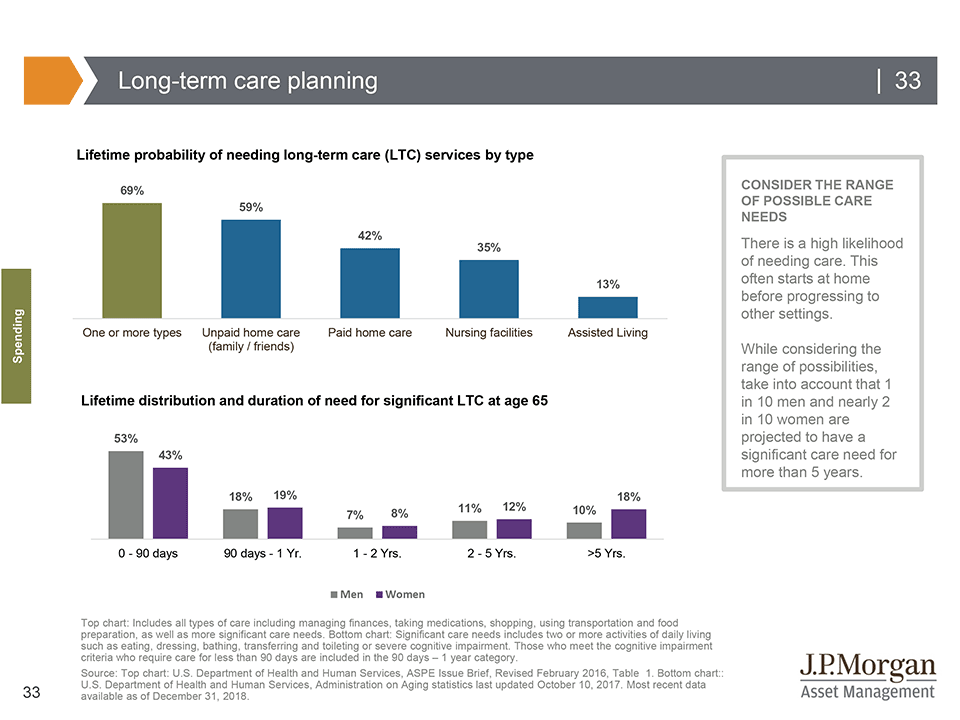
▲Long-term care planning
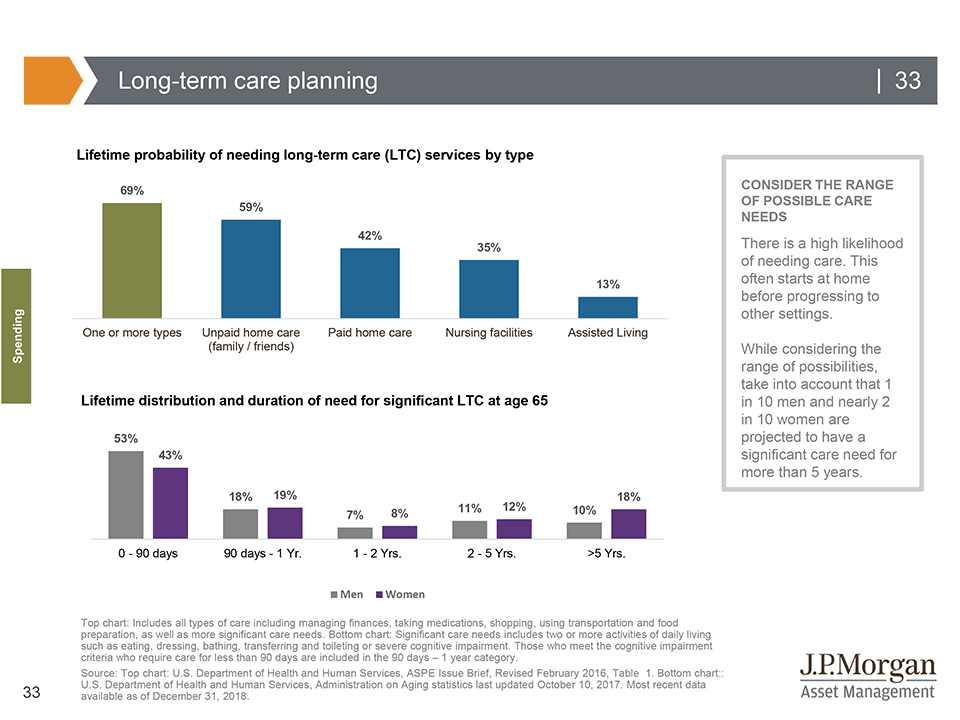
At age 65, the lifetime likelihood of needing at least some care is nearly 70%. Most often, care will be at home although it may progress to other settings. Duration of care needs vary widely, with about 5 in 10 men and 4 in 10 women requiring significant care for zero – 90 days and 1 in 10 men and nearly 2 in 10 women needing significant care for 5 years or more. When planning for long-term care consider multiple solutions that may be utilized including family assistance, income, savings, home equity, life insurance for a surviving spouse, and insurance options that range from traditional long-term care insurance to combination products. (2)

Sources

  1. fool.com/retirement/2018/09/02/5-long-term-care-stats-that-will-blow-you-away.aspx
  2. https://am.jpmorgan.com/us/en/asset-management/gim/protected/adv/insights/guide-to-retirement

This material was prepared by MarketingPro, Inc., and does not necessarily represent the views of the presenting party, nor their affiliates. This information has been derived from sources believed to be accurate. Please note – investing involves risk, and past performance is no guarantee of future results. The publisher is not engaged in rendering legal, accounting or other professional services. If assistance is needed, the reader is advised to engage the services of a competent professional. This information should not be construed as investment, tax or legal advice and may not be relied on for the purpose of avoiding any Federal tax penalty. This is neither a solicitation nor recommendation to purchase or sell any investment or insurance product or service, and should not be relied upon as such. All indices are unmanaged and are not illustrative of any particular investment.

Why You Shouldn’t Take a Loan From Your Retirement Plan

man holding ipad

Photo by rawpixel.com on Pexels.com

Thinking about borrowing money from your 401(k), 403(b), or 457 account?

Think twice about that because these loans are not only risky, but injurious, to your retirement planning.

A loan of this kind damages your retirement savings prospects.

A 401(k), 403(b), or 457 should never be viewed like a savings or checking account. When you withdraw from a bank account, you pull out cash. When you take a loan from your workplace retirement plan, you sell shares of your investments to generate cash. You buy back investment shares as you repay the loan. (1)

In borrowing from a 401(k), 403(b), or 457, you siphon down invested retirement assets, leaving a smaller account balance that experiences a smaller degree of compounding. In repaying the loan, you will likely repurchase investment shares at higher prices than in the past – in other words, you will be buying high. None of this makes financial sense.(1)

Most plan providers charge an origination fee for a loan (it can be in the neighborhood of $100), and of course, they charge interest. While you will repay interest and the principal as you repay the loan, that interest still represents money that could have remained in the account and remained invested.1,2

As you strive to repay the loan amount, there may be a financial side effect. You may end up reducing or suspending your regular per-paycheck contributions to the plan. Some plans may even bar you from making plan contributions for several months after the loan is taken. (3,4)

Your take-home pay may be docked.

Most loans from 401(k), 403(b), and 457 plans are repaid incrementally – the plan subtracts X dollars from your paycheck, month after month, until the amount borrowed is fully restored. (1)

If you leave your job, you will have to pay 100% of your 401(k) loan back.

This applies if you quit; it applies if you are laid off or fired. Formerly, you had a maximum of 60 days to repay a workplace retirement plan loan. The Tax Cuts & Jobs Act of 2017 changed that for loans originated in 2018 and years forward. You now have until October of the year following the year you leave your job to repay the loan (the deadline is the due date of your federal taxes plus a 6-month extension, which usually means October 15). You also have a choice: you can either restore the funds to your workplace retirement plan or transfer them to either an IRA or a workplace retirement plan elsewhere.(2)

If you are younger than age 59½ and fail to pay the full amount of the loan back, the I.R.S. will characterize any amount not repaid as a premature distribution from a retirement plan – taxable income that is also subject to an early withdrawal penalty. (3)

Even if you have great job security, the loan will probably have to be repaid in full within five years.

Most workplace retirement plans set such terms. If the terms are not met, then the unpaid balance becomes a taxable distribution with possible penalties (assuming you are younger than 59½.(1)

Would you like to be taxed twice?

When you borrow from an employee retirement plan, you invite that prospect. You will be repaying your loan with after-tax dollars, and those dollars will be taxed again when you make a qualified withdrawal of them in the future (unless your plan offers you a Roth option). (3,4)

Why go into debt to pay off debt?

If you borrow from your retirement plan, you will be assuming one debt to pay off another. It is better to go to a reputable lender for a personal loan; borrowing cash has fewer potential drawbacks.

You should never confuse your retirement plan with a bank account.

Some employees seem to do just that. Fidelity Investments says that 20.8% of its 401(k) plan participants have outstanding loans in 2018. In taking their loans, they are opening the door to the possibility of having less money saved when they retire. (4)

Why risk that? Look elsewhere for money in a crisis. Borrow from your employer-sponsored retirement plan only as a last resort.

FINAL-2019-GTR-2_22_HIGH-RES-46
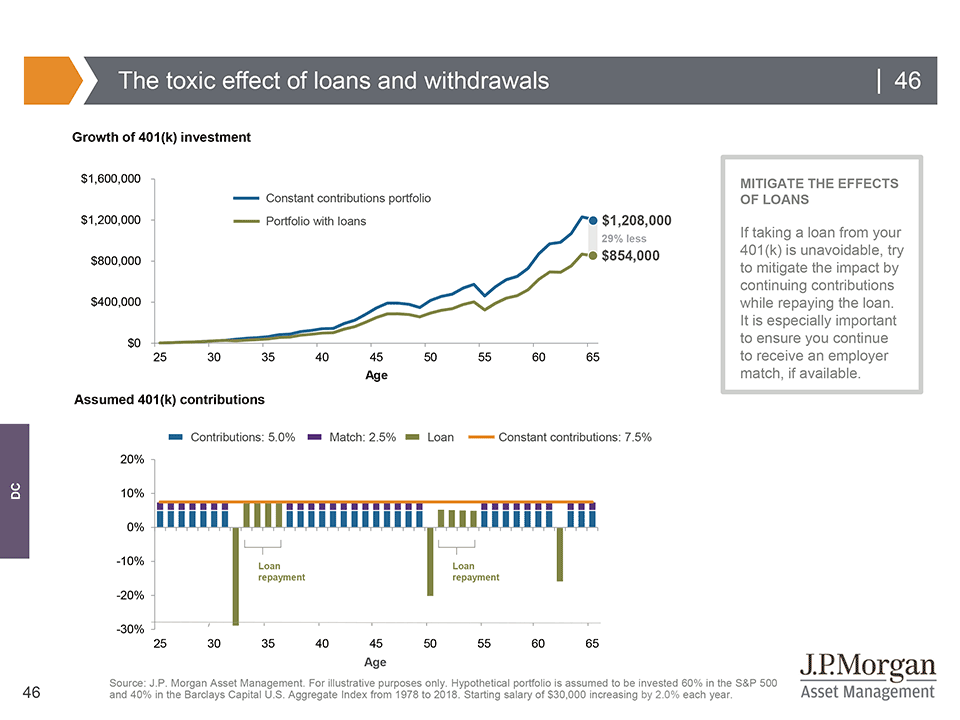
▲The toxic effect of loans and withdrawals

The top chart shows that employees who took loans and a withdrawal from their account may end up with significantly lower balances in the end. The bottom chart shows that the employee did not get the benefit of contributions and company match when paying back their loans. To avoid this scenario, stress the importance of an emergency reserve and savings for other goals outside of the retirement account. If the employee must borrow, if they keep contributing while paying back the loan that may mitigate the negative impact of the loan.

Sources

  1. gobankingrates.com/retirement/401k/borrowing-401k/
  2. forbes.com/sites/ashleaebeling/2018/01/16/new-tax-law-liberalizes-401k-loan-repayment-rules/
  3. cbsnews.com/news/when-is-it-ok-to-withdraw-or-borrow-from-your-retirement-savings/
  4. cnbc.com/2018/06/26/the-lure-of-a-401k-loan-could-mask-its-risks.html
  5. https://am.jpmorgan.com/us/en/asset-management/gim/protected/adv/insights/guide-to-retirement

This material was prepared by MarketingPro, Inc., and does not necessarily represent the views of the presenting party, nor their affiliates. This information has been derived from sources believed to be accurate. Please note – investing involves risk, and past performance is no guarantee of future results. The publisher is not engaged in rendering legal, accounting or other professional services. If assistance is needed, the reader is advised to engage the services of a competent professional. This information should not be construed as investment, tax or legal advice and may not be relied on for avoiding any Federal tax penalty. This is neither a solicitation nor recommendation to purchase or sell any investment or insurance product or service, and should not be relied upon as such. All indices are unmanaged and are not illustrative of any particular investment.
How to Value the Value of Working With a Financial Advisor

jeff-sheldon-guH91yuPaMk-unsplash.jpg

Photo by Jeff Sheldon on Unsplash

A good professional provides important guidance and insight through the years.

What kind of role can a financial professional play for an investor?

The answer: a very important one. While the value of such a relationship is hard to quantify, the intangible benefits may be significant and long-lasting.

There are certain investors who turn to a financial professional with one goal in mind: the “alpha” objective of beating the market, quarter after quarter. Even Wall Street money managers fail at that task – and they fail routinely.

At some point, these investors realize that their financial professional has no control over what happens in the market. They come to understand the real value of the relationship, which is about strategy, coaching, and understanding.

A good financial professional can help an investor interpret today’s financial climate, determine objectives, and assess progress toward those goals. Alone, an investor may be challenged to do any of this effectively. Moreover, an uncoached investor may make self-defeating decisions. Today’s steady stream of instant information can prompt emotional behavior and blunders.

No investor is infallible

Investors can feel that way during a great market year, when every decision seems to work out well. Overconfidence can set in, and the reality that the market has occasional bad years can be forgotten.

This is when irrational exuberance creeps in. A sudden Wall Street shock may lead an investor to sell low today, buy high tomorrow, and attempt to time the market.

Market timing may be a factor in the following divergence: according to investment research firm DALBAR, U.S. stocks gained 10% a year on average from 1988-2018, yet the average equity investor’s portfolio returned just 4.1% annually in that period. (1)

A good financial professional helps an investor commit to staying on track

Through subtle or overt coaching, the investor learns to take short-term ups and downs in stride and focus on the long term. A strategy is put in place, based on a defined investment policy and target asset allocations with an eye on major financial goals. The client’s best interest is paramount.

As the investor-professional relationship unfolds, the investor begins to notice the intangible ways the professional provides value. Insight and knowledge inform investment selection and portfolio construction. The professional explains the subtleties of investment classes and how potential risk often relates to potential reward.

Perhaps most importantly, the professional helps the client get past the “noise” and “buzz” of the financial markets to see what is really important to his or her financial life.

The investor gains a new level of understanding, a context for all the investing and saving. The effort to build wealth and retire well is not merely focused on “success,” but also on significance.

This is the value a financial professional brings to the table. You cannot quantify it in dollar terms, but you can certainly appreciate it over time.MI-GTM_3Q19_August_High-Res-64

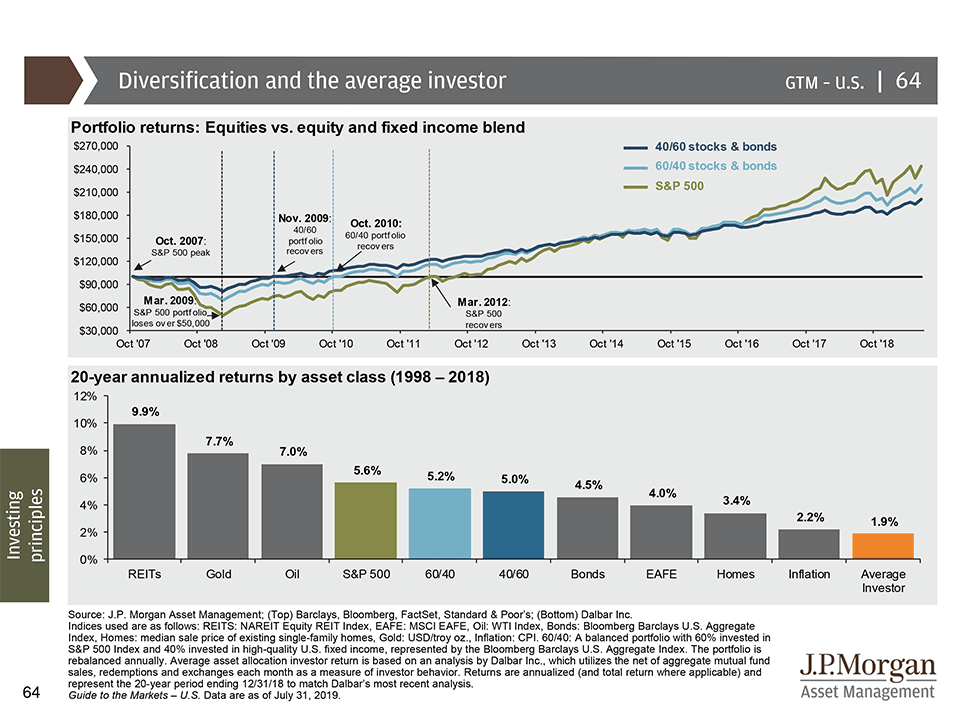
▲ Diversification and the average investor

The top chart shows the powerful effects of portfolio diversification. It illustrates the difference in movements between the S&P 500, a 60/40 portfolio and a 40/60 portfolio indicating when each respective portfolio would have recovered its original value at the peak of the market in 2007 from the market bottom in 2009. It shows that the S&P 500 fell far more than either of the two diversified portfolio and also took two or more years longer to recover its value. The bottom chart shows 20-year annualized returns by asset class, as well as how an “average investor” would have fared. The average investor asset allocation return is based on an analysis by Dalbar, which utilizes the net of aggregate mutual fund sales, redemptions and exchanges each month as a measure of investor behavior.

Sources

  1. cnbc.com/2019/07/31/youre-making-big-financial-mistakes-and-its-your-brains-fault.html
  2. https://am.jpmorgan.com/us/en/asset-management/gim/adv/insights/guide-to-the-markets/viewer

This material was prepared by MarketingPro, Inc., and does not necessarily represent the views of the presenting party, nor their affiliates. This information has been derived from sources believed to be accurate. Please note – investing involves risk, and past performance is no guarantee of future results. The publisher is not engaged in rendering legal, accounting or other professional services. If assistance is needed, the reader is advised to engage the services of a competent professional. This information should not be construed as investment, tax or legal advice and may not be relied on for the purpose of avoiding any Federal tax penalty. This is neither a solicitation nor recommendation to purchase or sell any investment or insurance product or service, and should not be relied upon as such. All indices are unmanaged and are not illustrative of any particular investment.

How the Sequence of Portfolio Returns Could Impact Your Retirement

game

A look at how variable rates of return do (and do not) impact investors over time.

What exactly is the “sequence of returns”?

The phrase simply describes the yearly variation in an investment portfolio’s rate of return. Across 20 or 30 years of saving and investing for the future, what kind of impact do these deviations from the average return have on a portfolio’s final value?

The answer: no impact at all.

Once an investor retires, however, these ups and downs can have a major effect on portfolio value – and retirement income.

During the accumulation phase, the sequence of returns is ultimately inconsequential.

Yearly returns may vary greatly or minimally; in the end, the variance from the mean hardly matters. (Think of “the end” as the moment the investor retires: the time when the emphasis on accumulating assets gives way to the need to withdraw assets.)

An analysis from BlackRock bears this out. The asset manager compares three model investing scenarios: three investors start portfolios with lump sums of $1 million, and each of the three portfolios averages a 7% annual return across 25 years. In two of these scenarios, annual returns vary from -7% to +22%. In the third scenario, the return is simply 7% every year. In all three scenarios, each investor accumulates $5,434,372 after 25 years – because the average annual return is 7% in each case. (1)

Here is another way to look at it.

The average annual return of your portfolio is dynamic; it changes, year-to-year. You have no idea what the average annual return of your portfolio will be when “it is all said and done,” just like a baseball player has no idea what his lifetime batting average will be four seasons into a 13-year playing career. As you save and invest, the sequence of annual portfolio returns influences your average yearly return, but the deviations from the mean will not impact the portfolio’s final value. It will be what it will be. (1)

When you shift from asset accumulation to asset distribution, the story changes.

You must try to protect your invested assets against sequence of returns risk.

This is the risk of your retirement coinciding with a bear market (or something close).

Even if your portfolio performs well across the duration of your retirement, a bad year or two at the beginning could heighten concerns about outliving your money.

For a classic illustration of the damage done by sequence of returns risk, consider the awful 2007-2009 bear market. Picture a couple at the start of 2008 with a $1 million portfolio, held 60% in equities and 40% in fixed-income investments. They arrange to retire at the end of the year. This will prove a costly decision. The bond market (in shorthand, the S&P U.S. Aggregate Bond Index) gains 5.7% in 2008, but the stock market (in shorthand, the S&P 500) dives 37.0%. As a result, their $1 million portfolio declines to $800,800 in just one year. (2)

If you are about to retire, do not dismiss this risk.

If you are far from retirement, keep saving and investing knowing that the sequence of returns will have its greatest implications as you make your retirement transition.

FINAL-2019-GTR-2_22_HIGH-RES-40

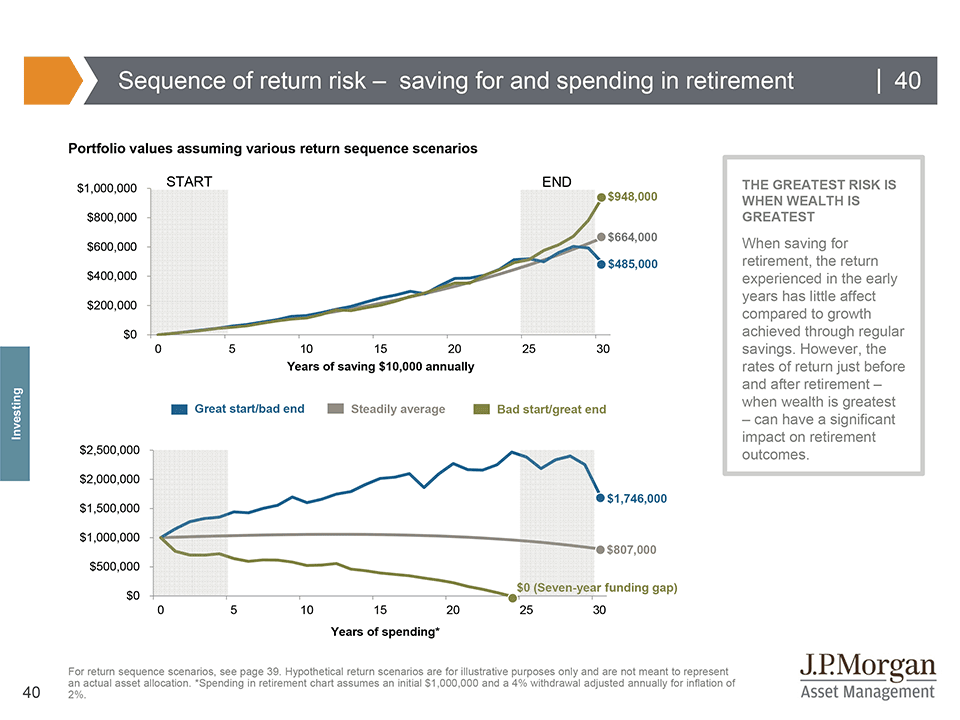
▲ Sequence of return risk – saving for and spending in retirement

Poor returns have the biggest impact on outcomes when wealth is greatest. Using the three sequence of return scenarios – Great start/bad end in blue, steadily average in grey and bad start/great end in green – this chart shows outcomes assuming someone is saving for retirement in the top chart and spending in retirement in the bottom chart.

  • The top chart assumes that someone starts with $0 and begins saving $10,000 per year. In the early years of saving, the return experience makes very little difference across sequence of return scenarios. The most powerful impact to the portfolio’s value is the savings behavior. However, the sequence of return experienced at the end of the savings timeframe when wealth is greatest produces very different outcomes.
  • The bottom chart shows the impact of withdrawals from a portfolio to fund a retirement lifestyle. If returns are poor early in retirement, the portfolio is what we call ‘ravaged’ because more shares are sold at lower prices thereby exacerbating the poor returns that the portfolio is experiencing. This results in the portfolio being depleted in 23 years – or 7 years before the 30 year planning horizon. If, instead, a great start occurs the beginning of retirement and the same spending is assumed, the portfolio value is estimated to be $1.7M after 30 years.

The key takeaway to understand is how important it is to have the right level of risk prior to as well as just after retirement because that is when you may have the most wealth at risk. You should consider to mitigate sequence of return risk through diversification, investments that use options strategies for defensive purposes or annuities that offer principal protection or protected income.

Sources

  1. blackrock.com/pt/literature/investor-education/sequence-of-returns-one-pager-va-us.pdf
  2. kiplinger.com/article/retirement/T047-C032-S014-is-your-retirement-income-in-peril-of-this-risk.html
  3. https://am.jpmorgan.com/us/en/asset-management/gim/protected/adv/insights/guide-to-retirement

This material was prepared by MarketingPro, Inc., and does not necessarily represent the views of the presenting party, nor their affiliates. This information has been derived from sources believed to be accurate. Please note – investing involves risk, and past performance is no guarantee of future results. The publisher is not engaged in rendering legal, accounting or other professional services. If assistance is needed, the reader is advised to engage the services of a competent professional. This information should not be construed as investment, tax or legal advice and may not be relied on for the purpose of avoiding any Federal tax penalty. This is neither a solicitation nor recommendation to purchase or sell any investment or insurance product or service, and should not be relied upon as such. All indices are unmanaged and are not illustrative of any particular investment.
Could Social Security Really Go Away?

Social security card and American money dollar bills

That may be unlikely, but the program does face financial challenges.

Will Social Security run out of money in the 2030s?

You may have heard warnings about this dire scenario coming true. These warnings, however, assume that no action will be taken to address Social Security’s financial challenges between now and then.

It is true that Social Security is being strained by a gradual demographic shift.

The Census Bureau says that in 2035, America will have more senior citizens than children for the first time. In that year, 21% of us will be age 65 or older. (1)

As this shift occurs, the ratio of workers to retirees is also changing.

There were three working adults for every Social Security recipient in 1995. The ratio is projected to be 2.2 to 1 in 2035. (2)

Since Social Security is largely funded with payroll taxes, this presents a major dilemma.

Social Security may soon pay out more money than it takes in.

That has not happened since 1982. This could become a “new normal” given the above-mentioned population and labor force changes. (3)

When you read a sentence stating, “Social Security could run out of money by 2035,” it is really referring to the potential depletion of the Social Security Administration’s Old Age, Survivors, and Disability Insurance (OASDI) trust funds – the twin trust funds from which monthly retiree and disability payments are disbursed. Should Social Security’s net cash outflow continue unchecked, these trust funds may actually be exhausted around that time. (4)

Social Security is currently authorized to pay full benefits to retirees through the mid-2030s. If its shortfall continues, it will have to ask Congress for greater spending authority in order to sustain benefit payments to meet retiree expectations. (4)

What if Congress fails to address Social Security’s cash flow problem?

If no action is taken, Social Security could elect to reduce retirement benefits at some point in the future. Its board of trustees notes one option in its latest annual report: benefits could be cut by 21%. That could help payouts continue steadily through 2092. (2)

No one wants to see benefits cut, so what might Congress do to address the crisis?

A few ideas have emerged.

  1. Expose all wages to the Social Security tax or increase it at certain levels. Right now, the Social Security tax only applies to income below $132,900. Lifting this wage cap on the tax or boosting the tax above a particular income threshold would bring Social Security more revenue, specifically from higher-earning Americans. (5)
  2. Raise Social Security’s full retirement age (FRA). This is the age when people become eligible to receive unreduced retirement benefits. The Social Security reforms passed in 1983 have gradually increased the FRA from 65 to 67.5
  3. Calculate COLAs differently. Social Security could figure its cost-of-living adjustments (COLAs) using the “chained” version of the Consumer Price Index, which some economists believe more accurately measures inflation than the standard CPI. Its COLAs could be smaller as a result. (5)

Social Security could be restructured in the coming decades.

Significant reforms may or may not fix its revenue problem. In the future, Social Security might not be able to offer retirees exactly what it does now, and with that in mind, you might want to reevaluate your potential sources of retirement income today.

Sources

  1. denverpost.com/2019/03/01/ageism-colorado-tight-labor-market/
  2. fool.com/retirement/2018/09/29/social-securitys-fast-facts-and-figures-report-hig.aspx
  3. fool.com/retirement/2019/03/03/why-2019-is-the-social-security-year-weve-all-fear.aspx
  4. taxfoundation.org/social-security-deficit/
  5. morningstar.com/articles/918591/will-the-big-social-security-fix-include-expansion.html

This material was prepared by MarketingPro, Inc., and does not necessarily represent the views of the presenting party, nor their affiliates. This information has been derived from sources believed to be accurate. Please note – investing involves risk, and past performance is no guarantee of future results. The publisher is not engaged in rendering legal, accounting or other professional services. If assistance is needed, the reader is advised to engage the services of a competent professional. This information should not be construed as investment, tax or legal advice and may not be relied on for the purpose of avoiding any Federal tax penalty. This is neither a solicitation nor recommendation to purchase or sell any investment or insurance product or service, and should not be relied upon as such. All indices are unmanaged and are not illustrative of any particular investment.

Facts vs. Fiction: How Much Do You Really Know About Long-Term Care?

person in hospital gown using walking frame beside hospital bed

Photo by rawpixel.com on Pexels.com

Separating some eldercare facts from some eldercare myths.

How much does eldercare cost, and how do you arrange it when it is needed?

The average person might have difficulty answering those two questions, for the answers are not widely known. For clarification, here are some facts to dispel some myths.

True or false: Medicare will pay for your mom or dad’s nursing home care.

FALSE, because Medicare is not long-term care insurance. (1)

Part A of Medicare will pay the bill for up to 20 days of skilled nursing facility care – but after that, you or your parents may have to pay some costs out-of-pocket. After 100 days, Medicare will not pay a penny of nursing home costs – it will all have to be paid out-of-pocket, unless the patient can somehow go without skilled nursing care for 60 days or 30 days including a 3-day hospital stay. In those instances, Medicare’s “clock” resets. (2)

True or false: a semi-private room in a nursing home costs about $35,000 a year.

FALSE. According to Genworth Financial’s most recent Cost of Care Survey, the median cost is now $85,775. A semi-private room in an assisted living facility has a median annual cost of $45,000 annually. A home health aide? $49,192 yearly. Even if you just need someone to help mom or dad with eating, bathing, or getting dressed, the median hourly expense is not cheap: non-medical home aides, according to Genworth, run about $21 per hour, which at 10 hours a week means nearly $11,000 a year. (3,4)

True or false: about 40% of today’s 65-year-olds will eventually need long-term care.

FALSE. The Department of Health and Human Services estimates that close to 70% will. About a third of 65-year-olds may never need such care, but one-fifth are projected to require it for more than five years. (5)

True or false: the earlier you buy long-term care insurance, the less expensive it is.

TRUE. As with life insurance, younger policyholders pay lower premiums. Premiums climb notably for those who wait until their mid-sixties to buy coverage. The American Association for Long-Term Care Insurance’s 2018 price index notes that a 60-year-old couple will pay an average of $3,490 a year for a policy with an initial daily benefit of $150 for up to three years and a 90-day elimination period. A 65-year-old couple pays an average of $4,675 annually for the same coverage. This is a 34% difference. (6)

True or false: Medicaid can pay nursing home costs.

TRUE. The question is, do you really want that to happen? While Medicaid rules vary per state, in most instances a person may only qualify for Medicaid if they have no more than $2,000 in “countable” assets ($3,000 for a couple). Countable assets include bank accounts, equity investments, certificates of deposit, rental or vacation homes, investment real estate, and even second cars owned by a household (assets held within certain trusts may be exempt). A homeowner can even be disqualified from Medicaid for having too much home equity. A primary residence, a primary motor vehicle, personal property and household items, burial funds of less than $1,500, and tiny life insurance policies with face value of less than $1,500 are not countable. So yes, at the brink of poverty, Medicaid may end up paying long-term care expenses. (4,7)

Sadly, many Americans seem to think that the government will ride to the rescue when they or their loved ones need nursing home care or assisted living. Two-thirds of people polled in another Genworth Financial survey about eldercare held this expectation. (4)

In reality, government programs do not help the average household pay for any sustained eldercare expenses. The financial responsibility largely falls on you.

A little planning now could make a big difference in the years to come. Call or email an insurance professional today to learn more about ways to pay for long-term care and to discuss your options. You need to find a way to address this concern, as it could seriously threaten your net worth and your retirement savings.

FINAL-2019-GTR-2_22_HIGH-RES-33-1

▲ Long-term care planning

At age 65, the lifetime likelihood of needing at least some care is nearly 70%. Most often, care will be at home although it may progress to other settings. Duration of care needs vary widely, with about 5 in 10 men and 4 in 10 women requiring significant care for zero – 90 days and 1 in 10 men and nearly 2 in 10 women needing significant care for 5 years or more. When planning for long-term care consider multiple solutions that may be utilized including family assistance, income, savings, home equity, life insurance for a surviving spouse, and insurance options that range from traditional long-term care insurance to combination products. (7)

Sources:

  1. medicare.gov/coverage/long-term-care.html
  2. fool.com/retirement/2018/05/24/the-1-retirement-expense-were-still-not-preparing.aspx
  3. forbes.com/sites/nextavenue/2017/09/26/the-staggering-prices-of-long-term-care-2017/
  4. longtermcare.acl.gov/the-basics/how-much-care-will-you-need.html
  5. fool.com/retirement/2018/02/02/your-2018-guide-to-long-term-care-insurance.aspx
  6. longtermcare.acl.gov/medicare-medicaid-more/medicaid/medicaid-eligibility/financial-requirements-assets.html
  7. https://am.jpmorgan.com/us/en/asset-management/gim/protected/adv/insights/guide-to-retirement

This material was prepared by MarketingPro, Inc., and does not necessarily represent the views of the presenting party, nor their affiliates. All information is believed to be from reliable sources; however we make no representation as to its completeness or accuracy. Please note – investing involves risk, and past performance is no guarantee of future results. The publisher is not engaged in rendering legal, accounting or other professional services. If assistance is needed, the reader is advised to engage the services of a competent professional. This information should not be construed as investment, tax or legal advice and may not be relied on for the purpose of avoiding any Federal tax penalty. This is neither a solicitation nor recommendation to purchase or sell any investment or insurance product or service, and should not be relied upon as such. All indices are unmanaged and are not illustrative of any particular investment.
What’s the Difference Between an IRA and a 401(k) for Retirement Savings?

piggy-2889044_1920

Comparing their features, merits, and demerits.

How do you save for retirement?

Two options probably come to mind right away: the IRA and the 401(k). Both offer you relatively easy ways to build a retirement fund. Here is a look at the features, merits, and demerits of each account, starting with what they have in common.

SIMILARITIES:

1. Taxes are deferred on money held within IRAs and 401(k)s.

That opens the door for tax-free compounding of those invested dollars – a major plus for any retirement saver. (1)

2. IRAs and 401(k)s also offer you another big tax break.

It varies depending on whether the account is traditional or Roth in nature. When you have a traditional IRA or 401(k), your account contributions are tax deductible, but when you eventually withdraw the money for retirement, it will be taxed as regular income. When you have a Roth IRA or 401(k), your account contributions are not tax deductible, but if you follow Internal Revenue Service rules, your withdrawals from the account in retirement are tax free. (1)

3. Generally, the I.R.S. penalizes withdrawals from these accounts before age 59½.

Distributions from traditional IRAs and 401(k)s prior to that age usually trigger a 10% federal tax penalty, on top of income tax on the withdrawn amount. Roth IRAs and Roth 401(k)s allow you to withdraw a sum equivalent to your account contributions at any time without taxes or penalties, but early distributions of the account earnings are taxable and may also be hit with the 10% early withdrawal penalty. (1)

4. You must make annual withdrawals from 401(k)s and traditional IRAs after age 70½.

Annual withdrawals from a Roth IRA are not required during the owner’s lifetime, only after his or her death. Even Roth 401(k)s require annual withdrawals after age 70½. (2)

DIFFERENCES:

1.Annual contribution limits for IRAs and 401(k)s differ greatly.

You may direct up to $18,500 into a 401(k) in 2018; $24,500, if you are 50 or older. In contrast, the maximum 2018 IRA contribution is $5,500; $6,500, if you are 50 or older. (1)

2. Your employer may provide you with matching 401(k) contributions.

This is free money coming your way. The match is usually partial, but certainly nothing to disregard – it might be a portion of the dollars you contribute up to 6% of your annual salary, for example. Do these employer contributions count toward your personal yearly 401(k) contribution limit? No, they do not. Contribute enough to get the match if your company offers you one.1

3. An IRA permits a wide variety of investments, in contrast to a 401(k).

The typical 401(k) offers only about 20 investment options, and you have no control over what investments are chosen. With an IRA, you have a vast range of potential investment choices. (1,3)

4. You can contribute to a 401(k) no matter how much you earn.

Your income may limit your eligibility to contribute to a Roth IRA; at certain income levels, you may be prohibited from contributing the full amount, or any amount. (1)

5. If you leave your job, you cannot take your 401(k) with you.

It stays in the hands of the retirement plan administrator that your employer has selected. The money remains invested, but you may have less control over it than you once did. You do have choices: you can withdraw the money from the old 401(k), which will likely result in a tax penalty; you can leave it where it is; you can possibly transfer it to a 401(k) at your new job; or, you can roll it over into an IRA. (4,5)

6. You cannot control 401(k) fees.

Some 401(k)s have high annual account and administrative fees that effectively eat into their annual investment returns. The plan administrator sets such costs. The annual fees on your IRA may not nearly be so expensive. (1)

All this said, contributing to an IRA or a 401(k) is an excellent idea.

In fact, many pre-retirees contribute to both 401(k)s and IRAs at once. Today, investing in these accounts seems all but necessary to pursue retirement savings and income goals.

JP-GTR-2018-18

▲The power of tax-deferred compounding

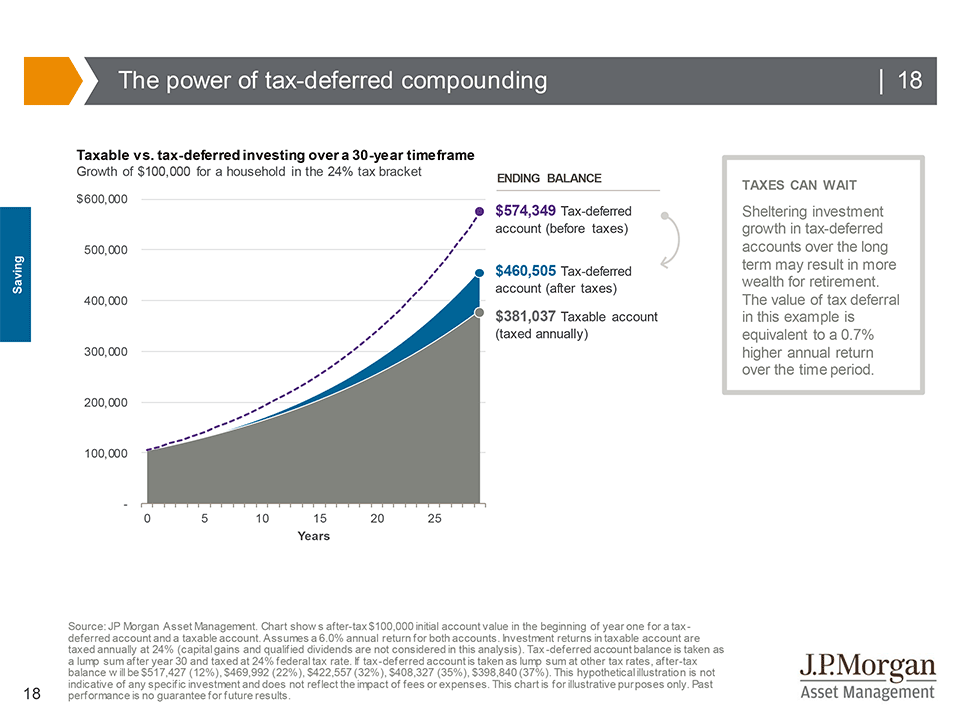
Deferring the tax on investment earnings, such as dividends, interest or capital gains, may help accumulate more after-tax wealth over time than earning the same return in a taxable account. This is known as tax-deferred compounding. This chart shows an initial $100,000 after-tax investment in either a taxable or tax-deferred account that earns a 6% return (assumed to be subject to ordinary income taxes). Assuming an income tax rate of 24%, the value of the tax-deferred account (net of taxes owed) after 30 years accumulates over $79,000 more than if the investment return had been taxed 24% each year. (6)

Sources:

  1. nerdwallet.com/article/ira-vs-401k-retirement-accounts
  2. irs.gov/retirement-plans/retirement-plans-faqs-regarding-required-minimum-distributions
  3. tinyurl.com/y77cjtfz
  4. finance.zacks.com/tax-penalty-moving-401k-ira-3585.html
  5. cnbc.com/2018/04/26/what-to-do-with-your-401k-when-you-change-jobs.html
  6. https://am.jpmorgan.com/us/en/asset-management/gim/protected/adv/insights/guide-to-retirement

This material was prepared by MarketingPro, Inc., and does not necessarily represent the views of the presenting party, nor their affiliates. This information has been derived from sources believed to be accurate. Please note – investing involves risk, and past performance is no guarantee of future results. The publisher is not engaged in rendering legal, accounting or other professional services. If assistance is needed, the reader is advised to engage the services of a competent professional. This information should not be construed as investment, tax or legal advice and may not be relied on for avoiding any Federal tax penalty. This is neither a solicitation nor recommendation to purchase or sell any investment or insurance product or service, and should not be relied upon as such. All indices are unmanaged and are not illustrative of any particular investment.

4 Important Questions You’ll Need to Answer Before Claiming Social Security

img_0546 2

Whether you want to leave work at 62, 67, or 70, claiming the retirement benefits you are entitled to by federal law is no casual decision. You will want to consider a few key factors first.

1. How long do you think you will live?

If you have a feeling you will live into your nineties, for example, it may be better to claim later. If you start receiving Social Security benefits at or after Full Retirement Age (which varies from age 66-67 for those born in 1943 or later), your monthly benefit will be larger than if you had claimed at 62. If you file for benefits at FRA or later, chances are you probably a) worked into your mid-sixties, b) are in fairly good health, c) have sizable retirement savings. (1)

If you sense you might not live into your eighties or you really need retirement income, then claiming at or close to 62 might make more sense. If you have an average lifespan, you will, theoretically, receive the average amount of lifetime benefits regardless of when you claim them; the choice comes down to more lifetime payments that are smaller or fewer lifetime payments that are larger. For the record, Social Security’s actuaries project the average 65-year-old man living 84.3 years and the average 65-year-old woman living 86.7 years. (2)

2. Will you keep working?

You might not want to work too much, for earning too much income can result in your Social Security being withheld or taxed.

Prior to Full Retirement Age, your benefits may be lessened if your income tops certain limits. In 2018, if you are 62-65 and receive Social Security, $1 of your benefits will be withheld for every $2 that you earn above $17,040. If you receive Social Security and turn 66 later this year, then $1 of your benefits will be withheld for every $3 that you earn above $45,360. (3)

Social Security income may also be taxed above the program’s “combined income” threshold. (“Combined income” = adjusted gross income + non-taxable interest + 50% of Social Security benefits.) Single filers who have combined incomes from $25,000-34,000 may have to pay federal income tax on up to 50% of their Social Security benefits, and that also applies to joint filers with combined incomes of $32,000-44,000. Single filers with combined incomes above $34,000 and joint filers whose combined incomes surpass $44,000 may have to pay federal income tax on up to 85% of their Social Security benefits. (3)

3. When does your spouse want to file?

Timing does matter, especially for two-income couples. If the lower-earning spouse collects Social Security benefits first, and then the higher-earning spouse collects them later, that may result in greater lifetime benefits for the household. (4)

4. How much in benefits might be coming your way?

Visit ssa.gov to find out, and keep in mind that Social Security calculates your monthly benefit using a formula based on your 35 highest-earning years. If you have worked for less than 35 years, Social Security fills in the “blank years” with zeros. If you have, say, just 33 years of work experience, working another couple of years might translate to slightly higher Social Security income. (1)

Your claiming decision may be one of the major financial decisions of your life. Your choices should be evaluated years in advance, with insight from the financial professional who has helped you plan for retirement.

jp-gtr-2018-10

▲ Maximizing Social Security benefits

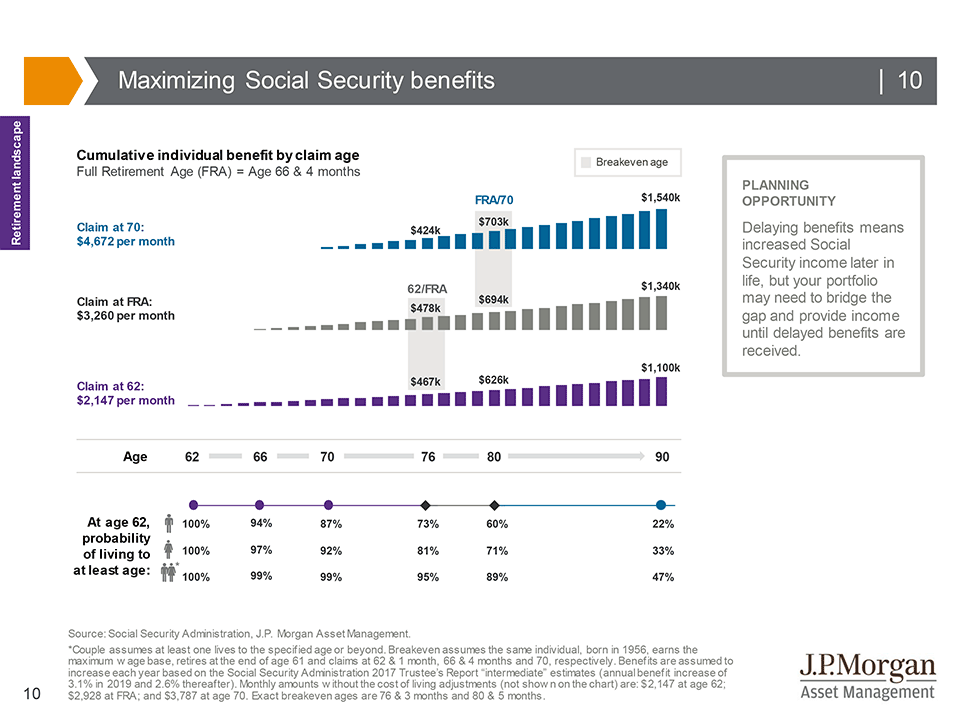
The age at which one claims Social Security greatly affects the amount of benefit received. Key claiming ages are 62, full retirement age (FRA is currently 66 and 4 months for today’s 62-year-olds) and 70, as shown in the row of ages in the middle of the slide. The top three graphs show the three most common ages an individual is likely to claim and the monthly benefit he or she would receive at those ages. Claiming at the latest age (70) provides the highest monthly amount but delays receipt of the benefit for 8 years. Claiming at Full Retirement Age, 66 and 4 months, or 62 years old provides lesser amounts at earlier ages. The grey shading between the bar charts represents the ages at which waiting until a later claim age results in greater cumulative benefits than the earlier age. This is called the breakeven age. The breakeven age between taking benefits at age 62 and FRA is age 76 and between FRA and 70 is 80. Not shown is the breakeven between 62 and 70, which is 79 (78 and 6 months). Along the bottom of the page, the percentages show the probability that a man, woman or one member of a married couple currently age 62 will reach the specified ages. Comparing these percentages against the breakeven ages will help a beneficiary make an informed decision about when to claim Social Security if maximizing the cumulative benefit received is a primary goal. Note that while the benefits shown are for a high-income earner who maxes out their Social Security taxes each year (income of $128,700 in 2018), the breakeven ages would hold true for those at other income levels.

Sources

  1. fool.com/investing/2018/07/07/4-frequently-asked-social-security-questions.aspx
  2. ssa.gov/planners/lifeexpectancy.html
  3. blackrock.com/investing/literature/investor-education/social-security-retirement-benefits-quick-reference-one-pager-va-us.pdf
  4. thebalance.com/social-security-for-married-couples-2389042
  5. https://am.jpmorgan.com/us/en/asset-management/gim/protected/adv/insights/guide-to-retirement

This material was prepared by MarketingPro, Inc., and does not necessarily represent the views of the presenting party, nor their affiliates. All information is believed to be from reliable sources; however we make no representation as to its completeness or accuracy. Please note – investing involves risk, and past performance is no guarantee of future results. The publisher is not engaged in rendering legal, accounting or other professional services. If assistance is needed, the reader is advised to engage the services of a competent professional. This information should not be construed as investment, tax or legal advice and may not be relied on for the purpose of avoiding any Federal tax penalty. This is neither a solicitation nor recommendation to purchase or sell any investment or insurance product or service, and should not be relied upon as such. All indices are unmanaged and are not illustrative of any particular investment.

How Annuities Can Help Provide a Retirement Income Floor

binoculars-2194228_1920

Here’s why many people choose annuities for for retirement income, and what prospective annuity holders should consider.

Imagine an income stream you cannot outlive.

That sums up the appeal of an annuity. If you are interested in steady retirement income (and the potential to defer taxes), you might want to look at the potential offered by annuities. Before making the leap, however, you must understand how they work.

Just what is an annuity?

It is an income contract you arrange with an insurance company. You provide a lump sum or continuing contributions to fund the contract; in return, the insurer agrees to pay you a specific amount of money in the future, usually per month. If you are skittish about stocks and searching for a low-risk alternative, annuities may appear very attractive. While there are different kinds of annuities available with myriad riders and options that can be attached, the basic annuity choices are easily explained. (2)

Annuities can be either immediate or deferred.

With an immediate annuity, payments to you begin shortly after the inception of the income contract. With a deferred annuity, you make regular contributions to the annuity, which accumulate on a tax-deferred basis for a set number of years (called the accumulation phase) before the payments to you begin. (1,2)

Annuities can be fixed or variable.

Fixed annuities pay out a fixed amount on a recurring basis. With variable annuities, the payment can vary: these investments do essentially have a toe in the stock market. The insurer places some of the money that you direct into the annuity into Wall Street investments, attempting to capture some of the upside of the market, while promising to preserve your capital. Some variable annuities come with a guaranteed income benefit option: a pledge from the insurer to provide at least a certain level of income to you. (1,3)

In addition, some annuities are indexed.

These annuities can be either fixed or variable; they track the performance of a stock index (often, the S&P 500), and receive a credit linked to its performance. For example, if the linked index gains 8% in a year, the indexed annuity may return 4%. Why is the return less than the actual index return? It is because the insurer usually makes you a trade-off: it promises contractually that you will get at least a minimum guaranteed return during the early years of the annuity contract. (3)

Annuities require a long-term commitment.

Insurance companies expect annuity contracts to last for decades; they have built their business models with this presumption in mind. So, if you change your mind and decide to cancel an annuity contract a few years after it begins, you may have to pay a surrender charge – in effect, a penalty. (Most insurance companies will let you withdraw 10-15% of the money in your annuity without penalty in an emergency.) Federal tax law also discourages you from withdrawing money from an annuity – if the withdrawal happens before you are 59½, you are looking at a 10% early withdrawal penalty just like the ones for traditional IRAs and workplace retirement accounts. (1,3)

Annuities can have all kinds of “bells and whistles.”

Some offer options to help you pay for long-term care. Some set the length of the annuity contract, with a provision that if you die before the contract ends, the balance remaining in your annuity will go to your estate. In fact, some annuities work like joint-and-survivor pensions: when an annuity owner dies, payments continue to his or her spouse. (Generally, the more guarantees, riders, and options you attach to an annuity, the lower your income payments may be.) (1)

Deferred annuities offer you the potential for great tax savings.

The younger you are when you arrange a deferred annuity contract, the greater the possible tax savings. A deferred annuity has the quality of a tax shelter: its earnings grow without being taxed, they are only taxable once you draw an income stream from the annuity. If you start directing money into a deferred annuity when you are relatively young, that money can potentially enjoy many years of tax-free compounding. Also, your contributions to an annuity may lower your taxable income for the year(s) in which you make them. While annuity income is regular taxable income, you may find yourself in a lower tax bracket in retirement than when you worked. (1)

Please note that annuities come with minimums and fees.

The fee to create an annuity contract is often high when compared to the fees for establishing investment accounts – sometimes as high as 5-6%. Annuities typically call for a minimum investment of at least $5,000; realistically, an immediate annuity demands a five- or six-figure initial investment. (3)

No investment is risk free, but an annuity does offer an intriguing investment choice for the risk averse. If you are seeking an income-producing investment that attempts to either limit or minimize risk, annuities may be worth considering.

JP-GTR-2018-48

▲Understanding annuities: Which annuity may be right for you?

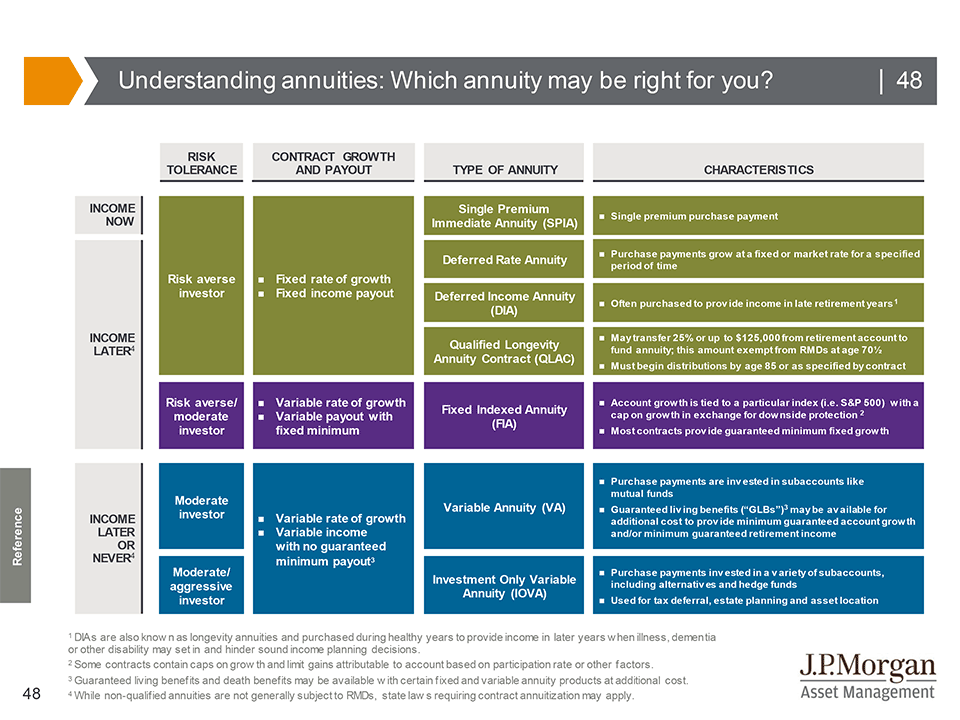
Annuities come in all shapes and sizes, which can often confuse investors. This chart helps to identify the type of annuity that aligns to specific income needs and tolerance for investment risk, and provides information about how the annuity growth and payout amounts are determined, as well as other key characteristics to know.

Sources

  1. investopedia.com/articles/retirement/05/063005.asp
  2. forbes.com/sites/forbesfinancecouncil/2018/01/04/annuities-explained-in-plain-english/#626afc215bd6
  3. apps.suzeorman.com/igsbase/igstemplate.cfm?SRC=MD012&SRCN=aoedetails&GnavID=20&SnavID=29&TnavID&AreasofExpertiseID=107
  4. https://am.jpmorgan.com/us/en/asset-management/gim/protected/adv/insights/guide-to-retirement

This material was prepared by MarketingPro, Inc., and does not necessarily represent the views of the presenting party, nor their affiliates. This information has been derived from sources believed to be accurate. Please note – investing involves risk, and past performance is no guarantee of future results. The publisher is not engaged in rendering legal, accounting or other professional services. If assistance is needed, the reader is advised to engage the services of a competent professional. This information should not be construed as investment, tax or legal advice and may not be relied on for the purpose of avoiding any Federal tax penalty. This is neither a solicitation nor recommendation to purchase or sell any investment or insurance product or service, and should not be relied upon as such. All indices are unmanaged and are not illustrative of any particular investment.