Uncategorized

7 Things to Put on Your Year-End Financial Checklist

The end of the year is a key time to review your financial “health” and well-being. To that end, here are seven aspects of your financial life to think about as this year leads into the next.

#1 | YOUR INVESTMENTS

Review your approach to investing and make sure it suits your objectives. Look over your portfolio positions and revisit your asset allocation.

#2 | YOUR RETIREMENT PLANNING STRATEGY 

Does it seem as practical as it did a few years ago? Are you able to max out contributions to IRAs and workplace retirement plans, like 401(k)s? Is it time to make catch-up contributions? Finally, consider Roth IRA conversion scenarios. If you are at the age when a Required Minimum Distribution (RMD) is required from your traditional IRA(s), be sure to take your RMD by December 31. If you don’t, the IRS will assess a penalty of 50% of the RMD amount on top of the taxes you will already pay on that income. (While you can postpone your very first IRA RMD until April 1, 2018, that forces you into taking two RMDs next year, both taxable events.)1


#3 | YOUR TAX SITUATION

How many potential credits and/or deductions can you and your accountant find before the year ends? Have your CPA craft a year-end projection including Alternative Minimum Tax (AMT). In years past, some business owners and executives didn’t really look into deductions and credits because they just assumed they would be hit by the AMT. The recent rise in the top marginal tax bracket (to 39.6%) made fewer high-earning executives and business owners subject to the AMT – their ordinary income tax liabilities grew. The top bracket looks as though it will remain at 39.6% for 2018 even if tax reforms pass. So, examine accelerated depreciation, R&D credits, the Work Opportunity Tax Credit, incentive stock options, and certain types of tax-advantaged investments.2

Review any sales of appreciated property and both realized and unrealized losses and gains. Look back at last year’s loss carry-forwards. If you’ve sold securities, gather up cost-basis information. Look for any transactions that could potentially enhance your circumstances.


#4 | YOUR CHARITABLE GIFTING GOALS

Plan charitable contributions or contributions to education accounts, and make any desired cash gifts to family members. The annual federal gift tax exclusion is $14,000 per individual for 2017, meaning you can gift as much as $14,000 to as many individuals as you like this year, tax-free. A married couple can gift up to $28,000, tax-free, to as many individuals as they like. (The limits rise to $15,000 and $30,000 in 2018.) The gifts do count against the lifetime estate tax exemption amount, which is $5.49 million per individual (and therefore, $10.98 million per married couple) in 2017.3,4

You could also gift appreciated securities to a charity. If you have owned them for more than a year, you can deduct 100% of their fair market value and legally avoid capital gains tax you would normally incur from selling them.5

Besides outright gifts, you can explore creating and funding trusts on behalf of your family. The end of the year is also a good time to review any trusts you have in place.

 #5 | YOUR LIFE INSURANCE COVERAGE

Are your policies and beneficiaries up-to-date? Review premium costs and beneficiaries, and think about whether your insurance needs have changed.


#6 | LIFE EVENTS

Did you happen to get married or divorced in 2017? Did you move or change jobs? Buy a home or business? Did you lose a family member or see a severe illness or ailment affect a loved one? Did you reach the point at which Mom or Dad needed assisted living? Was there a new addition to your family this year? Did you receive an inheritance or a gift? All of these circumstances can have a financial impact on your life as well as the way you invest and plan for retirement and wind down your career or business. They are worth discussing with the financial or tax professional you know and trust.


#7 | DID YOU REACH ANY OF THESE FINANCIALLY IMPORTANT AGES IN 2017? 

If so, act accordingly.

  • Did you turn 70½ this year? If so, you must now take Required Minimum Distributions (RMDs) from your IRA(s).
  • Did you turn 65 this year? If so, you are likely now eligible to apply for Medicare.
  • Did you turn 62 this year? If so, you can choose to apply for Social Security benefits.
  • Did you turn 59½ this year? If so, you may take IRA distributions without a 10% early withdrawal tax penalty.
  • Did you turn 55 this year? If so, you may be allowed to take distributions from your 401(k) account without penalty, provided you no longer work for that employer.
  • Did you turn 50 this year? If so, you can make “catch-up” contributions to IRAs (and certain qualified retirement plans).1,5

Sources:

  1. This material was prepared, in part, by MarketingPro, Inc.
  2. fool.com/retirement/2017/04/29/whats-my-required-minimum-distribution-for-2017.aspx [4/29/17]
  3. businessinsider.com/trump-gop-tax-reform-plan-bill-text-details-rate-2017-10 [11/2/17]
  4. irs.gov/Businesses/Small-Businesses-&-Self-Employed/Frequently-Asked-Questions-on-Gift-Taxes [10/23/17]
  5. turbotax.intuit.com/tax-tips/estates/the-gift-tax-made-simple/L5tGWVC8N [11/10/17]
  6. kiplinger.com/article/taxes/T055-C032-S014-4-year-end-tax-savings-tips-to-try-by-thanksgiving.html [10/17]
  7. merrilledge.com/article/ready-set-retire-8-deadlines-you-need-to-know [11/10/17]

Will You Be Prepared When the Market Cools Off?

Markets have cycles, and at some point, the major indices will descend.
We have seen a tremendous rally on Wall Street, nearly nine months long, with the S&P 500, Nasdaq Composite, and Dow Jones Industrial Average repeatedly settling at all-time peaks. Investors are delighted by what they have witnessed. Have they become irrationally exuberant?

The Major Indices Do Not Always Rise.

That obvious fact risks becoming “back of mind” these days. On June 15, the Nasdaq Composite was up 27.16% year-over-year and 12.67% in the past six months. The S&P 500 was up 17.23% in a year and 7.31% in six months. Performance like that can breed overconfidence in equities. (1,2)

The S&P last corrected at the beginning of 2016, and a market drop may seem like a remote possibility now. Then again, corrections usually arrive without much warning. You may want to ask yourself: “Am I prepared for one?”(3)

TIP #1:

Are You Mentally Prepared?

Corrections have been rare in recent years. There have only been four in this 8-year bull market. So, it is easy to forget how frequently they have occurred across Wall Street’s long history (they have normally happened about once a year).(3,4)

The next correction may shock investors who have been lulled into a false sense of security. You need not be among them. It will not be the end of the world or the markets. A correction, in a sense, is a reality check. It presents some good buying opportunities, and helps tame irrational exuberance. You could argue that corrections make the market healthier. In big-picture terms, the typical correction is brief. On average, the markets take 3-4 months to recover from a fall of at least 10%.(4)

TIP #2:

Are You Financially Prepared?

Some people have portfolios that are not very diverse, with large asset allocations in equities and much smaller asset allocations in more conservative investment vehicles and cash. These are the investors likely to take a hard hit when the big indices correct.

You can stand apart from their ranks by appropriately checking up on, and diversifying, your portfolio as needed. Thanks to the recent rally, many investors have seen their equity positions grow larger, perhaps too large. If you are one of them (and you may be), you may want to try to dial down your risk exposure.

TIP #3:

Do You Have an Adequate Emergency Fund?

A correction is not quite an emergency, but it is nice to have a strong cash position when the market turns sour.

TIP #4:

Are Your Retirement and Estate Plans Current?

A prolonged slump on Wall Street could impact both. Many older baby boomers had to rethink their retirement strategies in the wake of the 2007-09 bear market.

TIP #5:

Consistently Fund Your Retirement Accounts

Finally, a deep dip in the equity market should not stop you from consistently funding your retirement accounts. In a downturn, your account contributions, in essence, buy greater amounts of shares belonging to quality companies than they would otherwise.

A correction will happen – maybe not tomorrow, maybe not for the rest of 2017, but at some point, a retreat will take place. React to it with patience, or else you may end up selling low and buying high.

Sources.

  1. money.cnn.com/data/markets/nasdaq/ [6/15/17]
  2. money.cnn.com/data/markets/sandp/ [6/15/17]
  3. fortune.com/2017/03/09/stock-market-bull-market-longest/ [3/9/17]
  4. investopedia.com/terms/c/correction.asp [6/15/17]
  5. This material was prepared by MarketingPro, Inc., and does not necessarily represent the views of the presenting party, nor their affiliates. This information has been derived from sources believed to be accurate. Please note – investing involves risk, and past performance is no guarantee of future results. The publisher is not engaged in rendering legal, accounting or other professional services. If assistance is needed, the reader is advised to engage the services of a competent professional. This information should not be construed as investment, tax or legal advice and may not be relied on for the purpose of avoiding any Federal tax penalty. This is neither a solicitation nor recommendation to purchase or sell any investment or insurance product or service, and should not be relied upon as such. All indices are unmanaged and are not illustrative of any particular investment.

Market and Economic Update for the Second Quarter of 2017

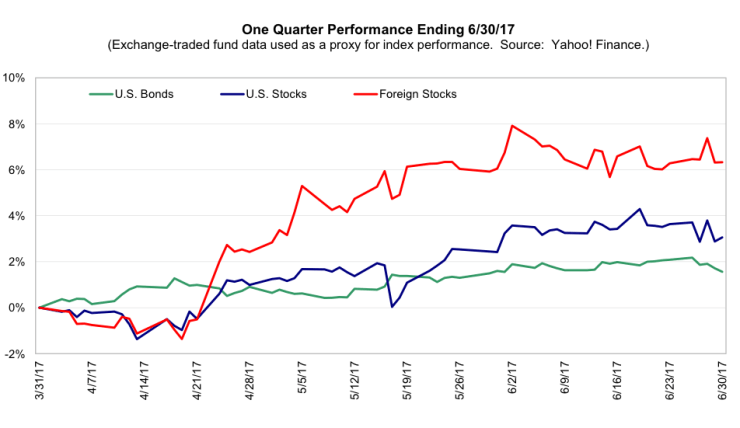
It has been an awfully good year in most of the capital markets so far. Just like a great summer day with blue skies and bright sunshine, most stock markets have happily been rising and the economy has been chugging along. Bonds of many types have been profitable. We open our account statements and we’re pleased with the progress.

2Q.2017.Chart

The Economy Has Been Looking Good

From an economic standpoint there has been much to be cheerful about. Corporate earnings in the first quarter came in above expectations and sharply higher than preceding quarters. Unemployment is very low and while we haven’t seen a dramatic uptick in wages we are seeing what looks close to full employment. GDP growth continues to show positive numbers even if the pace of growth is somewhat slower than we would like it to be. Good things haven’t been confined to our shores either; Europe’s economy, in spite of Brexit and some tough election cycles, has continued to firm, China continues to grow, even with concerns about banking and debt, India and other parts of Asia show steady progress, and South American economies continue to improve despite the political turmoil in Brazil and elsewhere.

No Signs of Recession Yet

There doesn’t seem to be any sign of recession on the horizon as yet; the Fed continues to be both transparent about and circumspect towards the execution of rate changes. Our government is promising lower taxes and less regulation, items that can cheer even the most gloomy business owner.

So What Could Possibly Go Wrong?

It’s important to remember (or perhaps re-remember) that markets don’t move in a straight line, not very often at any rate. We’ve had 16 periods of downward market movement since the bull began running back in early 2009! It is entirely possible that we are ready for another, and we think it a useful endeavor to remind ourselves of this every so often. Bear markets begin when markets or economies get pretty far out of alignment and while we don’t think we’re seeing any of that right now, the garden variety market correction can strike at any time.

Planning & Diversification

As always, our defense is two-fold, good planning and diversification. In regards to the former, we sure don’t want to get too excited about stock market gyrations that concern money we won’t be touching for a long time; we know we can’t really time the market and we also know that over the long-term stocks tend to give superior returns in spite of that very same volatility. We also know we don’t want to have to eat our “seed corn” and so shorter term money should be invested in other areas.

What Will The Second Half of 2017 Bring?

We of course don’t know if the second half of 2017 will be as productive as the first has been. As mentioned earlier, we don’t think we’re on the verge of a recessionary time and that bodes well for the economy over the short and intermediate term. US stocks appear a bit richer than average, but that has been the case for some time and that modest overvaluation has moderated a bit in light of the robust first quarter earnings.

We’re also cognizant of the fact that reasonable investment time horizons are often greater than many folks’ attention spans and this can create volatility once someone in the proverbial theater yells “fire”! Watching that sort of “running for the exits” is always disconcerting. It is the age old story: we tolerate shorter term volatility for longer term performance; it isn’t always fun but over time it works exceedingly well.


Source:

  1. Prepared by LSA Portfolio Analytics

JULY: 3 Things To Do This Month To Help Keep Your Financial Life On Track

Like maintaining a healthy lifestyle, maintaining a healthy financial life requires ongoing maintenance. It’s much easier to stay on track if you break the necessary tasks down into smaller more manageable tasks. So, here are three quick personal finance tips to help you stay on track this month:
TIP #1

Run a Retirement Plan Projection

Run a retirement plan projection so that you know where you are and what you need to do to get closer to your goals. You should do this once a year to see if you are heading in the right direction. For a quick calculation of what you need to be saving for retirement you can use this calculator at CNNMoney. If you need a more thorough calculation you should consider work with a CERTIFIED FINANCIAL PLANNER™ (CFP®). They’ll have access to more sophisticated software and will look at your entire financial life. If you are already working with a CERTIFIED FINANCIAL PLANNER™ (CFP®) you will want to revisit their projections at your annual review to account for changes in your finances.

TIP #2

Increase Your 401(k) Plan Contributions

For most people, setting a goal to max out your 401(k) or 403(b) plan contributions should be key. At minimum, shoot for at least contributing enough to get your company match. If you’re saving in a 401(k) or 403(b) and aren’t already on track to max it out, increase your contributions by 1%. Re-evaluate in 6 months and increase your contributions by another 1% until you ultimately max it out.

TIP #3

Review Your Investment Strategy

Has anything changed over the last 6 months that would cause you to have to make changes? Births? deaths? New goals? If so, review your plan or speak to your CERTIFIED FINANCIAL PLANNER™ (CFP®) to help you make smart choices.


Sources:

  1. http://www.learnvest.com/knowledge-center/your-january-2016-financial-to-dos/
  2. http://money.usnews.com/money/personal-finance/articles/2014/12/02/your-end-of-year-financial-checklist
  3. http://www.forbes.com/sites/learnvest/2013/01/04/your-financial-to-dos-for-every-month-in-2013/#14fe6d3d41d4

Market and Economic Update for The First Quarter of 2017

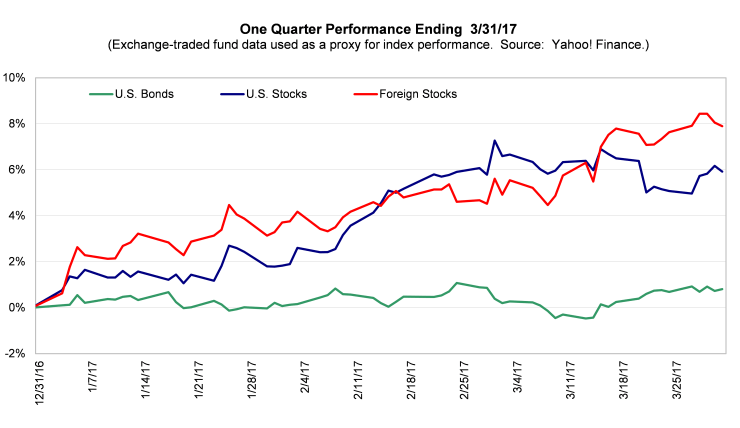
The year started with a bang as both US and international stock markets roared ahead in the first quarter. Bonds were much more muted as investors grappled with the potential upward nudging of rates by the Fed.
1Q.2017.graphic

The Markets & The Economy: A Look Back

As we pass the eighth anniversary of the turning of the markets and economy it is useful to look back and think about just how far we’ve come over that time. Things were looking pretty grim back in the spring of 2009 and almost all of us had been scarred in one way or another by the significant downturn in the economy that some call the Great Recession. On the business front some pretty big names had simply disappeared, tipped over into liquidation by that tumultuous series of events and families across the country were struggling to hold onto their jobs and their homes.

The Economy Today

Fast forward to today and things look a lot different. We have reached “full employment” and rather than a surplus of folks looking for work we now have many positions being unfilled. Businesses are healthy, the economy is chugging along and the stock market is breaking new records as corporate earnings move upwards and as investors increasingly feel comfortable with paying more for a dollar of earnings that they did a year or so ago.

Politics & The Market

It is an interesting time for certain. The change in the political landscape has been significant and markets and businesses have responded, seeing the potential for growth in the economy seemingly enhanced by the promise of lower taxes and less regulation. We’ve seen this most directly in the action of the stock market whose advance since the election has been robust but anecdotally we hear of businesses beginning to put capital to work and laying the plans for future expansion.

Future Assumptions

It’s important to remember that capital markets (stock, bond and other) look ahead and incorporate assumptions about what the world might look like 6 months or a year hence into the price movements of today. That market rise last quarter isn’t about what is so much as what will (or could) be. Should that vision of the future not turn out quite the way it might be expected to, then adjustments will be made in outlooks and be incorporated into the market levels of tomorrow.

Market Valuations

Over the long term, of course, stock prices are based on economic growth, the level of interest rates (as they set the bar for investment alternatives to stocks) and current market valuations, i.e. what investors are willing to pay for a dollar of current or future earnings. That last factor is a key one, and one that we employ regularly when looking at the relative attractiveness of the various components of our portfolios. Absolute valuations for the market as a whole (for instance “the market is too high”) are quite hard to make meaningful judgments about in the near and intermediate term as markets that are getting a bit pricey may continue to do so for some time and vice versa! We can however use relative valuations to see which segments of the market are starting to overheat or look very attractively priced and we review these data points on a continual basis as we think about constructive changes in our portfolios.

Looking Forward

Looking forward, markets will continue to be influenced by a number of economic factors. Corporate earnings are key of course and the direction of the economy is perhaps the major contributing factor to successful growing companies and to jobs and opportunities in communities throughout the country. So far so good on that score, we’re seeing continued economic growth coupled with low unemployment and the Conference Board’s leading economic indicators continue to point in the right direction.

Interest Rates

Interest rate increases, which folks expect more of this year, can have a moderating influence on markets in a number of ways but a measured pace of increases is not terribly worrisome as they reinforce the notion of strength in the broader economy. A significant difference over time in rates will also wiggle itself into the valuation equation however, which brings us back to, you guessed it, valuations!

What’s Next?

As we talked about earlier, trying to judge the valuation of the market as a whole is very difficult save perhaps in those times when valuations are near extremes of their range (think May of 2000 on the upper end and March of 2009 on the other end). Valuations have been creeping up over the last 8 years and we’re higher now than average certainly but perhaps not in the nosebleed territory as yet. These higher metrics could certainly provide, coupled with some other sort of economic uncertainty, an excuse though for the next market correction but that is just as it should be as market corrections do happen fairly frequently and their effects are naturally mitigated to some degree by our overall portfolio diversification.

In the meantime it’s spring, the days are longer and, thankfully, our televisions and computers have an “off” switch we can use to moderate the barrage of political and financial news that can be so unsettling at times. It’s the economy that will be the prime driver of the markets and the political parties have a lot less to do with that than one might be led to believe.


Source:

  1. Prepared by LSA Portfolio Analytics

How Much Can You Contribute to Your Retirement Plan in 2017?

A new year brings new opportunities to try and max out your retirement savings. Here’s a rundown of the 2017 contribution limits:

IRAs

For 2017 they remain the same as 2016: $5,500 for IRA owners who will be 49 and younger this year, $6,500 for IRA owners who will be 50 or older this year. These limits apply to both Roth and traditional IRAs. What if you own multiple IRAs? The total combined contributions cannot exceed the maximum allowed

401(k)s, 403(b)s, & 457s

Each of these workplace retirement plans have 2017 contribution limits of $18,000, $24,000 if you will be 50 or older this year. Now, If you are a participant in a 457 plan and within three years of what your employer deems “normal” retirement age, you can contribute up to $36,000 annually to your plan during the last three years preceding that “normal” retirement date.

2017.Contribution.Limits

High Earners

High earners may find their ability to make a full Roth IRA contribution restricted. This applies to a single filer or head of household whose modified adjusted gross income (MAGI) falls within the $118,000-133,000 range, and to married couples with a MAGI of $186,000-196,000. If your MAGI exceeds the high ends of those phase-out ranges, you may not make a 2017 Roth IRA contribution. (For tax year 2016, the respective phase-out ranges are $117,000-132,000 for single and $184,000-194,000 for married)

SIMPLE IRAs & SEP-IRAs

In 2017, the contribution limit for a SIMPLE IRA is $12,500; those who will be 50 or older this year may contribute up to $15,500. Federal law requires business owners to match these annual contributions to at least some degree; self-employed individuals can make both employee and employer contributions to a SIMPLE IRA. Both Business owners and the self-employed can contribute to SEP-IRAs. The annual contribution limit on a SEP-IRA is very high – in 2017, it is either $54,000 or 25% of your income, whichever is lower.


Sources

  1. This material was prepared, in part, by MarketingPro, Inc.
  2. fool.com/retirement/2017/01/17/roth-vs-traditional-ira-which-is-better.aspx
  3. money.usnews.com/money/retirement/iras/articles/2016-12-19/how-saving-in-an-ira-can-reduce-your-2016-tax-bill
  4. forbes.com/sites/ashleaebeling/2016/10/27/irs-announces-2017-retirement-plans-contributions-limits-for-401ks-and-more/ 
  5. fool.com/retirement/2016/12/19/457-plan-contribution-limits-in-2017.aspx 
  6. money.cnn.com/2017/01/13/retirement/ira-myths/

Smart Strategies for Sticking With Your Financial Resolutions This Year

Have you already forgotten about your New Year’s resolutions? Like many of us, we start the new year with good intentions. The question is, how do we keep our New Year’s resolutions from faltering? Often, our New Year’s resolutions fail because there is only an end in mind – a clear goal, but no concrete steps toward realizing it. Mapping out the incremental steps can make the goal seem more achievable.

Here are my 6 tips for making and keeping your financial resolutions this year:

TIP# 1
MAXIMIZE YOUR PLAN CONTRIBUTIONS

Contribution limits are set by the federal government each year so be sure to find out what the limits are for your retirement plan. If you will be 50 or older you’ll be able to make an additional catch-up contribution. Here’s a link to our key financial data report for 2017 which includes the dollar amounts for contribution limits: 2017 Key Financial Data.

TIP #2
SET UP AUTOMATIC CONTRIBUTIONS

There are two excellent reasons for doing this. One, time is on your side – in fact, time may be the greatest ally you have when it comes to succeeding as a retirement saver and an investor. An early start means more years of compounding for your invested assets. It also gives you more time to recover from a market downturn. Two, scheduling regular account contributions makes saving for retirement a given in your life.

TIP #3
REVIEW & REDUCE YOUR DEBT

Look at your debts, one by one. You may be able to renegotiate the terms of loans and interest rates with lenders and credit card firms. See if you can cut down the number of debts you have – either attack the one with the highest interest rate first or the smallest balance first, then repeat with the remaining debts.

TIP #4
REBALANCE YOUR PORTFOLIO

Many investors go years without rebalancing, which can be problematic. Rebalancing is crucial for the smart investor.

TIP #5
SOLIDIFY SOME RETIREMENT VARIABLES

Accumulating assets for retirement is great;  doing so with a planned retirement age and an estimated retirement budget is even better. The older you get, the less hazy those variables start to become. See if you can define the “when” of retirement this year – that may make the “how” and “how much” clearer as well.

TIP #6
SOLIDIFY YOUR COLLEGE PLANNING

If your child has now reached his or her teens, see if you can get a ballpark figure on the cost of attending local and out-of-state colleges. Even better, inquire about their financial aid packages and any relevant scholarships and grants. If you have college savings built up, you can work with those numbers and determine how those savings need to grow in the next few years.

Good luck with your financial resolutions. If you need help feel free to reach out, or download a copy of my free eBook, The Pre-Retirement Toolkit.


Sources:

  1. This material was prepared in part by MarketingPro, Inc.

5 Smart Money Moves to Make When You Are in Your 50’s

So you are in your 50’s? Here are the smart financial moves you should be making right now:

RETIREMENT RED ZONE

At this point in your financial life you’re in what I would call the Retirement Red Zone. You are getting close, but you’re not quite there yet and you still have some important work to do.

SMART MOVE #1

PICK A DATE

TIP: Start Thinking About an Approximate Retirement Date

Will you work 5 more years? 10 years? 20? You need to have a rough idea of when you may stop working so you can plan accordingly. The longer you work the less you’ll need in retirement savings and vice versa.

SMART MOVE #2

RAMP UP SAVINGS

TIP: Take Advantage of Catch-Up Contributions

Ramp up your savings if you can and take advantage of catch-up contributions. For the current catch-up contribution allowances click here.

A Catch-Up Contribution is a type of retirement savings contribution that allows people over 50 to make additional contributions to their 401(k) and/or individual retirement accounts.

SMART MOVE #3

REDUCE DEBT

TIP: Retiring With Major Debt Isn’t Good for Your Financial Health

Aim to reduce your debt as much as possible by the time you retire. Retiring with major debts won’t be good for your retirement and can prove to be extremely stressful for both you and your spouse.

SMART MOVE #4

CONSIDER LONG TERM CARE INSURANCE

LTC = Long Term Care Insurance

Long Term Care Insurance is coverage that provides nursing-home care, home-health care, personal or adult day care for individuals above the age of 65 or with a chronic or disabling condition that needs constant supervision.

LTC is a smart move for most of us, but can be too costly for many to purchase. If you have the means to purchase it, now is the time to do it.

If you buy a policy in your 40’s you risk paying too much over the life of the policy. On the flip side if you wait until 60’s or later the premiums skyrocket and you may not even get the coverage. So, your 50’s is the sweet spot to make that purchase.

SMART MOVE #5

UPDATE YOUR WILL

Nearly ½ of All Americans Over 50 Don’t Have a Will!

According to AARP nearly half of all americans over age 50 don’t have a basic will, so make sure you have one.

For more info on the importance of having a will watch this video:


Sources

  1. This material was prepared, in part, by MarketingPro, Inc.
  2. http://www.investopedia.com/

3 Smart Financial Tasks to Start Off The New Year Right

Here are 3 things to do in January to help keep your financial life on track this year:

TASK #1

Set Up Your Budget

Set up your budget for the new year. Review your spending habits from the previous year and create a saving and spending plan for the current year. You can use online tools to help with this. I use http://bit.ly/FirstStepCashManagement when working with clients but you also check out http://www.YouNeedABudget.com or http://www.Mint.com

TASK #2

Get A Credit Report

Get a copy of your credit report. You should be checking this three times throughout the year. You are entitled to one free report every year from all three agencies Experian, Transunion, Equifax. So, spread out your requests over the year. Pick one agency to obtain report from now. You want to look for anything that doesn’t seem right on the report and take action if you need to. Go to http://www.annualcreditreport.com

TASK #3

Review Retirement Plan Contributions

If you aren’t already maxing out your retirement plan contributions consider increasing the amount you contribute by 1% this month. Since you’ll be looking at your budget this month make sure you work savings into your plan. Keep increasing your contribution by 1% every 6 months until you’ve at least reached the 10% mark.


Sources:

  1. http://www.learnvest.com/knowledge-center/your-january-2016-financial-to-dos/
  2. http://money.usnews.com/money/personal-finance/articles/2014/12/02/your-end-of-year-financial-checklist
  3. http://www.forbes.com/sites/learnvest/2013/01/04/your-financial-to-dos-for-every-month-in-2013/#14fe6d3d41d4

3 Things To-Do in December to Keep Your Financial Life On Track

Here are 3 great year end tasks you should seriously considering doing this month:

TIP #1

Review Your Accounts

The end of the year is a great time to take a look at all your investment accounts to determine if you need to rebalance in the new year. Over time your portfolio can deviate from your intended allocation due to market fluctuations. If you are working with and advisor they will most likely be doing this for you.

TIP #2

Tax-Loss Harvest

Determine if you should do any tax-loss harvesting. What’s that? Tax-loss harvesting is the practice of selling a security that has experienced a loss. By realizing, or “harvesting” a loss, investors are able to offset taxes on both gains and income. In your taxable accounts, if you sold any capital assets for a gain this year, now may be a good time to sell off some of your investment dogs so that you can offset those gains with losses. If you are working with an advisor they can help with this. TIP: Your accountant can help you determine if you should take any capital gains or losses

TIP #3

Reflect on the Year

Take this month to reflect on your financial life this year. What went right and what went wrong? Make note of the good things and try to keep that going. For the things that didn’t work out see if there is any room for improvement next year.


Sources:

  1. http://www.learnvest.com/knowledge-center/your-january-2016-financial-to-dos/
  2. http://money.usnews.com/money/personal-finance/articles/2014/12/02/your-end-of-year-financial-checklist
  3. http://www.forbes.com/sites/learnvest/2013/01/04/your-financial-to-dos-for-every-month-in-2013/#14fe6d3d41d4