Retirement Planning

What This Blog Is About – and How It Can Help You Think More Clearly About Retirement

This is a personal blog about retirement planning, investing, and the decisions that come with life’s transitions. I write to help pre-retirees and retirees think more clearly about their financial choices and feel more confident about where they’re headed.

2022 Contribution Limits: Is it Time to Contribute More?

Photo by Suzy Hazelwood on Pexels.com

Preparing for retirement just got a little more financial wiggle room. The Internal Revenue Service (IRS) announced new contribution limits for 2022.

401(k) & 403(b)

For workplace retirement accounts (i.e. 401(k), 403(b), amongst others), the contribution limit rises $1,000 to $20,500. Catch-up contributions remain at $6,500. (1)

Traditional IRA

Staying put for 2022 are traditional Individual Retirement Accounts (IRAs), with the limit remaining at $6,000. The catch-up contribution for traditional IRAs remains $1,000 as well. (1)

Roth IRA

Eligibility for Roth IRA contributions has increased, as well. These have bumped up to $129,000 to $144,000 for single filers and heads of households, and $204,000 to $214,000 for those filing jointly as married couples. (1)

SIMPLE IRA

Another increase was for SIMPLE IRA Plans (SIMPLE is an acronym for Savings Incentive Match Plan for Employees), which increases from $13,500 to $14,000. (1)

If these increases apply to your retirement strategy, a financial professional may be able to help make some adjustments to your contributions.

Contribution Limits (3,4)20222021Change
401(k) & 403(b) maximum employee elective deferral$20,500$19,500+$1,000
401(k)s 403(b), etc. employee catch-up contribution
(if age 50 or older by year-end)*
$6,500$6,500None
Traditional IRA & Roth IRA$6,000$6,000None
Traditional IRA & Roth IRA catch-up contributions
(if age 50 or older by year-end)*
$1.000$1,000None
SIMPLE IRA$14,000$13,500+$500

RMDs Explained

Once you reach age 72, you must begin taking required minimum distributions from a Traditional Individual Retirement Account (IRA) or Savings Incentive Match Plan for Employees IRA in most circumstances. Withdrawals from Traditional IRAs are taxed as ordinary income and, if taken before age 59½, may be subject to a 10% federal income tax penalty.

Once you reach age 72, you must begin taking required minimum distributions from your 401(k), 403(b), or other defined-contribution plans in most circumstances. Withdrawals from your 401(k) or other defined-contribution plans are taxed as ordinary income and, if taken before age 59½, may be subject to a 10% federal income tax penalty.

5-Year Holding Period for Roth IRAs

To qualify for the tax-free and penalty-free withdrawal of earnings, Roth IRA distributions must meet a five-year holding requirement and occur after age 59½. Tax-free and penalty-free withdrawal can also be taken under certain other circumstances, such as the owner’s death. The original Roth IRA owner is not required to take minimum annual withdrawals.

Sources

  1. CNBC.com, November 5, 2021
  2. https://www.investopedia.com/retirement/401k-contribution-limits/
  3. https://www.irs.gov/pub/irs-drop/n-21-61.pdf
  4. https://www.irs.gov/retirement-plans/401k-plans-deferrals-and-matching-when-compensation-exceeds-the-annual-limit

This material was prepared by MarketingPro, Inc., and does not necessarily represent the views of the presenting party, nor their affiliates. This information has been derived from sources believed to be accurate. Please note – investing involves risk, and past performance is no guarantee of future results. The publisher is not engaged in rendering legal, accounting or other professional services. If assistance is needed, the reader is advised to engage the services of a competent professional. This information should not be construed as investment, tax or legal advice and may not be relied on for the purpose of avoiding any Federal tax penalty. This is neither a solicitation nor recommendation to purchase or sell any investment or insurance product or service, and should not be relied upon as such. All indices are unmanaged and are not illustrative of any particular investment.

Required Minimum Distribution (RMD) Rules: 4 Key Things Every Retiree Should Know

Photo by Kampus Production on Pexels.com

Most people worry about not having enough money for retirement. But did you also know that there is such a thing as having too much money? Too much money may not necessarily be a bad thing, but you do need to worry about required minimum distributions (RMDs). Here’s what you need to know about RMDs.

RMDs Depend on Your Age

The main point of RMDs is to keep money from staying tax-free forever. The government gave a temporary tax break to encourage you to save for retirement, but it still wants that tax money. A required minimum distribution is a required withdrawal from your retirement account. It counts in your taxable income just like any other withdrawal in retirement.

Currently, RMDs start when you hit age 72 (or 70½ if you turned 70½ prior to January 1, 2020) and they are calculated to empty your retirement account within your expected life expectancy. (1) Each year, you need to withdraw a certain percentage of your account with the percentage going up as you age. However, it’s important to realize that you do not have to spend all of this money. You can also reinvest it into a taxable account.

Not Taking the RMD Can Mean Big Penalties

Thinking about skipping RMDs to avoid taxes? Think again. Not only do you still have to pay the taxes on the RMD amount, but you’ll also owe a 50 percent penalty.

For example, if you were supposed to withdraw $10,000 but didn’t, the IRS will charge you an extra $5,000. The penalty repeats every year until you catch up on your RMDs from previous years.

RMDs Can Throw a Wrench in Your Tax Planning

There are many reasons why you might want to reduce your taxable income in retirement. These can include qualifying for things like Medicaid subsidies, avoiding taxes on your Social Security benefits, trying to stay in a lower capital gains tax bracket, or just wanting to pay fewer taxes.

Required minimum distributions can throw a major wrench in your tax planning because not only are they not avoidable, they can suddenly increase if the market surges. If you’re using a tax strategy that requires reducing your income to a certain level, it’s important to build in flexibility for your RMDs.

RMDs Can Be Avoided

There are still ways to reduce or even avoid RMDs altogether. The main idea is to get the money out of your retirement account when you want to not when the IRS wants you to.

One method is to make extra withdrawals at the end of the year. In December, you can estimate your taxes for the year. If you still have room in a lower tax bracket or below the income you need to stay under, you can withdraw additional money. When next year’s RMDs are calculated, it will be on a lower account balance.

You can also convert to a Roth IRA instead of taxing the money out of a tax-advantaged account. Roth IRAs don’t have RMDs because the money has already been taxed. When you make the conversion, you pay ordinary income tax rates on the amount you converted. There are no penalties even if you do the conversion before you turn 59 1/2.

▼ Download

Sources

  1. https://www.irs.gov/retirement-plans/plan-participant-employee/retirement-topics-required-minimum-distributions-rmds

This content is developed from sources believed to be providing accurate information, and provided by Twenty Over Ten. It may not be used for the purpose of avoiding any federal tax penalties. Please consult legal or tax professionals for specific information regarding your individual situation. The opinions expressed and material provided are for general information, and should not be considered a solicitation for the purchase or sale of any security.

What to Be Thinking About In Preparation for Retirement

Photo by Sora Shimazaki on Pexels.com

How do you picture your future?

If you are like many contemplating retirement, your view is likely pragmatic compared to that of your parents. That doesn’t mean you must have a “plain vanilla” tomorrow. Even if your retirement savings are not as great as you would prefer, you still have great potential to design the life you want.

With that in mind, here are some things to think about.

What do you absolutely need to accomplish?

If you could only get four or five things done in retirement, what would they be? Answering this question might lead you to compile a “short list” of life goals, and while they may have nothing to do with money, the financial decisions you make may be integral to achieving them.

What would revitalize you?

Some people retire with no particular goals at all, and others retire burnt out. After weeks or months of respite, ambition inevitably returns. They start to think about what pursuits or adventures they could embark on to make these years special. Others have known for decades what dreams they will follow … and yet, when the time to follow them arrives, those dreams may unfold differently than anticipated and may even be supplanted by new ones.

In retirement, time is really your most valuable asset. With more free time and opportunity for reflection, you might find your old dreams giving way to new ones. You may find yourself called to volunteer as never before or motivated to work again in a new context.

Who should you share your time with?

Here is another profound choice you get to make in retirement. The quick answer to this question for many retirees would be “family.” Today, we have nuclear families, blended families, extended families; some people think of their friends or their employees as family. You may define it as you wish and allocate more or less of your time to your family as you wish (some people do want less family time when they retire).

Regardless of how you define “family” or whether or not you want more “family time” in retirement, you probably don’t want to spend your time around “dream stealers.” They do exist. If you have a grand dream in mind for retirement, you may meet people who try to thwart it and urge you not to pursue it. (Hopefully, they are not in close proximity to you.) Reducing their psychological impact on your retirement may increase your happiness.

How much will you spend?

We can’t control all retirement expenses, but we can control some of them. The thought of downsizing may have crossed your mind. While only about 10% of people older than 60 sell homes and move following retirement, it can potentially lead to more manageable mortgage payments. You could also lose one or more cars (and the insurance that goes with them) and live in a neighborhood with extensive, efficient public transit. Ditching landlines and premium cable TV (or maybe all cable TV) can bring more savings. Garage sales and donations can have financial benefits as well as helping you get rid of clutter, with either cash or a federal tax deduction.1

This article is for informational purposes only and is not a replacement for real-life advice, so make sure to consult your tax, legal, and accounting professionals before modifying your overall tax strategy.

Could you leave a legacy?

Many of us would like to give our kids or grandkids a good start in life, but given some of the economic realities of today, leaving an inheritance can be trickier than many realize.

Consider a couple with, for example, $285,000 in retirement savings. If that couple follows the 4% rule, the old maxim that you should withdraw about 4% of your retirement savings per year, subsequently adjusted for inflation – then you are talking about $11,400 withdrawn to start. When you combine that $11,400 with Social Security and other potential investment income, that couple isn’t exactly rich. Sustaining and enhancing income becomes the priority, and legacy preparations may have to take a backseat. On the other hand, a recent survey showed that 92% of all respondents believe it is important to leave money and other assets to their children.2

How are you preparing for retirement?

This is the most important question of all. If you feel you need to prepare more for the future or reexamine your existing strategy in light of recent changes in your life, conferring with a financial professional experienced in retirement approaches may be a smart move.

Changes in lifestyle

As households transition into retirement, time that had been spent working now is available for other pursuits. Individuals often enter retirement having spent too little time determining how they plan to spend this time – and run the risk of spending valuable time and money pursuing activities that may not prove to be as fulfilling as they had anticipated. For those who continue to work, they work fewer hours per day. Watching more television is a concerning trend. While a slightly higher percentage of people volunteer at older ages, it is important to note that the time spent volunteering remains about the same.

Sources

  1. IRS.gov, March 14, 2019
  2. Bankofamerica.com, Spring 2019
  3. https://am.jpmorgan.com/us/en/asset-management/protected/adv/insights/retirement-insights/guide-to-retirement/#

This material was prepared by MarketingLibrary.Net Inc., and does not necessarily represent the views of the presenting party, nor their affiliates. All information is believed to be from reliable sources; however we make no representation as to its completeness or accuracy. Please note – investing involves risk, and past performance is no guarantee of future results. The publisher is not engaged in rendering legal, accounting or other professional services. If assistance is needed, the reader is advised to engage the services of a competent professional. This information should not be construed as investment, tax or legal advice and may not be relied on for the purpose of avoiding any Federal tax penalty. This is neither a solicitation nor recommendation to purchase or sell any investment or insurance product or service, and should not be relied upon as such. All indices are unmanaged and are not illustrative of any particular investment.

Retirement Questions to Consider That Have Nothing to Do With Money

Image by RitaE from Pixabay

Retirement Planning is Not Entirely Financial

Your degree of happiness in your “second act” may depend on some factors that don’t come with an obvious price tag. Here are some non-monetary factors to consider as you plan your retirement.

What Will You Do With Your Time?

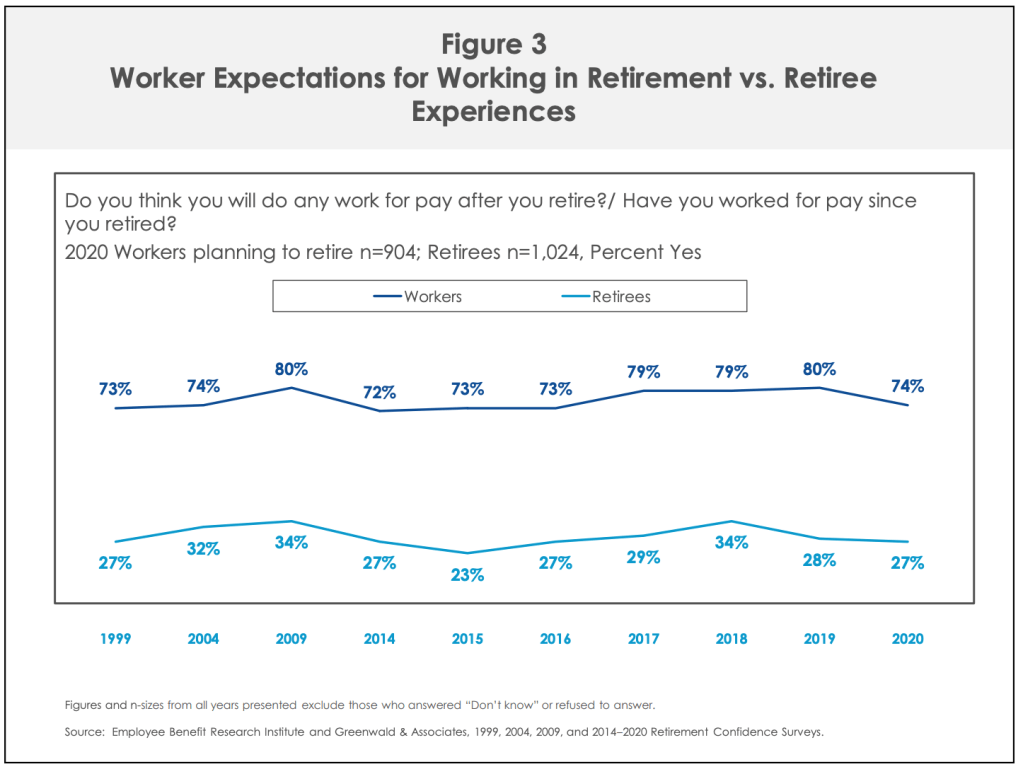
Too many people retire without any idea of what their retirement will look like. They leave work, and they cannot figure out what to do with themselves, so they grow restless. It’s important to identify what you want your retirement to look like and what you see yourself doing. Maybe you love your career, and can’t imagine not working during your retirement. There’s no hard and fast rule to your dream retirement, so it’s important to be honest with yourself. An EBRI retirement confidence survey shows that almost 74% of retirees plan to work for pay, whereas just 27% of retirees report that they’ve actually worked for pay. (1)

While this concept doesn’t have a monetary value, having a clear vision for your retirement may help you align your financial goals. It’s important to remember that your vision for retirement may change—like deciding you don’t want to continue working after all.

Where Will You Live?

This is another factor in retirement happiness. If you can surround yourself with family members and friends whose company you enjoy, in a community where you can maintain old friendships and meet new people with similar interests or life experience, that is a definite plus. If all this can occur in a walkable community with good mass transit and senior services, all the better. Moving away from the life you know to a spread-out, car-dependent suburb where anonymity seems more prevalent than community may not be the best decision for you.

How Are You Preparing to Get Around in Your Eighties and Nineties?

The actuaries at Social Security project that the average life expectancy for men is 84 years old, and the life expectancy for women is 86.5 years. Some will live longer. Say you find yourself in that group. What kind of car would you want to drive at 85 or 90? At what age would you cease driving? Lastly, if you do stop driving, who would you count on to help you go where you want to go and get out in the world? (2)

How Will You Keep Up Your Home?

At 45, you can tackle that bathroom remodel or backyard upgrade yourself. At 75, you will probably outsource projects of that sort, whether or not you stay in your current home. You may want to move out of a single-family home and into a townhome or condo for retirement. Regardless of the size of your retirement residence, you will probably need to fund minor or major repairs, and you may need to find reliable and affordable sources for gardening or landscaping.

These are the non-financial retirement questions that no pre-retiree should dismiss. Think about them as you prepare and invest for the future.

▲Working for Pay in Retirement

“Nearly 3 in 4 workers (74 percent) plan to work for pay in retirement, compared with just 27 percent of retirees who report they have actually worked for pay in retirement. In fact, the RCS has consistently found that workers are far more likely to plan to work for pay in retirement than retirees are to have actually worked (Figure 3). In the 2019 RCS, among retirees who worked for pay in retirement reported why they worked for pay in retirement and almost all gave a positive reason for doing so, saying they continued to work because they wanted to stay active and involved (91 percent), they enjoyed working (89 percent), or a job opportunity came along (58 percent). a Retirees could have retired for more than one reason. However, they reported that financial reasons also played a role in that decision, such as wanting money to buy extras (75 percent), needing money to make ends meet (37 percent), a decrease in the value of their savings or investments (28 percent), or keeping health insurance or other benefits (16 percent). *Retirees could have worked for pay in retirement for more than one reason.” (1)

Sources

  1. EBRI/Greenwald Retirement Confidence Survey, 2020
  2. SSA.gov

This material was prepared by MarketingPro, Inc., and does not necessarily represent the views of the presenting party, nor their affiliates. This information has been derived from sources believed to be accurate. Please note – investing involves risk, and past performance is no guarantee of future results. The publisher is not engaged in rendering legal, accounting or other professional services. If assistance is needed, the reader is advised to engage the services of a competent professional. This information should not be construed as investment, tax or legal advice and may not be relied on for the purpose of avoiding any Federal tax penalty. This is neither a solicitation nor recommendation to purchase or sell any investment or insurance product or service, and should not be relied upon as such. All indices are unmanaged and are not illustrative of any particular investment.

How Much Do You Really Know About Extended Care? Fact vs. Myth

Photo by Andrea Piacquadio on Pexels.com

How much does eldercare cost, and how do you arrange it when it is needed? The average person might have difficulty answering those two questions, for the answers are not widely known. For clarification, here are some facts to dispel some myths.

True or False:
Medicare will pay for your mom or dad’s nursing home care.

FALSE. Medicare is not extended care insurance. (1)

Medicare Part A will pay the bill for up to 20 days of skilled nursing facility (SNF) care, but after that, you or your parents may have to cover some costs out-of-pocket. After 100 days in a SNF, you will have to cover all costs out of pocket. The only way to “reset the clock” for Medicare coverage of these services is if the patient can somehow go without skilled nursing care for 30 or 60 days or if they require a hospital stay of three full days or longer.

True or False:
A semi-private room in a skilled nursing facility costs about $35,000 a year.

FALSE. The median cost of a semi-private room is now $89,297. A private room in an assisted living facility has a median annual cost of $100,375 annually. A home health aide could run you up to $4,385 per month for full-time care. Even if you just need someone to help mom or dad with activities of daily living (ADLs), such as eating, bathing, or getting dressed, the median hourly expense is not cheap: non-medical home aides run about $23 per hour, which at 10 hours a week, means nearly $12,000 a year. (2,3)

True or False:
Only around 40% of Americans aged 65 and older are expected to need extended care.

FALSE. Someone turning 65 today has a 70% chance of needing extended care. That means that by 2030, it’s estimated that around 24 million Americans will need extended care. This is double the current number already receiving care. (4,5)

True or False:
The earlier you buy extended care insurance, the more manageable the premiums.

TRUE. Younger policyholders may pay lower premiums.

The best time to consider extended care insurance is when you are healthy. While you may be paying a premium for a longer amount of time, the expense may pale in comparison to paying for unexpected medical costs out of pocket. (6)

True or False:
Medicaid can pay nursing home costs.

TRUE. The question is, do you really want that to happen? While Medicaid rules vary by state, in most instances, a person may only qualify for Medicaid if they have no more than $2,000 in “countable” assets ($3,000 for a couple). A homeowner can even be disqualified from Medicaid for having too much home equity. A primary residence, a primary motor vehicle, personal property, and household items, burial funds of less than $1,500, and tiny life insurance policies (with face values of less than $1,500) are not countable. So, yes, under these economic circumstances, Medicaid may end up paying extended care expenses. (7)

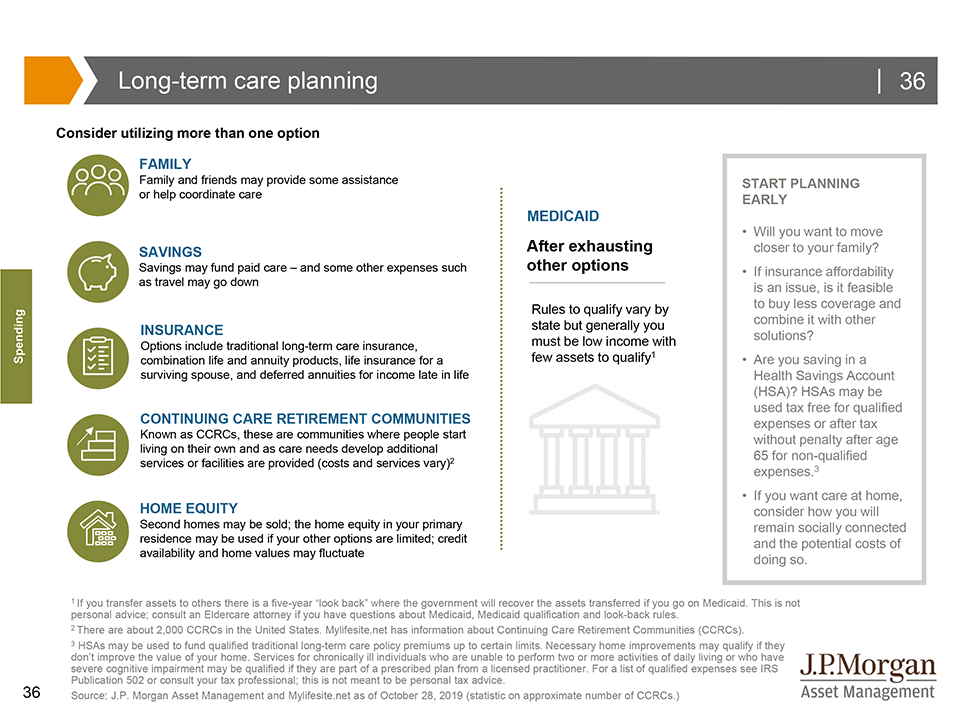
▲Long-term care planning solutions

When planning for long-term care, consider multiple solutions that may be utilized including family assistance, income, savings, home equity, life insurance for a surviving spouse, and other insurance options that range from traditional long-term care insurance to combination products to annuities. Continuing Care Retirement Communities (CCRCs) are also a possibility for those who can afford them. Types of CCRCs vary – see MyLifeSite.net for more information. Medicaid may be a last resort; and if Medicaid is utilized, you may have less control of type of care and care setting. For specifics regarding Medicaid qualification in your area, consult with an eldercare attorney.

Sources

  1. Medicare.gov, March 26, 2020
  2. SeniorLiving.org, June 24, 2020
  3. APlaceForMom.com, May 11, 2020
  4. AmericanActionForum.org, February 18, 2020
  5. LongTermCare.gov, July 23, 2020
  6. Forbes.com, April 17, 2020
  7. LongTermCare.ACL.gov, July 23, 2020
  8. https://am.jpmorgan.com/us/en/asset-management/gim/protected/adv/insights/guide-to-retirement

This material was prepared by MarketingPro, Inc., and does not necessarily represent the views of the presenting party, nor their affiliates. This information has been derived from sources believed to be accurate. Please note – investing involves risk, and past performance is no guarantee of future results. The publisher is not engaged in rendering legal, accounting or other professional services. If assistance is needed, the reader is advised to engage the services of a competent professional. This information should not be construed as investment, tax or legal advice and may not be relied on for the purpose of avoiding any Federal tax penalty. This is neither a solicitation nor recommendation to purchase or sell any investment or insurance product or service, and should not be relied upon as such. All indices are unmanaged and are not illustrative of any particular investment.

How Much Money Will You Need for Retirement?

Image by dietcheese from Pixabay

It depends on your goals, time horizon, and risk tolerance.

“Will I Outlive My Retirement Money?”

That’s one of the top fears for people who are starting to prepare for their retirement years.

So I have to chuckle a bit when I see headlines that say, “Here’s how much money Americans think they need to retire comfortably.” (1)

$1.9 million is the number, according to a nationwide survey of 1,000 employed 401(k) participants by a well-known financial services company. In 2019, the same survey reported the number was $1.7 million. But this year’s pandemic increased the total by $200,000.2

Is $1.9 million a realistic figure for retirement? It’s hard to say. The survey didn’t ask participants how they arrived at that figure or what information they used to draw that conclusion.

Determining How Much Money You Need in Retirement is a Process.

It shouldn’t be a number that you pull out of thin air.

The process should include looking at your current financial situation and developing an approach based on your goals, time horizon, and risk tolerance. The process should take into consideration all your potential sources of retirement income, and also may project what your income would look like each year in retirement.

A significant figure like $1.9 million does little good if you’re uncertain what it means for your retirement years. It’s a good idea to develop a retirement strategy combined with investment ideas designed to help you pursue the retirement you envision.

▲Retirement Saving Checkpoints

Achieving a financially successful retirement requires consistent savings, disciplined investing and a plan, yet too few Americans have calculated what it will take to be able to retire at their current lifestyle. This chart (for household incomes of $100,000 or more) helps investors to quickly gauge whether they are “on track” to afford their current lifestyle for 30 years in retirement based on their current age and annual household income. This analysis uses an appropriate income replacement rate (detailed on slide 15), an estimate of how much Social Security is likely to cover and the rate of return and inflation rate assumptions detailed on the right to determine the amount of investable wealth needed today, assuming a 10% gross annual savings rate until retirement. It is important to note that this analysis assumes a household with a primary earner who plans to retire at age 65 when the spouse is assumed to be 62. If an investor’s current retirement savings falls short of the amount for their age and income, developing a written retirement plan tailored to their unique situation with the help of an experienced financial advisor is a recommended next step.

Sources

  1. FoxBusiness.com, August 4, 2020
  2. Pressroom.aboutshwab.com, August 4, 2020
  3. https://am.jpmorgan.com/us/en/asset-management/gim/protected/adv/insights/guide-to-retirement

This material was prepared by MarketingPro, Inc., and does not necessarily represent the views of the presenting party, nor their affiliates. This information has been derived from sources believed to be accurate. Please note – investing involves risk, and past performance is no guarantee of future results. The publisher is not engaged in rendering legal, accounting or other professional services. If assistance is needed, the reader is advised to engage the services of a competent professional. This information should not be construed as investment, tax or legal advice and may not be relied on for the purpose of avoiding any Federal tax penalty. This is neither a solicitation nor recommendation to purchase or sell any investment or insurance product or service, and should not be relied upon as such. All indices are unmanaged and are not illustrative of any particular investment.

4 Key Factors to Consider Before Filing For Your Social Security Benefits

Whether you want to leave work at 62, 67, or 72, claiming the retirement benefits you are entitled to by federal law is no casual decision. You will want to consider a few key factors first.

How long do you think you will live?

If you have a feeling you will live into your nineties, for example, it may be better to claim later. If you start receiving Social Security benefits at or after Full Retirement Age (which varies from age 66 to 67 for those born in 1943 or later), your monthly benefit will be larger than if you had claimed at 62. If you file for benefits at FRA or later, chances are you probably a) worked into your mid-sixties, b) are in fairly good health, and c) have sizable retirement savings. (1)

If you really need retirement income, then claiming at or close to 62 might make more sense. If you have an average lifespan, you will, theoretically, receive the average amount of lifetime benefits regardless of when you claim them. Essentially, the choice comes down to more lifetime payments that are smaller versus fewer lifetime payments that are larger. For the record, Social Security’s actuaries project that the average 65-year-old man to live 84.0 years, and the average 65-year-old woman, 86.5 years. (2)

Will you keep working?

You might not want to work too much, since earning too much income may result in your Social Security being withheld or taxed.

Prior to Full Retirement Age, your benefits may be lessened if your income tops certain limits. In 2018, if you are aged 62 to 65, receive Social Security, and have an income over $17,040, $1 of your benefits will be withheld for every $2. If you receive Social Security and turn 66 later this year, then $1 of your benefits will be withheld for every $3 that you earn above $45,360. (3)

Social Security income may also be taxed above the program’s “combined income” threshold. (“Combined income” = adjusted gross income + nontaxable interest + 50% of Social Security benefits.) Single filers who have combined incomes from $25,000 to $34,000 may have to pay federal income tax on up to 50% of their Social Security benefits, and that also applies to joint filers with combined incomes of $32,000 to $44,000. Single filers with combined incomes above $34,000 and joint filers whose combined incomes surpass $44,000 may have to pay federal income taxes on up to 85% of their Social Security benefits. (3)

When does your spouse want to file?

Timing does matter, especially for two-income couples. If the lower-earning spouse collects Social Security benefits first, and then the higher-earning spouse collects them later, that may result in greater lifetime benefits for the household. (4)

Finally, how much in benefits might be coming your way?

Visit SSA.gov to find out, and keep in mind that Social Security calculates your monthly benefit using a formula based on your 35 highest-earning years. If you have worked for less than 35 years, Social Security fills in the “blank years” with zeros. If you have, say, just 33 years of work experience, working another couple years might translate to a slightly higher Social Security income. (1)

A claiming decision may be one of the most significant financial decisions of your life. Your choices should be evaluated years in advance – with insight from the financial professional who has helped you plan for retirement.

Maximizing Social Security benefits (average earner)

The age at which one claims Social Security greatly affects the amount of benefit received. Key claiming ages are 62, Full Retirement Age (FRA is currently 66 and 8 months for individuals turning 62 in 2020) and 70, as shown in the row of ages in the middle of the slide. The top three graphs show the three most common ages an individual is likely to claim and the monthly benefit he or she would receive at those ages, assuming average earnings at retirement of $70,000 (based on JPMorgan research). Claiming at the latest age (70) provides the highest monthly amount but delays receipt of the benefit for 8 years. Claiming at Full Retirement Age, 66 and 8 months, or at 62 years old provides lesser amounts at earlier ages. The bars represent the cumulative value of benefits received by the specified age. The gray shading between the bar charts represents the ages at which waiting until a later claim age results in greater cumulative benefits than claiming at the earlier age. This is called the “breakeven age.” The breakeven age between taking benefits at age 62 and FRA is age 76 and between FRA and 70 is 80. Along the bottom of the page, the percentages shown are the probability that a man, woman or one member of a married couple currently age 62 will live to the specified ages or beyond. Comparing these percentages against the breakeven ages will help a beneficiary make an informed decision about when to claim Social Security if maximizing the cumulative benefit received is a primary goal.

Note that while the benefits shown are for an average earner, the breakeven ages would be the same for those with other earnings histories.

Sources

  1. MarketWatch.com
  2. SSA.gov
  3. BlackRock.com
  4. MarketWatch.com
  5. https://am.jpmorgan.com/us/en/asset-management/gim/protected/adv/insights/guide-to-retirement

This material was prepared by MarketingPro, Inc., and does not necessarily represent the views of the presenting party, nor their affiliates. This information has been derived from sources believed to be accurate. Please note – investing involves risk, and past performance is no guarantee of future results. The publisher is not engaged in rendering legal, accounting or other professional services. If assistance is needed, the reader is advised to engage the services of a competent professional. This information should not be construed as investment, tax or legal advice and may not be relied on for the purpose of avoiding any Federal tax penalty. This is neither a solicitation nor recommendation to purchase or sell any investment or insurance product or service, and should not be relied upon as such. All indices are unmanaged and are not illustrative of any particular investment.

How to Use a Bucket Strategy to Help Weather Market Volatility in Retirement

buckets-1113926_1920 (1).jpg
Image by TRIXIE BRADLEY from Pixabay

The Bucket Strategy can take two forms.

1. The Expenses Bucket Strategy:

With this approach, you segment your retirement expenses into three buckets:

  • Basic Living Expenses – food, rent, utilities, etc.
  • Discretionary Expenses – vacations, dining out, etc.
  • Legacy Expenses – assets for heirs and charities

This strategy pairs appropriate investments to each bucket. For instance, Social Security might be assigned to the Basic Living Expenses bucket. If this source of income falls short, you might consider whether a fixed annuity can help fill the gap. With this approach, you are attempting to match income sources to essential expenses. (1)

The guarantees of an annuity contract depend on the issuing company’s claims-paying ability. Annuities have contract limitations, fees, and charges, including account and administrative fees, underlying investment management fees, mortality and expense fees, and charges for optional benefits. Most annuities have surrender fees that are usually highest if you take out the money in the initial years of the annuity contact. Withdrawals and income payments are taxed as ordinary income. If a withdrawal is made prior to age 59½, a 10% federal income tax penalty may apply (unless an exception applies).

For the Discretionary Expenses bucket, you might consider investing in top-rated bonds and large-cap stocks that offer the potential for growth and have a long-term history of paying a steady dividend. The market value of a bond will fluctuate with changes in interest rates. As rates fall, the value of existing bonds typically drop. If an investor sells a bond before maturity, it may be worth more or less than the initial purchase price. By holding a bond to maturity an investor will receive the interest payments due, plus their original principal, barring default by the issuer. Investments seeking to achieve higher yields also involve a higher degree of risk. Keep in mind that the return and principal value of stock prices will fluctuate as market conditions change. And shares, when sold, may be worth more or less than their original cost. Dividends on common stock are not fixed and can be decreased or eliminated on short notice.

Finally, if you have assets you expect to pass on, you might position some of them in more aggressive investments, such as small-cap stocks and international equity. Asset allocation is an approach to help manage investment risk. Asset allocation does not guarantee against investment loss.

International investments carry additional risks, which include differences in financial reporting standards, currency exchange rates, political risk unique to a specific country, foreign taxes and regulations, and the potential for illiquid markets. These factors may result in greater share price volatility.

2. The Timeframe Bucket Strategy:

This approach creates buckets based on different timeframes and assigns investments to each. For example:

  • 1 to 5 Years: This bucket funds your near-term expenses. It may be filled with cash and cash alternatives, such as money market accounts. Money market funds are considered low-risk securities but they are not backed by any government institution, so it’s possible to lose money. Money held in money market funds is not insured or guaranteed by the Federal Deposit Insurance Corporation or any other government agency. Money market funds seek to preserve the value of your investment at $1.00 a share. However, it is possible to lose money by investing in a money market fund. Money market mutual funds are sold by prospectus. Please consider the charges, risks, expenses, and investment objectives carefully before investing. A prospectus containing this and other information about the investment company can be obtained from your financial professional. Read it carefully before you invest or send money.
  • 6 to 10 Years: This bucket is designed to help replenish the funds in the 1-to-5-Years bucket. Investments might include a diversified, intermediate, top-rated bond portfolio. Diversification is an approach to help manage investment risk. It does not eliminate the risk of loss if security prices decline.
  • 11 to 20 Years: This bucket may be filled with investments such as large-cap stocks, which offer the potential for growth.
  • 21 or More Years: This bucket might include longer-term investments, such as small-cap and international stocks.

Each bucket is set up to be replenished by the next longer-term bucket. This approach can offer flexibility to provide replenishment at more opportune times. For example, if stock prices move higher, you might consider replenishing the 6-to-10-Years bucket, even though it’s not quite time.

A bucket approach to pursue your income needs is not the only way to build an income strategy, but it’s one strategy to consider as you prepare for retirement.

FINAL-2019-GTR-2_22_HIGH-RES-37
▲ Structuring a portfolio in retirement – the bucket strategy

Experiencing market volatility in retirement may result in some people pulling out of the market at the wrong time or not taking on the equity exposure they need to combat inflation. Leveraging mental accounting to encourage better behaviors–aligning a retirement portfolio in time-segmented buckets–may help people maintain a disciplined investment strategy through retirement with an appropriate level of equity exposure. The short-term bucket, invested in cash and cash equivalents, should cover one or more years of a household’s income gap in retirement–with the ideal number of years determined based on risk tolerance and market conditions over the near term. A ‘cushion’ amount should also be maintained to cover unexpected expenses. The intermediate-term bucket should have a growth component, with any current income generated through dividends or interest moved periodically to replenish the short-term bucket. The longer-term portfolio can be a long-term care reserve fund or positioned for legacy planning purposes, and pursue a more aggressive investment objective, based on the time horizon. (2)

Sources

  1. kiplinger.com/article/retirement/T037-C000-S002-how-to-implement-the-bucket-system-in-retirement.html
  2. https://am.jpmorgan.com/us/en/asset-management/gim/protected/adv/insights/guide-to-retirement

This material was prepared by MarketingPro, Inc., and does not necessarily represent the views of the presenting party, nor their affiliates. This information has been derived from sources believed to be accurate. Please note – investing involves risk, and past performance is no guarantee of future results. The publisher is not engaged in rendering legal, accounting or other professional services. If assistance is needed, the reader is advised to engage the services of a competent professional. This information should not be construed as investment, tax or legal advice and may not be relied on for the purpose of avoiding any Federal tax penalty. This is neither a solicitation nor recommendation to purchase or sell any investment or insurance product or service, and should not be relied upon as such. All indices are unmanaged and are not illustrative of any particular investment.

Are You Emotionally Ready to Retire? Four Questions to Ask Yourself Before Deciding

Image by LEEROY Agency from Pixabay

Retirement Is a Beginning

See if you are prepared to begin your retirement by answering four key questions.

1) Is Your Work Meaningful?

If it is emotionally and psychologically fulfilling, if it gives you a strong sense of purpose and identity, there may be a voice inside your head telling you not to retire yet. You may want to listen to it.

It can be tempting to see retirement as a “finish line”: no more long workdays, long commutes, or stressful deadlines. But it is really a starting line: the start of a new phase of life. Ideally, you cross the “finish line” knowing what comes next, what will be important to you in the future.

2) Do You Value Work or Leisure More at This Point in Your Life?

If the answer is leisure, score one for retirement. If the answer is work, maybe you need a new job or a new way of working rather than an exit from your company or your profession.

An old saying says that retirement feels like “six Saturdays and a Sunday.” Fantastic, right? It is, as long you don’t miss Monday through Friday. Some people really enjoy their careers; you may be one of them.

3) Where Do Your Friends Come From?

If very little of your social life involves the people you work with, then score another point for retirement. If your friends are mainly your coworkers, those friendships may be tested if you retire (and you may want to try to broaden your social circle for the future).

At a glance, it might seem that an enjoyable retirement requires just two things: sufficient income and sufficient return on your investments. These factors certainly promote a nice retirement, but there are also other important factors: your physical health, your mental health, your relationships with family and friends, your travels and adventures, and your outlets to express your creativity. Building a life away from work is a plus.

4) What Do You Think Your Retirement Will Be Like?

If you think it will be spectacularly different from your current life, ask yourself if your expectations are realistic. If after further consideration they seem unrealistic, you may want to keep working for a while until you are in a better financial position to try and realize them or until your expectations shift.

Ideally, you retire when you are financially, emotionally, and psychologically ready.

The era of the “organization man” retiring with a gold watch and a party at 65 is gone; the cultural forces that encouraged people to stop working at a certain age aren’t as strong as they once were.

Why you are retiring is as important as when you choose to retire.

When you are motivated to retire, you see retirement as a beginning rather than an end.

▲ If You Need Some Help Figuring Out How To Achieve A Satisfying Retirement Check Out This Book

How to Retire Happy, Wild, and Free offers inspirational advice on how to enjoy life to its fullest. The key to achieving an active and satisfying retirement involves a great deal more than having adequate financial resources; it also encompasses all other aspects of life — interesting leisure activities, creative pursuits, physical well-being, mental well-being, and solid social support.

Sources

  1. https://www.aarp.org/retirement/planning-for-retirement/info-2017/retirement-fear-fd.html 
  2. https://www.usatoday.com/story/money/personalfinance/2013/10/22/preparing-mentally-retirement/2885187/ 
  3. https://www.amazon.com/gp/product/096941949X/ref=ppx_yo_dt_b_asin_image_o02_s00?ie=UTF8&psc=1 https://static.twentyoverten.com/58e639ce21cca2513c90975b/3CK8UF2wC/Imagine-Your-Life-Without-Limits-Workbook.pdf 
  4. https://www.psychologytoday.com/us/blog/cutting-edge-leadership/201501/are-you-psychologically-ready-retire 
  5. https://www.marketwatch.com/story/why-youre-probably-not-psychologically-ready-to-retire-2019-05-21
  6. https://www.amazon.com/How-Retire-Happy-Wild-Free/dp/096941949X/ref=sr_1_2?crid=2N1K2XUGII9GT&keywords=how+to+retire+happy+wild+and+free+book&qid=1581466005&sprefix=how+to+reitre%2Caps%2C147&sr=8-2

This material was prepared by MarketingPro, Inc., and does not necessarily represent the views of the presenting party, nor their affiliates. All information is believed to be from reliable sources; however we make no representation as to its completeness or accuracy. Please note – investing involves risk, and past performance is no guarantee of future results. The publisher is not engaged in rendering legal, accounting or other professional services. If assistance is needed, the reader is advised to engage the services of a competent professional. This information should not be construed as investment, tax or legal advice and may not be relied on for the purpose of avoiding any Federal tax penalty. This is neither a solicitation nor recommendation to purchase or sell any investment or insurance product or service, and should not be relied upon as such. All indices are unmanaged and are not illustrative of any particular investment.