Retirement Planning

How Much Money Will You Need for Retirement?

Image by dietcheese from Pixabay

It depends on your goals, time horizon, and risk tolerance.

“Will I Outlive My Retirement Money?”

That’s one of the top fears for people who are starting to prepare for their retirement years.

So I have to chuckle a bit when I see headlines that say, “Here’s how much money Americans think they need to retire comfortably.” (1)

$1.9 million is the number, according to a nationwide survey of 1,000 employed 401(k) participants by a well-known financial services company. In 2019, the same survey reported the number was $1.7 million. But this year’s pandemic increased the total by $200,000.2

Is $1.9 million a realistic figure for retirement? It’s hard to say. The survey didn’t ask participants how they arrived at that figure or what information they used to draw that conclusion.

Determining How Much Money You Need in Retirement is a Process.

It shouldn’t be a number that you pull out of thin air.

The process should include looking at your current financial situation and developing an approach based on your goals, time horizon, and risk tolerance. The process should take into consideration all your potential sources of retirement income, and also may project what your income would look like each year in retirement.

A significant figure like $1.9 million does little good if you’re uncertain what it means for your retirement years. It’s a good idea to develop a retirement strategy combined with investment ideas designed to help you pursue the retirement you envision.

▲Retirement Saving Checkpoints

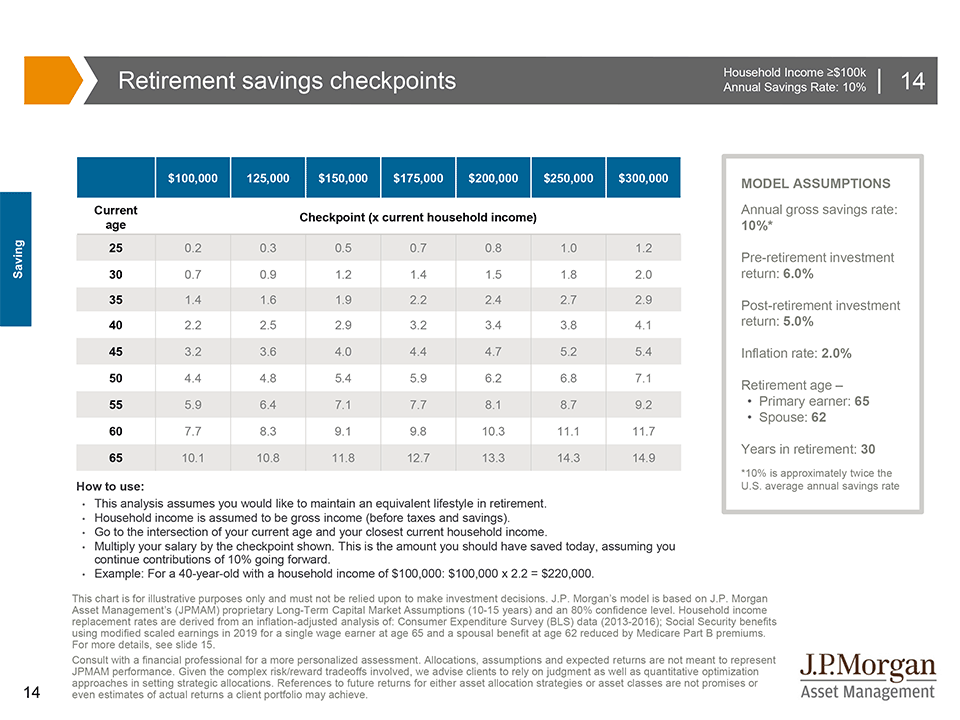
Achieving a financially successful retirement requires consistent savings, disciplined investing and a plan, yet too few Americans have calculated what it will take to be able to retire at their current lifestyle. This chart (for household incomes of $100,000 or more) helps investors to quickly gauge whether they are “on track” to afford their current lifestyle for 30 years in retirement based on their current age and annual household income. This analysis uses an appropriate income replacement rate (detailed on slide 15), an estimate of how much Social Security is likely to cover and the rate of return and inflation rate assumptions detailed on the right to determine the amount of investable wealth needed today, assuming a 10% gross annual savings rate until retirement. It is important to note that this analysis assumes a household with a primary earner who plans to retire at age 65 when the spouse is assumed to be 62. If an investor’s current retirement savings falls short of the amount for their age and income, developing a written retirement plan tailored to their unique situation with the help of an experienced financial advisor is a recommended next step.

Sources

  1. FoxBusiness.com, August 4, 2020
  2. Pressroom.aboutshwab.com, August 4, 2020
  3. https://am.jpmorgan.com/us/en/asset-management/gim/protected/adv/insights/guide-to-retirement

This material was prepared by MarketingPro, Inc., and does not necessarily represent the views of the presenting party, nor their affiliates. This information has been derived from sources believed to be accurate. Please note – investing involves risk, and past performance is no guarantee of future results. The publisher is not engaged in rendering legal, accounting or other professional services. If assistance is needed, the reader is advised to engage the services of a competent professional. This information should not be construed as investment, tax or legal advice and may not be relied on for the purpose of avoiding any Federal tax penalty. This is neither a solicitation nor recommendation to purchase or sell any investment or insurance product or service, and should not be relied upon as such. All indices are unmanaged and are not illustrative of any particular investment.

4 Key Factors to Consider Before Filing For Your Social Security Benefits

Whether you want to leave work at 62, 67, or 72, claiming the retirement benefits you are entitled to by federal law is no casual decision. You will want to consider a few key factors first.

How long do you think you will live?

If you have a feeling you will live into your nineties, for example, it may be better to claim later. If you start receiving Social Security benefits at or after Full Retirement Age (which varies from age 66 to 67 for those born in 1943 or later), your monthly benefit will be larger than if you had claimed at 62. If you file for benefits at FRA or later, chances are you probably a) worked into your mid-sixties, b) are in fairly good health, and c) have sizable retirement savings. (1)

If you really need retirement income, then claiming at or close to 62 might make more sense. If you have an average lifespan, you will, theoretically, receive the average amount of lifetime benefits regardless of when you claim them. Essentially, the choice comes down to more lifetime payments that are smaller versus fewer lifetime payments that are larger. For the record, Social Security’s actuaries project that the average 65-year-old man to live 84.0 years, and the average 65-year-old woman, 86.5 years. (2)

Will you keep working?

You might not want to work too much, since earning too much income may result in your Social Security being withheld or taxed.

Prior to Full Retirement Age, your benefits may be lessened if your income tops certain limits. In 2018, if you are aged 62 to 65, receive Social Security, and have an income over $17,040, $1 of your benefits will be withheld for every $2. If you receive Social Security and turn 66 later this year, then $1 of your benefits will be withheld for every $3 that you earn above $45,360. (3)

Social Security income may also be taxed above the program’s “combined income” threshold. (“Combined income” = adjusted gross income + nontaxable interest + 50% of Social Security benefits.) Single filers who have combined incomes from $25,000 to $34,000 may have to pay federal income tax on up to 50% of their Social Security benefits, and that also applies to joint filers with combined incomes of $32,000 to $44,000. Single filers with combined incomes above $34,000 and joint filers whose combined incomes surpass $44,000 may have to pay federal income taxes on up to 85% of their Social Security benefits. (3)

When does your spouse want to file?

Timing does matter, especially for two-income couples. If the lower-earning spouse collects Social Security benefits first, and then the higher-earning spouse collects them later, that may result in greater lifetime benefits for the household. (4)

Finally, how much in benefits might be coming your way?

Visit SSA.gov to find out, and keep in mind that Social Security calculates your monthly benefit using a formula based on your 35 highest-earning years. If you have worked for less than 35 years, Social Security fills in the “blank years” with zeros. If you have, say, just 33 years of work experience, working another couple years might translate to a slightly higher Social Security income. (1)

A claiming decision may be one of the most significant financial decisions of your life. Your choices should be evaluated years in advance – with insight from the financial professional who has helped you plan for retirement.

Maximizing Social Security benefits (average earner)

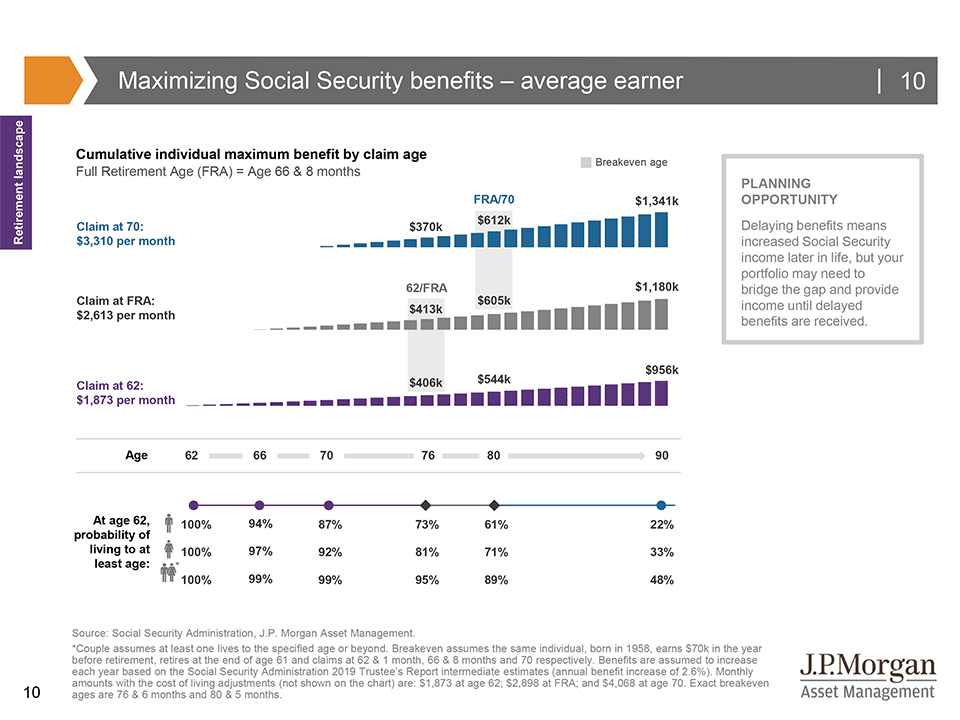
The age at which one claims Social Security greatly affects the amount of benefit received. Key claiming ages are 62, Full Retirement Age (FRA is currently 66 and 8 months for individuals turning 62 in 2020) and 70, as shown in the row of ages in the middle of the slide. The top three graphs show the three most common ages an individual is likely to claim and the monthly benefit he or she would receive at those ages, assuming average earnings at retirement of $70,000 (based on JPMorgan research). Claiming at the latest age (70) provides the highest monthly amount but delays receipt of the benefit for 8 years. Claiming at Full Retirement Age, 66 and 8 months, or at 62 years old provides lesser amounts at earlier ages. The bars represent the cumulative value of benefits received by the specified age. The gray shading between the bar charts represents the ages at which waiting until a later claim age results in greater cumulative benefits than claiming at the earlier age. This is called the “breakeven age.” The breakeven age between taking benefits at age 62 and FRA is age 76 and between FRA and 70 is 80. Along the bottom of the page, the percentages shown are the probability that a man, woman or one member of a married couple currently age 62 will live to the specified ages or beyond. Comparing these percentages against the breakeven ages will help a beneficiary make an informed decision about when to claim Social Security if maximizing the cumulative benefit received is a primary goal.

Note that while the benefits shown are for an average earner, the breakeven ages would be the same for those with other earnings histories.

Sources

  1. MarketWatch.com
  2. SSA.gov
  3. BlackRock.com
  4. MarketWatch.com
  5. https://am.jpmorgan.com/us/en/asset-management/gim/protected/adv/insights/guide-to-retirement

This material was prepared by MarketingPro, Inc., and does not necessarily represent the views of the presenting party, nor their affiliates. This information has been derived from sources believed to be accurate. Please note – investing involves risk, and past performance is no guarantee of future results. The publisher is not engaged in rendering legal, accounting or other professional services. If assistance is needed, the reader is advised to engage the services of a competent professional. This information should not be construed as investment, tax or legal advice and may not be relied on for the purpose of avoiding any Federal tax penalty. This is neither a solicitation nor recommendation to purchase or sell any investment or insurance product or service, and should not be relied upon as such. All indices are unmanaged and are not illustrative of any particular investment.

How to Use a Bucket Strategy to Help Weather Market Volatility in Retirement

buckets-1113926_1920 (1).jpg
Image by TRIXIE BRADLEY from Pixabay

The Bucket Strategy can take two forms.

1. The Expenses Bucket Strategy:

With this approach, you segment your retirement expenses into three buckets:

  • Basic Living Expenses – food, rent, utilities, etc.
  • Discretionary Expenses – vacations, dining out, etc.
  • Legacy Expenses – assets for heirs and charities

This strategy pairs appropriate investments to each bucket. For instance, Social Security might be assigned to the Basic Living Expenses bucket. If this source of income falls short, you might consider whether a fixed annuity can help fill the gap. With this approach, you are attempting to match income sources to essential expenses. (1)

The guarantees of an annuity contract depend on the issuing company’s claims-paying ability. Annuities have contract limitations, fees, and charges, including account and administrative fees, underlying investment management fees, mortality and expense fees, and charges for optional benefits. Most annuities have surrender fees that are usually highest if you take out the money in the initial years of the annuity contact. Withdrawals and income payments are taxed as ordinary income. If a withdrawal is made prior to age 59½, a 10% federal income tax penalty may apply (unless an exception applies).

For the Discretionary Expenses bucket, you might consider investing in top-rated bonds and large-cap stocks that offer the potential for growth and have a long-term history of paying a steady dividend. The market value of a bond will fluctuate with changes in interest rates. As rates fall, the value of existing bonds typically drop. If an investor sells a bond before maturity, it may be worth more or less than the initial purchase price. By holding a bond to maturity an investor will receive the interest payments due, plus their original principal, barring default by the issuer. Investments seeking to achieve higher yields also involve a higher degree of risk. Keep in mind that the return and principal value of stock prices will fluctuate as market conditions change. And shares, when sold, may be worth more or less than their original cost. Dividends on common stock are not fixed and can be decreased or eliminated on short notice.

Finally, if you have assets you expect to pass on, you might position some of them in more aggressive investments, such as small-cap stocks and international equity. Asset allocation is an approach to help manage investment risk. Asset allocation does not guarantee against investment loss.

International investments carry additional risks, which include differences in financial reporting standards, currency exchange rates, political risk unique to a specific country, foreign taxes and regulations, and the potential for illiquid markets. These factors may result in greater share price volatility.

2. The Timeframe Bucket Strategy:

This approach creates buckets based on different timeframes and assigns investments to each. For example:

  • 1 to 5 Years: This bucket funds your near-term expenses. It may be filled with cash and cash alternatives, such as money market accounts. Money market funds are considered low-risk securities but they are not backed by any government institution, so it’s possible to lose money. Money held in money market funds is not insured or guaranteed by the Federal Deposit Insurance Corporation or any other government agency. Money market funds seek to preserve the value of your investment at $1.00 a share. However, it is possible to lose money by investing in a money market fund. Money market mutual funds are sold by prospectus. Please consider the charges, risks, expenses, and investment objectives carefully before investing. A prospectus containing this and other information about the investment company can be obtained from your financial professional. Read it carefully before you invest or send money.
  • 6 to 10 Years: This bucket is designed to help replenish the funds in the 1-to-5-Years bucket. Investments might include a diversified, intermediate, top-rated bond portfolio. Diversification is an approach to help manage investment risk. It does not eliminate the risk of loss if security prices decline.
  • 11 to 20 Years: This bucket may be filled with investments such as large-cap stocks, which offer the potential for growth.
  • 21 or More Years: This bucket might include longer-term investments, such as small-cap and international stocks.

Each bucket is set up to be replenished by the next longer-term bucket. This approach can offer flexibility to provide replenishment at more opportune times. For example, if stock prices move higher, you might consider replenishing the 6-to-10-Years bucket, even though it’s not quite time.

A bucket approach to pursue your income needs is not the only way to build an income strategy, but it’s one strategy to consider as you prepare for retirement.

FINAL-2019-GTR-2_22_HIGH-RES-37
▲ Structuring a portfolio in retirement – the bucket strategy

Experiencing market volatility in retirement may result in some people pulling out of the market at the wrong time or not taking on the equity exposure they need to combat inflation. Leveraging mental accounting to encourage better behaviors–aligning a retirement portfolio in time-segmented buckets–may help people maintain a disciplined investment strategy through retirement with an appropriate level of equity exposure. The short-term bucket, invested in cash and cash equivalents, should cover one or more years of a household’s income gap in retirement–with the ideal number of years determined based on risk tolerance and market conditions over the near term. A ‘cushion’ amount should also be maintained to cover unexpected expenses. The intermediate-term bucket should have a growth component, with any current income generated through dividends or interest moved periodically to replenish the short-term bucket. The longer-term portfolio can be a long-term care reserve fund or positioned for legacy planning purposes, and pursue a more aggressive investment objective, based on the time horizon. (2)

Sources

  1. kiplinger.com/article/retirement/T037-C000-S002-how-to-implement-the-bucket-system-in-retirement.html
  2. https://am.jpmorgan.com/us/en/asset-management/gim/protected/adv/insights/guide-to-retirement

This material was prepared by MarketingPro, Inc., and does not necessarily represent the views of the presenting party, nor their affiliates. This information has been derived from sources believed to be accurate. Please note – investing involves risk, and past performance is no guarantee of future results. The publisher is not engaged in rendering legal, accounting or other professional services. If assistance is needed, the reader is advised to engage the services of a competent professional. This information should not be construed as investment, tax or legal advice and may not be relied on for the purpose of avoiding any Federal tax penalty. This is neither a solicitation nor recommendation to purchase or sell any investment or insurance product or service, and should not be relied upon as such. All indices are unmanaged and are not illustrative of any particular investment.

Are You Emotionally Ready to Retire? Four Questions to Ask Yourself Before Deciding

Image by LEEROY Agency from Pixabay

Retirement Is a Beginning

See if you are prepared to begin your retirement by answering four key questions.

1) Is Your Work Meaningful?

If it is emotionally and psychologically fulfilling, if it gives you a strong sense of purpose and identity, there may be a voice inside your head telling you not to retire yet. You may want to listen to it.

It can be tempting to see retirement as a “finish line”: no more long workdays, long commutes, or stressful deadlines. But it is really a starting line: the start of a new phase of life. Ideally, you cross the “finish line” knowing what comes next, what will be important to you in the future.

2) Do You Value Work or Leisure More at This Point in Your Life?

If the answer is leisure, score one for retirement. If the answer is work, maybe you need a new job or a new way of working rather than an exit from your company or your profession.

An old saying says that retirement feels like “six Saturdays and a Sunday.” Fantastic, right? It is, as long you don’t miss Monday through Friday. Some people really enjoy their careers; you may be one of them.

3) Where Do Your Friends Come From?

If very little of your social life involves the people you work with, then score another point for retirement. If your friends are mainly your coworkers, those friendships may be tested if you retire (and you may want to try to broaden your social circle for the future).

At a glance, it might seem that an enjoyable retirement requires just two things: sufficient income and sufficient return on your investments. These factors certainly promote a nice retirement, but there are also other important factors: your physical health, your mental health, your relationships with family and friends, your travels and adventures, and your outlets to express your creativity. Building a life away from work is a plus.

4) What Do You Think Your Retirement Will Be Like?

If you think it will be spectacularly different from your current life, ask yourself if your expectations are realistic. If after further consideration they seem unrealistic, you may want to keep working for a while until you are in a better financial position to try and realize them or until your expectations shift.

Ideally, you retire when you are financially, emotionally, and psychologically ready.

The era of the “organization man” retiring with a gold watch and a party at 65 is gone; the cultural forces that encouraged people to stop working at a certain age aren’t as strong as they once were.

Why you are retiring is as important as when you choose to retire.

When you are motivated to retire, you see retirement as a beginning rather than an end.

▲ If You Need Some Help Figuring Out How To Achieve A Satisfying Retirement Check Out This Book

How to Retire Happy, Wild, and Free offers inspirational advice on how to enjoy life to its fullest. The key to achieving an active and satisfying retirement involves a great deal more than having adequate financial resources; it also encompasses all other aspects of life — interesting leisure activities, creative pursuits, physical well-being, mental well-being, and solid social support.

Sources

  1. https://www.aarp.org/retirement/planning-for-retirement/info-2017/retirement-fear-fd.html 
  2. https://www.usatoday.com/story/money/personalfinance/2013/10/22/preparing-mentally-retirement/2885187/ 
  3. https://www.amazon.com/gp/product/096941949X/ref=ppx_yo_dt_b_asin_image_o02_s00?ie=UTF8&psc=1 https://static.twentyoverten.com/58e639ce21cca2513c90975b/3CK8UF2wC/Imagine-Your-Life-Without-Limits-Workbook.pdf 
  4. https://www.psychologytoday.com/us/blog/cutting-edge-leadership/201501/are-you-psychologically-ready-retire 
  5. https://www.marketwatch.com/story/why-youre-probably-not-psychologically-ready-to-retire-2019-05-21
  6. https://www.amazon.com/How-Retire-Happy-Wild-Free/dp/096941949X/ref=sr_1_2?crid=2N1K2XUGII9GT&keywords=how+to+retire+happy+wild+and+free+book&qid=1581466005&sprefix=how+to+reitre%2Caps%2C147&sr=8-2

This material was prepared by MarketingPro, Inc., and does not necessarily represent the views of the presenting party, nor their affiliates. All information is believed to be from reliable sources; however we make no representation as to its completeness or accuracy. Please note – investing involves risk, and past performance is no guarantee of future results. The publisher is not engaged in rendering legal, accounting or other professional services. If assistance is needed, the reader is advised to engage the services of a competent professional. This information should not be construed as investment, tax or legal advice and may not be relied on for the purpose of avoiding any Federal tax penalty. This is neither a solicitation nor recommendation to purchase or sell any investment or insurance product or service, and should not be relied upon as such. All indices are unmanaged and are not illustrative of any particular investment.

The Major Retirement Planning Mistakes and How to Avoid Them

Much is out there about the classic financial mistakes that plague start-ups, family businesses, corporations, and charities. Aside from these blunders, some classic financial missteps plague retirees.

Calling them “mistakes” may be a bit harsh, as not all of them represent errors in judgment. Yet whether they result from ignorance or fate, we need to be aware of them as we plan for and enter retirement.

1) Leaving Work Too Early

As Social Security benefits rise about 8% for every year you delay receiving them, waiting a few years to apply for benefits can position you for higher retirement income. Filing for your monthly benefits before you reach Social Security’s Full Retirement Age (FRA) can mean comparatively smaller monthly payments. Meanwhile, if you can delay claiming Social Security, that positions you for more significant monthly benefits. (1)

2) Underestimating Medical Bills

In its latest estimate of retiree health care costs, the Center for Retirement Research at Boston College says that the average retiree will need at least $4,300 per year to pay for future health care costs. Medicare will not pay for everything. That $4,300 represents out-of-pocket costs, which includes dental, vision, and long-term care. (2)

3) Taking the Potential For Longevity Too Lightly

Actuaries at the Social Security Administration project that around a third of today’s 65-year-olds will live to age 90, with about one in seven living 95 years or longer. The prospect of a 20- or 30-year retirement is not unreasonable, yet there is still a lingering cultural assumption that our retirements might duplicate the relatively brief ones of our parents. (3)

4) Withdrawing Too Much Each Year

You may have heard of the “4% rule,” a guideline stating that you should take out only about 4% of your retirement savings annually. Many cautious retirees try to abide by it.

So, why do others withdraw 7% or 8% a year? In the first phase of retirement, people tend to live it up; more free time naturally promotes new ventures and adventures and an inclination to live a bit more lavishly.

5) Ignoring Tax Efficiency & Fees

It can be a good idea to have both taxable and tax-advantaged accounts in retirement. Assuming your retirement will be long, you may want to assign this or that investment to its “preferred domain.” What does that mean? It means the taxable or tax-advantaged account that may be most appropriate for it as you pursue a better after-tax return for the whole portfolio.

Many younger investors chase the return. Some retirees, however, find a shortfall when they try to live on portfolio income. In response, they move money into stocks offering significant dividends or high-yield bonds – something you might regret in the long run. Taking retirement income off both the principal and interest of a portfolio may give you a way to reduce ordinary income and income taxes.

6) Avoiding Market Risk

Equity investment does invite risk, but the reward may be worth it. In contrast, many fixed-rate investments offer comparatively small yields these days.

7) Retiring With Heavier Debts.

It is hard to preserve (or accumulate) wealth when you are handing portions of it to creditors.

8) Putting College Costs Before Retirement Costs

There is no “financial aid” program for retirement. There are no “retirement loans.” Your children have their whole financial lives ahead of them. Try to refrain from touching your home equity or your IRA to pay for their education expenses.

9) Retiring With No Plan or Investment Strategy

An unplanned retirement may bring terrible financial surprises; the absence of a strategy can leave people prone to market timing and day trading.

These are some of the classic retirement planning mistakes. Why not plan to avoid them? Take a little time to review and refine your retirement strategy in the company of the financial professional you know and trust.

▲ The retirement equation

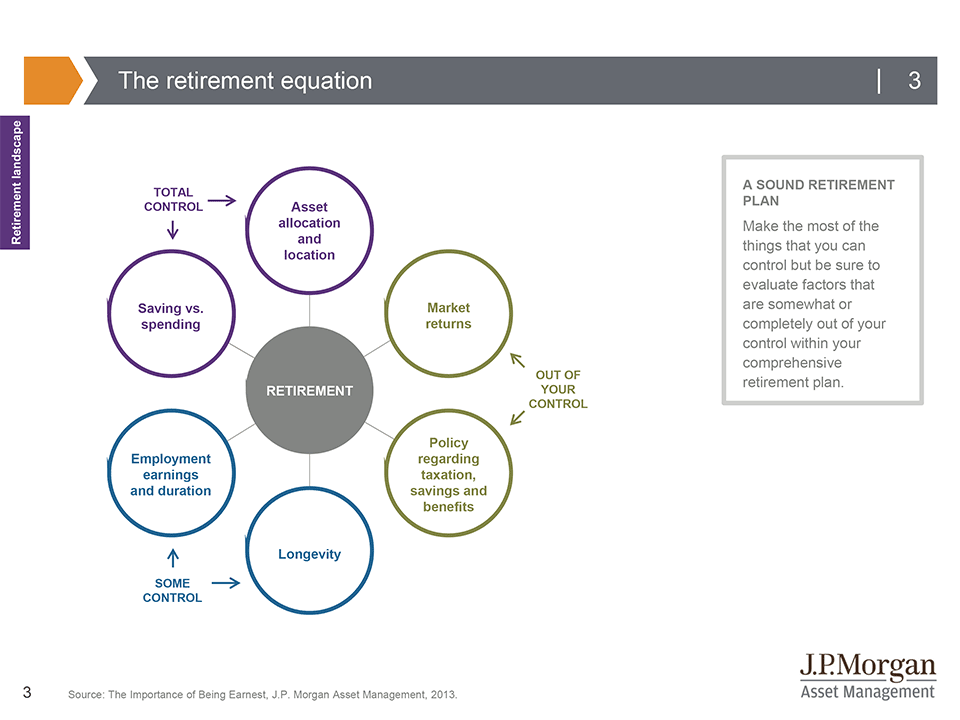
Planning for retirement can be overwhelming as individuals navigate various retirement factors over which we have varying levels of control. There are challenges in retirement planning over which we have no control, like the future of tax policy and market returns, and factors over which we have limited control, like longevity and how long we plan to work. The best way to achieve a secure retirement is to develop a comprehensive retirement plan and to focus on the factors we can control: maximize savings, understand and manage spending and adhere to a disciplined approach to investing. (4)

Sources

  1. forbes.com/sites/bobcarlson/2019/01/25/5-ways-to-maximize-social-security-benefits
  2. fool.com/retirement/2019/12/11/4-steps-to-making-sure-youre-ready-to-retire.aspx
  3. ssa.gov/planners/lifeexpectancy.html
  4. https://am.jpmorgan.com/us/en/asset-management/gim/protected/adv/insights/guide-to-retirement

This material was prepared by MarketingPro, Inc., and does not necessarily represent the views of the presenting party, nor their affiliates. This information has been derived from sources believed to be accurate. Please note – investing involves risk, and past performance is no guarantee of future results. The publisher is not engaged in rendering legal, accounting or other professional services. If assistance is needed, the reader is advised to engage the services of a competent professional. This information should not be construed as investment, tax or legal advice and may not be relied on for the purpose of avoiding any Federal tax penalty. This is neither a solicitation nor recommendation to purchase or sell any investment or insurance product or service, and should not be relied upon as such. All indices are unmanaged and are not illustrative of any particular investment.

The SECURE Act Explained: Changes to Long-Established Retirement Account Rules

The Setting Every Community Up for Retirement Enhancement (SECURE) Act is now law. With it, comes some of the biggest changes to retirement savings law in recent years. While the new rules don’t appear to amount to a massive upheaval, the SECURE Act will require a change in strategy for many Americans. For others, it may reveal new opportunities.

Limits on Stretch IRAs

The legislation “modifies” the required minimum distribution rules in regard to defined contribution plans and Individual Retirement Account (IRA) balances upon the death of the account owner. Under the new rules, distributions to individuals are generally required to be distributed by the end of the 10th calendar year following the year of the account owner’s death. (1)

Penalties may occur for missed RMDs. Any RMDs due for the original owner must be taken by their deadlines to avoid penalties. A surviving spouse of the IRA owner, disabled or chronically ill individuals, individuals who are not more than 10 years younger than the IRA owner, and child of the IRA owner who has not reached the age of majority may have other minimum distribution requirements.

Let’s say that a person has a hypothetical $1 million IRA. Under the new law, your beneficiary should consider taking at least $100,000 a year for 10 years regardless of their age. For example, say you are leaving your IRA to a 50-year-old child. They must take all the money from the IRA by the time they reach age 61. Prior to the rule change, a 50-year-old child could “stretch” the money over their expected lifetime, or roughly 30 more years.

The new limits on IRAs may force account owners to reconsider inheritance strategies and review how the accelerated income may affect a beneficiary’s tax situation.

IRA Contributions and Distributions.

Another major change is the removal of the age limit for traditional IRA contributions. Before the SECURE Act, you were required to stop making contributions at age 70½. Now, you can continue to make contributions as long as you meet the earned-income requirement.2

Also, as part of the Act, you are mandated to begin taking required minimum distributions (RMDs) from a traditional IRA at age 72, an increase from the prior 70½. Allowing money to remain in a tax-deferred account for an additional 18 months (before needing to take an RMD) may alter some previous projections of your retirement income.2
The SECURE Act’s rule change for RMDs only affects Americans turning 70½ in 2020. For these taxpayers, RMDs will become mandatory at age 72. If you meet this criterion, your first RMD won’t be necessary until April 1 of the year you turn 72. (2)

Multiple Employer Retirement Plans for Small Business.

In terms of wide-ranging potential, the SECURE Act may offer its biggest change in the realm of multi-employer retirement plans. Previously, multiple employer plans were only open to employers within the same field or sharing some other “common characteristics.” Now, small businesses have the opportunity to buy into larger plans alongside other small businesses, without the prior limitations. This opens small businesses to a much wider field of options. (1)

Another big change for small business employer plans comes for part-time employees. Before the SECURE Act, these retirement plans were not offered to employees who worked fewer than 1,000 hours in a year. Now, the door is open for employees who have either worked 1,000 hours in the space of one full year or to those who have worked at least 500 hours per year for three consecutive years. (2)

While the SECURE Act represents some of the most significant changes we have seen to the laws governing financial saving for retirement, it’s important to remember that these changes have been anticipated for a while now. If you have questions or concerns, reach out to your trusted financial professional.

Sources

  1. waysandmeans.house.gov/sites/democrats.waysandmeans.house.gov/files/documents/SECURE%20Act%20section%20by%20section.pdf
  2. marketwatch.com/story/with-president-trumps-signature-the-secure-act-is-passed-here-are-the-most-important-things-to-know-2019-12-21

This material was prepared by MarketingPro, Inc., and does not necessarily represent the views of the presenting party, nor their affiliates. This information has been derived from sources believed to be accurate. Please note – investing involves risk, and past performance is no guarantee of future results. The publisher is not engaged in rendering legal, accounting or other professional services. If assistance is needed, the reader is advised to engage the services of a competent professional. This information should not be construed as investment, tax or legal advice and may not be relied on for the purpose of avoiding any Federal tax penalty. This is neither a solicitation nor recommendation to purchase or sell any investment or insurance product or service, and should not be relied upon as such. All indices are unmanaged and are not illustrative of any particular investment.

Retirement Planning: What it is and How it Can Help You Increase Retirement Success

Photo by Alex on Pexels.com

Across the country, people are saving for that “someday” called retirement. Someday, their careers will end. Someday, they may live off their savings or investments, plus Social Security. They know this, but many of them do not know when, or how, it will happen. What is missing is a strategy – and a good strategy might make a great difference.

A retirement strategy directly addresses the “when, why, and how” of retiring.

It can even address the “where.” It breaks the whole process of getting ready for retirement into actionable steps.

This is so important. Too many people retire with doubts, unsure if they have enough retirement money and uncertain of what their tomorrows will look like. Year after year, many workers also retire earlier than they had planned, and according to a 2019 study by the Employee Benefit Research Institute, about 43% do. In contrast, you can save, invest, and act on your vision of retirement now to chart a path toward your goals and the future you want to create for yourself. (1)

Some people dismiss having a long-range retirement strategy, since no one can predict the future.

Indeed, there are things about the future you cannot control: how the stock market will perform, how the economy might do. That said, you have partial or full control over other things: the way you save and invest, your spending and your borrowing, the length and arc of your career, and your health. You also have the chance to be proactive and to prepare for the future.

A good retirement strategy has many elements.

It sets financial objectives. It addresses your retirement income: how much you may need, the sequence of account withdrawals, and the age at which you claim Social Security. It establishes (or refines) an investment approach. It examines tax implications and potential tax advantages. It takes possible health care costs into consideration and even the transfer of assets to heirs.

A prudent retirement strategy also entertains different consequences.

Financial advisors often use multiple-probability simulations to try and assess the degree of financial risk to a retirement strategy, in case of an unexpected outcome. These simulations can help to inform the advisor and the retiree or pre-retiree about the “what ifs” that may affect a strategy. They also consider sequence of returns risk, which refers to the uncertainty of the order of returns an investor may receive over an extended period of time. (2)

Let a retirement strategy guide you. Ask a financial professional to collaborate with you to create one, personalized for your goals and dreams. When you have such a strategy, you know what steps to take in pursuit of the future you want.

▲ The retirement equation

Planning for retirement can be overwhelming as individuals navigate various retirement factors over which we have varying levels of control. There are challenges in retirement planning over which we have no control, like the future of tax policy and market returns, and factors over which we have limited control, like longevity and how long we plan to work. The best way to achieve a secure retirement is to develop a comprehensive retirement plan and to focus on the factors we can control: maximize savings, understand and manage spending and adhere to a disciplined approach to investing. (3)

Sources

  1. ebri.org/docs/default-source/rcs/2019-rcs/rcs_19-fs-2_expect.pdf?sfvrsn=2a553f2f_4
  2. investopedia.com/terms/m/montecarlosimulation.asp
  3. https://am.jpmorgan.com/us/en/asset-management/gim/adv/insights/guide-to-retirement

This material was prepared by MarketingPro, Inc., and does not necessarily represent the views of the presenting party, nor their affiliates. All information is believed to be from reliable sources; however we make no representation as to its completeness or accuracy. Please note – investing involves risk, and past performance is no guarantee of future results. The publisher is not engaged in rendering legal, accounting or other professional services. If assistance is needed, the reader is advised to engage the services of a competent professional. This information should not be construed as investment, tax or legal advice and may not be relied on for the purpose of avoiding any Federal tax penalty. This is neither a solicitation nor recommendation to purchase or sell any investment or insurance product or service, and should not be relied upon as such. All indices are unmanaged and are not illustrative of any particular investment.
Post-Retirement Risks That Can Get In The Way of Making Your Money Last

barca-473854_1920

Image by Carabo Spain from Pixabay

“What is your greatest retirement fear?”

If you ask any group of retirees and pre-retirees this question, “outliving my money” will likely be one of the top answers. In fact, 51% of investors surveyed for a 2019 AIG retirement study ranked outliving their money as their top anxiety. (1)

Retirees face greater “longevity risk” today.

The Census Bureau says that Americans typically retire around age 63. Social Security projects that today’s 63-year-olds will live into their mid-eighties, on average. This is a mean life expectancy, so while some of these seniors may pass away earlier, others may live past 90 or 100. (2,3)

If your retirement lasts 20, 30, or even 40 years, how well do you think your retirement savings will hold up? What financial steps could you take in your retirement to try and prevent those savings from eroding? As you think ahead, consider the following possibilities and realities.

Understand that you may need to work part time in your sixties and seventies.

The income from part-time work can be an economic lifesaver for retirees. What if you worked part time and earned $20,000-30,000 a year? If you can do that for five or ten years, you effectively give your retirement savings five or ten more years to last and grow.

Retire with health insurance and prepare adequately for out-of-pocket costs.

Financially speaking, this may be the most frustrating part of retirement. You can enroll in Medicare at age 65, but how do you handle the premiums for private health insurance if you retire before then? Striving to work until you are eligible for Medicare makes economic sense and so does building a personal health care account. According to Fidelity research, a typical 65-year-old couple retiring today will face out-of-pocket health care costs approaching $300,000 over the rest of their lives. (4)

Many people may retire unaware of these financial factors.

With luck and a favorable investing climate, their retirement savings may last a long time. Luck is not a plan, however, and hope is not a strategy. Those who are retiring unaware of these factors may risk outliving their money.

FINAL-2019-GTR-2_22_HIGH-RES-3.png

▲ The retirement equation

Planning for retirement can be overwhelming as individuals navigate various retirement factors over which we have varying levels of control. There are challenges in retirement planning over which we have no control, like the future of tax policy and market returns, and factors over which we have limited control, like longevity and how long we plan to work. The best way to achieve a secure retirement is to develop a comprehensive retirement plan and to focus on the factors we can control: maximize savings, understand and manage spending and adhere to a disciplined approach to investing. (5)

Sources

  1. markets.businessinsider.com/news/stocks/more-than-half-of-americans-want-to-live-to-100-but-worry-about-affording-longer-lifespans-1028099970
  2. thebalance.com/average-retirement-age-in-the-united-states-2388864
  3. usatoday.com/story/money/columnist/2019/09/30/social-security-4-key-trends-you-need-know-benefits/3790032002/
  4. fidelity.com/viewpoints/retirement/transition-to-medicare
  5. https://am.jpmorgan.com/us/en/asset-management/gim/adv/insights/guide-to-retirement

This material was prepared by MarketingPro, Inc., and does not necessarily represent the views of the presenting party, nor their affiliates. This information has been derived from sources believed to be accurate. Please note – investing involves risk, and past performance is no guarantee of future results. The publisher is not engaged in rendering legal, accounting or other professional services. If assistance is needed, the reader is advised to engage the services of a competent professional. This information should not be construed as investment, tax or legal advice and may not be relied on for the purpose of avoiding any Federal tax penalty. This is neither a solicitation nor recommendation to purchase or sell any investment or insurance product or service, and should not be relied upon as such. All indices are unmanaged and are not illustrative of any particular investment.

Understanding the Parts (A, B, C, D) of Medicare and What They Cover

man and woman holding wine glasses

Photo by rawpixel.com on Pexels.com

Whether your 65th birthday is on the horizon or decades away, you should understand the parts of Medicare – what they cover and where they come from.

Parts A & B: Original Medicare

There are two components. Part A is hospital insurance. It provides coverage for inpatient stays at medical facilities. It can also help cover the costs of hospice care, home health care, and nursing home care – but not for long and only under certain parameters. (1,2)

Seniors are frequently warned that Medicare will only pay for a maximum of 100 days of nursing home care (provided certain conditions are met). Part A is the part that does so. Under current rules, you pay $0 for days 1-20 of skilled nursing facility (SNF) care under Part A. During days 21-100, a $170.50 daily coinsurance payment may be required of you. (2)

Part B is medical insurance and can help pick up some of the tab for physical therapy, physician services, expenses for durable medical equipment (hospital beds, wheelchairs), and other medical services, such as lab tests and a variety of health screenings. (1)

Part B isn’t free. You pay monthly premiums to get it and a yearly deductible (plus 20% of costs). The premiums vary according to the Medicare recipient’s income level. The standard monthly premium amount is $135.50 this year. The current yearly deductible is $185. (Some people automatically receive Part B coverage, but others must sign up for it.) (3)

Part C: Medicare Advantage plans.

Insurance companies offer these Medicare-approved plans. To keep up your Part C coverage, you must keep up your payment of Part B premiums as well as your Part C premiums. To say not all Part C plans are alike is an understatement. Provider networks, premiums, copays, coinsurance, and out-of-pocket spending limits can all vary widely, so shopping around is wise. During Medicare’s annual Open Enrollment Period (October 15 – December 7), seniors can choose to switch out of Original Medicare to a Medicare Advantage plan or vice versa; although, any such move is much wiser with a Medigap policy already in place. (4,5)

How does a Medigap plan differ from a Part C plan? Medigap plans (also called Medicare Supplement plans) emerged to address the gaps in Part A and Part B coverage. If you have Part A and Part B already in place, a Medigap policy can pick up some copayments, coinsurance, and deductibles for you. You pay Part B premiums in addition to Medigap plan premiums to keep a Medigap policy in effect. These plans no longer offer prescription drug coverage. (6)

Part D: prescription drug plans.

While Part C plans commonly offer prescription drug coverage, insurers also sell Part D plans as a standalone product to those with Original Medicare. As per Medigap and Part C coverage, you need to keep paying Part B premiums in addition to premiums for the drug plan to keep Part D coverage going. (7)

Every Part D plan has a formulary, a list of medications covered under the plan. Most Part D plans rank approved drugs into tiers by cost. The good news is that Medicare’s website will determine the best Part D plan for you. Go to medicare.gov/find-a-plan to start your search; enter your medications and the website will do the legwork for you. (8)

FINAL-2019-GTR-2_22_HIGH-RES-29

▲ What is Medicare?

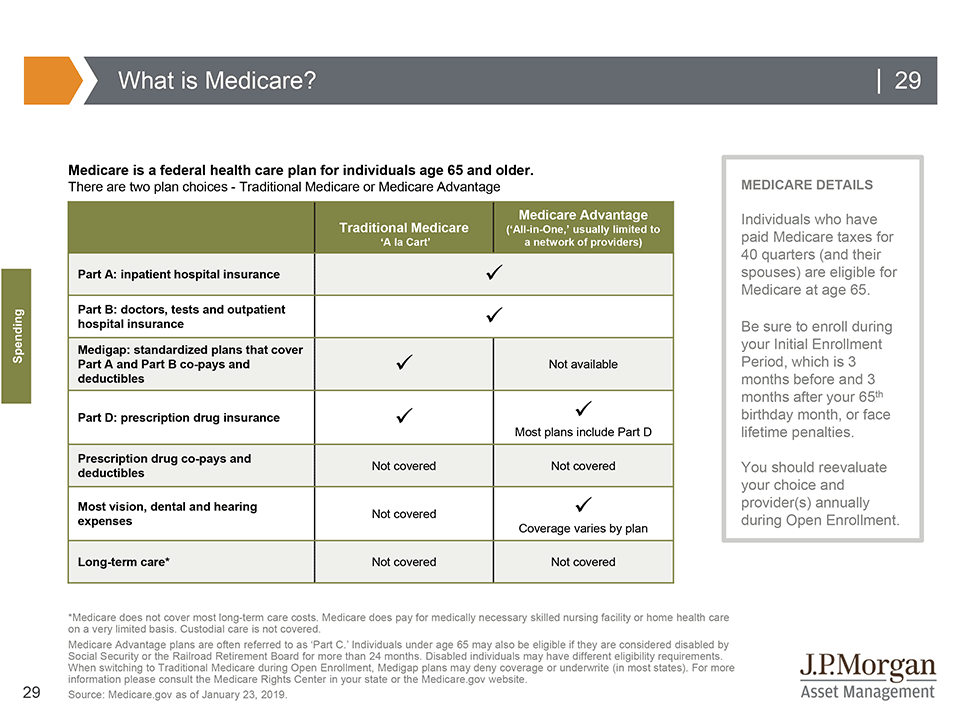
The left side of this table shows all the parts of Medicare. The next column to the right has a check mark for all the parts of Medicare that are included in traditional Medicare. Individuals sign up for the different parts, and Part A is usually free for most people. The column to the far right shows what is typically included in Medicare Advantage, which are local plans sold by private companies. Usually Medicare Advantage beneficiaries are limited to a local network of providers. During the annual enrollment period, beneficiaries may switch from traditional Medicare to Medicare Advantage and vice versa. However, Medigap, which covers the gaps in Parts A and B, is only available with traditional Medicare, and must be signed up for when first eligible or the individual may be denied coverage, face underwriting or incur higher premiums. Whichever plan an individual chooses, they should consider future coverage needs including drug coverage to avoid lifetime penalties when signing up later. (9)

Sources

  1. mymedicarematters.org/coverage/parts-a-b/whats-covered/
  2. medicare.gov/coverage/skilled-nursing-facility-snf-care
  3. medicare.gov/your-medicare-costs/part-b-costs
  4. medicareinteractive.org/get-answers/medicare-basics/medicare-coverage-overview/original-medicare
  5. medicare.gov/sign-up-change-plans/joining-a-health-or-drug-plan
  6. medicare.gov/supplements-other-insurance/whats-medicare-supplement-insurance-medigap
  7. ehealthinsurance.com/medicare/part-d-all/medicare-part-d-prescription-drug-coverage-costs
  8. https://www.medicare.gov/drug-coverage-part-d/what-drug-plans-cover
  9. https://am.jpmorgan.com/us/en/asset-management/gim/protected/adv/insights/guide-to-retirement

This material was prepared by MarketingPro, Inc., and does not necessarily represent the views of the presenting party, nor their affiliates. This information has been derived from sources believed to be accurate. Please note – investing involves risk, and past performance is no guarantee of future results. The publisher is not engaged in rendering legal, accounting or other professional services. If assistance is needed, the reader is advised to engage the services of a competent professional. This information should not be construed as investment, tax or legal advice and may not be relied on for the purpose of avoiding any Federal tax penalty. This is neither a solicitation nor recommendation to purchase or sell any investment or insurance product or service, and should not be relied upon as such. All indices are unmanaged and are not illustrative of any particular investment.

The Pros and Cons of Using a Reverse Mortgage For Retirement Income

white and red wooden house with fence

Photo by Scott Webb on Pexels.com

Often criticized, these loans are getting another look.

Is a reverse mortgage worth it?

Before the great recession, couples who asked their retirement advisors if they should get a reverse mortgage were often given a quick answer: “No.”

Today, the answer to that question might be “yes”. In an environment with minimal interest rates, these loans can offer retired homeowners a source of tax-free cash, either in periodic payments or a lump sum. (A HELOC is also possible.)

How does it work?

A reverse mortgage allows you to borrow against your home equity while retaining ownership of your residence. Many of these loans have variable rates, consequently permitting different payment options. (1)

Reverse mortgage balances increase with time, as there are no monthly payments to reduce principal as in a “forward” mortgage. The loan doesn’t have to be repaid until you move out of the home or pass away. At the time of repayment, the amount owed will not exceed the home’s value – but when the loan becomes due it must typically be paid in full, including interest and closing costs. (1)

What are the qualifications?

You must be 62 or older to get a reverse mortgage. You also have to own your home free and clear, or have a mortgage balance that can easily be paid off using funds from the loan. In addition, you must keep paying property taxes and homeowners insurance and maintain your residence with needed repairs to avoid defaulting on the loan. (2,3,4)

Why not get a reverse mortgage?

These products have gotten a bad rap for many reasons. At first, they were seen as loans of last resort. If you were up in age and close to outliving your money, they could give you needed income.

Then the perception of reverse mortgages began to change, thanks to marketing. Commercials for these loans appeared everywhere, with celebrities hawking them as a cure for retirement income woes. Sixty-something homeowners liked the pitch and signed up – but today, some wish they had studied the fine print.

  1. Reverse mortgages can come with severe fees – origination fees, closing fees and even ongoing fees to cover the risk of a possible default or the sale of the property for less than the value of the loan.
  2. If just one spouse takes out the loan and then dies or moves out of the house, the spouse whose name isn’t on the loan is stuck with paying off the mortgage – and that often means selling the home in question.
  3. You are giving up home equity. Let’s say that you have to move because of family or health reasons. How would you finance that move?
  4. If you have cash flow problems and can’t keep up with your property taxes or homeowners insurance, you could default and lose your home. According to Forbes, about 10% of U.S. homeowners with reverse mortgages currently face this risk.
  5. If you really want to use your home as an ATM in retirement, you could refinance or take out a home equity loan or HELOC with no reverse mortgage involved. (3,4)

During 2011-2012, Wells Fargo, MetLife and Bank of America all got out of the reverse mortgage business. Interpret that as you wish. Their reverse mortgages represented 36% of the market. In their absence, smaller nonbank originators have picked up the slack – perhaps not the best development for interested homeowners. (3)

So why get a reverse mortgage?

Even with all the demerits that these loans have, they can be a boon to retirees searching for a consistent income stream. That includes younger retirees: a recent MetLife study shows that 15% more homeowners aged 62-64 considered a reverse mortgage in 2010 than in 1999. Forbes notes that reverse mortgage applicants trending younger, with about 70% opting for a fixed rate lump sum payment option. (3,5)

There are three types of reverse mortgages.

The single-purpose reverse mortgage (offered by nonprofits and state and local agencies) is the least expensive. Federally insured Home Equity Conversion Mortgages (HECMs) are HUD-backed and may only proceed after consumer counseling from an independent government-approved housing counseling agency. That is also true for some proprietary reverse mortgages available from private lenders. HECMs let you choose your cash payment option, and you can change it if you need to for a fee of about $20. (1)

Reality can’t be ignored: many baby boomers are house-rich, cash-poor and scared of retiring with insufficient income. Is a reverse mortgage their only choice? Hardly – yet with interest rates low and retirement savings scant, more and more baby boomers may resolve to convert home equity into cash.

Sources

  1. www.ftc.gov/bcp/edu/pubs/consumer/homes/rea13.shtm
  2. blogs.smartmoney.com/encore/2012/08/07/reversing-the-negative-view-of-reverse-mortgages/
  3. www.forbes.com/sites/ashleaebeling/2012/06/28/cfpb-dont-get-stung-by-a-reverse-mortgage/
  4. www.npr.org/2011/02/15/133777150/Reverse-Mortgages-Good-For-Seniors
  5. www.bankrate.com/financing/mortgages/too-young-for-reverse-mortgage/ 

This material was prepared by MarketingLibrary.Net Inc., and does not necessarily represent the views of the presenting party, nor their affiliates. All information is believed to be from reliable sources; however we make no representation as to its completeness or accuracy. Please note – investing involves risk, and past performance is no guarantee of future results. The publisher is not engaged in rendering legal, accounting or other professional services. If assistance is needed, the reader is advised to engage the services of a competent professional. This information should not be construed as investment, tax or legal advice and may not be relied on for the purpose of avoiding any Federal tax penalty. This is neither a solicitation nor recommendation to purchase or sell any investment or insurance product or service, and should not be relied upon as such. All indices are unmanaged and are not illustrative of any particular investment.