Uncategorized

5 Popular Options for Charitable Giving: The Gifts That Keep on Giving

Photo by tear cordez on Pexels.com

According to Giving USA 2018, Americans gave an estimated $410.02 billion to charity in 2017. That’s the first time that the amount has totaled more that $400 billion in the history of the report. (1) Americans give to charity for two main reasons: to support a cause or organization they care about or to leave a legacy through their support.

When giving to charitable organizations, some people elect to support through cash donations. Others, however, understand that supporting an organization may generate tax benefits. They may opt to follow techniques that can maximize both the gift and the potential tax benefit. Here’s a quick review of a few charitable choices:

Remember, the information in this article is not a replacement for real-life advice. It may not be used for the purpose of avoiding any federal tax penalties. Make sure to consult your tax, legal, or accounting professional before modifying your charitable giving strategy.

Direct Gifts

Direct gifts are just that: contributions made directly to charitable organizations. Direct gifts may be deductible from income taxes depending on your individual situation.

Charitable Gift Annuities

Charitable gift annuities are not related to annuities offered by insurance companies. Under this arrangement, the donor gives money, securities, or real estate, and in return, the charitable organization agrees to pay the donor a fixed income. Upon the death of the donor, the assets pass to the charitable organization. Charitable gift annuities enable donors to receive consistent income and potentially manage taxes.

Pooled-Income Funds

Pooled-income funds pool contributions from various donors into a fund, which is invested by the charitable organization. Income from the fund is distributed to the donors according to their share of the fund. Pooled-income funds enable donors to receive income, potentially manage taxes, and make a future gift to charity.

Gifts in Trust

Gifts in trust enable donors to contribute to a charity and leave assets to beneficiaries. Generally, these irrevocable trusts take one of two forms. With a charitable remainder trust, the donor can receive lifetime income from the assets in the trust, which then pass to the charity when the donor dies; in the case of a charitable lead trust, the charity receives the income from the assets in the trust, which then pass to the donor’s beneficiaries when the donor dies.

Using a trust involves a complex set of tax rules and regulations. Before moving forward with a trust, consider working with a professional who is familiar with the rules and regulations.

Donor-Advised Funds

Donor-advised funds are funds administered by a charity to which a donor can make irrevocable contributions. This gift may have tax considerations, which is another benefit. The donor also can recommend that the fund make distributions to qualified charitable organizations.

Some people are comfortable with their current gifting strategies. Others, however, may want a more advanced strategy that can maximize their gift and generate potential tax benefits. A financial professional can help you assess which approach may work best for you.

Sources

  1. givingusa.org/giving-usa-2018-americans-gave-410-02-billion-to-charity-in-2017-crossing-the-400-billion-mark-for-the-first-time/

This material was prepared by MarketingPro, Inc., and does not necessarily represent the views of the presenting party, nor their affiliates. This information has been derived from sources believed to be accurate. Please note – investing involves risk, and past performance is no guarantee of future results. The publisher is not engaged in rendering legal, accounting or other professional services. If assistance is needed, the reader is advised to engage the services of a competent professional. This information should not be construed as investment, tax or legal advice and may not be relied on for the purpose of avoiding any Federal tax penalty. This is neither a solicitation nor recommendation to purchase or sell any investment or insurance product or service, and should not be relied upon as such. All indices are unmanaged and are not illustrative of any particular investment.


End-of-Year Money Moves for 2019

dollar-currency-money-us-dollar-47344.jpeg

Photo by Pixabay on Pexels.com

Here are some things you might consider before saying goodbye to 2019.

What has changed for you in 2019?

Did you start a new job or leave a job behind? Did you retire? Did you start a family? If notable changes occurred in your personal or professional life, then you will want to review your finances before this year ends and 2020 begins.

Even if your 2019 has been relatively uneventful, the end of the year is still a good time to get cracking and see where you can manage your take bill and/or build a little more wealth.

Keep in mind this article is for informational purposes only and is not a replacement for real-life advice. Please consult your tax, legal, and accounting professionals before modifying your tax strategy.

Do you practice tax-loss harvesting?

That is the art of taking capital losses (selling securities worth less than what you first paid for them) to offset your short-term capital gains. You might want to consider this move, which may lower your taxable income. It should be made with the guidance of a financial professional you trust. (1)

In fact, you could even take it a step further. Consider that up to $3,000 of capital losses in excess of capital gains can be deducted from ordinary income, and any remaining capital losses above that can be carried forward to offset capital gains in upcoming years. When you live in a high-tax state, this is one way to defer tax. (1)

Do you want to itemize deductions?

You may just want to take the standard deduction for 2019, which has ballooned to $12,000 for single filers and $24,000 for joint filers because of the Tax Cuts & Jobs Act. If you do think it might be better for you to itemize, now would be a good time to get receipts and assorted paperwork together. While many miscellaneous deductions have disappeared, some key deductions are still around: the state and local tax (SALT) deduction, now capped at $10,000; the mortgage interest deduction; the deduction for charitable contributions, which now has a higher limit of 60% of adjusted gross income; and the medical expense deduction. (2,3)

Could you ramp up 401(k) or 403(b) contributions?

Contribution to these retirement plans may lower your yearly gross income. If you lower your gross income enough, you might be able to qualify for other tax credits or breaks available to those under certain income limits. Note that contributions to Roth 401(k)s and Roth 403(b)s are made with after-tax rather than pretax dollars, so contributions to those accounts are not deductible and will not lower your taxable income for the year. (4,5)

Are you thinking of gifting?

How about donating to a qualified charity or nonprofit organization before 2019 ends? Your gift may qualify as a tax deduction. You must itemize deductions using Schedule A to claim a deduction for a charitable gift. (4,5)

While we’re on the topic of estate strategy, why not take a moment to review your beneficiary designations? If you haven’t reviewed them for a decade or more (which is all too common), double-check to see that these assets will go where you want them to go, should you pass away. Lastly, look at your will to see that it remains valid and up to date.

Can you take advantage of the American Opportunity Tax Credit?

The AOTC allows individuals whose modified adjusted gross income is $80,000 or less (and joint filers with MAGI of $160,000 or less) a chance to claim a credit of up to $2,500 for qualified college expenses. Phaseouts kick in above those MAGI levels. (6)

See that you have withheld the right amount.

If you discover that you have withheld too little on your W-4 form so far, you may need to adjust your withholding before the year ends.

What can you do before ringing in the New Year?

Talk with a financial or tax professional now rather than in February or March. Little year-end moves might help you improve your short-term and long-term financial situation.

FINAL-2019-GTR-2_22_HIGH-RES-47

▲ A closer look at tax rates – 2019

At-a-glance individual federal income tax guide for 2019. (7)

Sources

  1. investopedia.com/articles/taxes/08/tax-loss-harvesting.asp
  2. nerdwallet.com/blog/taxes/itemize-take-standard-deduction/
  3. investopedia.com/articles/retirement/06/addroths.asp
  4. investopedia.com/articles/personal-finance/041315/tips-charitable-contributions-limits-and-taxes.asp
  5. marketwatch.com/story/how-the-new-tax-law-creates-a-perfect-storm-for-roth-ira-conversions-2018-03-26
  6. irs.gov/newsroom/american-opportunity-tax-credit-questions-and-answers
  7. https://am.jpmorgan.com/us/en/asset-management/gim/protected/adv/insights/guide-to-retirement

This material was prepared by MarketingPro, Inc., and does not necessarily represent the views of the presenting party, nor their affiliates. This information has been derived from sources believed to be accurate. Please note – investing involves risk, and past performance is no guarantee of future results. The publisher is not engaged in rendering legal, accounting or other professional services. If assistance is needed, the reader is advised to engage the services of a competent professional. This information should not be construed as investment, tax or legal advice and may not be relied on for the purpose of avoiding any Federal tax penalty. This is neither a solicitation nor recommendation to purchase or sell any investment or insurance product or service, and should not be relied upon as such. All indices are unmanaged and are not illustrative of any particular investment.

Covering the Cost of College Using 529 Plans, Coverdell ESAs, UTMA or UGMA accounts

people wearing backpacks

Photo by Stanley Morales on Pexels.com

You can plan to meet the costs through a variety of methods.

How can you cover your child’s future college costs?

Saving early (and often) may be the key for most families. Here are some college savings vehicles to consider.

529 plans

Offered by states and some educational institutions, these plans let you save up to $14,000 per year for your child’s college costs without having to file an IRS gift tax return. A married couple can contribute up to $28,000 per year. (An individual or couple’s annual contribution to the plan cannot exceed the IRS yearly gift tax exclusion.) These plans commonly offer you options to try and grow your college savings through equity investments. You can even participate in 529 plans offered by other states, which may be advantageous if your student wants to go to college in another part of the country. (1,2)

While contributions to a 529 plan are not tax-deductible, 529 plan earnings are exempt from federal tax and generally exempt from state tax when withdrawn, as long as they are used to pay for qualified education expenses of the plan beneficiary. If your child doesn’t want to go to college, you can change the beneficiary to another child in your family. You can even roll over distributions from a 529 plan into another 529 plan established for the same beneficiary (or for another family member) without tax consequences. (1)

Grandparents can start a 529 plan, or other college savings vehicle, just as parents can; the earlier, the better. In fact, anyone can set up a 529 plan on behalf of anyone. You can even establish one for yourself. (1)

529 plans have been improved with two additional features. One, you can now use 529 plan dollars to pay for computer hardware, software, and computer-related technology, as long as such purchases are qualified higher education expenses. Two, you can now reinvest any 529 plan distribution refunded to you by an eligible educational institution, as long as it goes back into the same 529 plan account. You have a 60-day period to do this from when you receive the refund. (3)

Investors should consider the investment objective, risks, charges, and expenses associated with 529 plans before investing. More information about 529 plans is available in each issuer’s official statement, which should be read carefully before investing. A copy of the official statement can be obtained from a financial professional. Before investing, consider whether your state offers a 529 plan that provides residents with favorable state tax benefits.

Coverdell ESAs

Single filers with adjusted gross income (AGI) of $95,000 or less and joint filers with AGI of $190,000 or less can pour up to $2,000 annually into these tax-advantaged accounts. While the annual contribution ceiling is much lower than that of a 529 plan, Coverdell ESAs have perks that 529 plans lack. Money saved and invested in a Coverdell ESA can be used for college or K-12 education expenses. Coverdell ESAs offer a broader variety of investment options compared to many 529 plans, and plan fees are also commonly lower.(4)

Contributions to Coverdell ESAs aren’t tax-deductible, but the account enjoys tax-deferred growth and withdrawals are tax-free so long as they are used for qualified education expenses. Contributions may be made until the account beneficiary turns 18. The money must be withdrawn when the beneficiary turns 30 (there is a 30-day grace period), or taxes and penalties will be incurred. Money from a Coverdell ESA may even be rolled over tax-free into a 529 plan (but 529 plan money may not be rolled over into a Coverdell ESA). (2,4)

UGMA & UTMA accounts

These all-purpose savings and investment accounts are often used to save for college. When you put money in the account, you are making an irrevocable gift to your child. You manage the account assets. When your child reaches the “age of majority” (usually 18 or 21, as defined by state UGMA or UTMA law), he or she can use the money to pay for college. However, once that age is reached, that child can also use the money to pay for anything else.(5)

Imagine your child graduating from college debt-free. With the right kind of college planning, that may happen.

JPM_CPE_19
▲Comparing college savings vehicles
  • 529 plan: Potential for tax-free investing for qualified education expenses;* high levels of flexibility, control and contribution maximums along with special gift and estate tax benefits.
  • Custodial account: Less tax efficiency and control than other accounts; higher impact on financial aid eligibility.
  • Coverdell account: Potential for tax-free investing for any qualified education expense; more restrictions and lower contributions than other accounts.
  • Key takeaway: Not all college savings plans are the same. Differences among accounts can have a major impact on current taxes and future college funds.

* Earnings on non-qualified withdrawals may be subject to federal income tax and a 10% federal penalty tax, as well as state and local income taxes. Federal law allows distributions for tuition expenses in connection with enrollment or attendance at an elementary or secondary public, private or religious school (“K-12 Tuition Expenses”) of up to $10,000 per beneficiary per year. Under New York State law, distributions for K-12 Tuition Expenses will be considered non-qualified withdrawals and will require the recapture of any New York State tax benefits that have accrued on contributions.

Sources

  1. irs.gov/uac/529-Plans:-Questions-and-Answers 
  2. time.com/money/3149426/college-savings-esa-529-differences-financial-aid/ 
  3. figuide.com/new-benefits-for-529-plans.html
  4. time.com/money/4102891/coverdell-529-education-college-savings-account/ 
  5. franklintempleton.com/investor/products/goals/education/ugma-utma-accounts?role=investor
  6. investopedia.com/articles/personal-finance/102915/life-insurance-vs-529.asp
  7. https://am.jpmorgan.com/us/en/asset-management/gim/protected/adv/products/college-savings-plan/college-planning-essentials

This material was prepared by MarketingPro, Inc., and does not necessarily represent the views of the presenting party, nor their affiliates. This information has been derived from sources believed to be accurate. Please note – investing involves risk, and past performance is no guarantee of future results. The publisher is not engaged in rendering legal, accounting or other professional services. If assistance is needed, the reader is advised to engage the services of a competent professional. This information should not be construed as investment, tax or legal advice and may not be relied on for the purpose of avoiding any Federal tax penalty. This is neither a solicitation nor recommendation to purchase or sell any investment or insurance product or service, and should not be relied upon as such. All indices are unmanaged and are not illustrative of any particular investment.

What Your Financial To-Do List Should Include for 2019

person holding black pen and book near pink ceramic mug

Photo by rawpixel.com on Pexels.com

Things you can do for your future as the year unfolds.

What financial, business, or life priorities do you need to address for 2019?

Now is a good time to think about the investing, saving, or budgeting methods you could employ toward specific objectives, from building your retirement fund to lowering your taxes. You have plenty of options. Here are a few that might prove convenient.

Can you contribute more to your retirement plans this year?

In 2019, the yearly contribution limit for a Roth or traditional IRA rises to $6,000 ($7,000 for those making “catch-up” contributions). Your modified adjusted gross income (MAGI) may affect how much you can put into a Roth IRA: singles and heads of household with MAGI above $137,000 and joint filers with MAGI above $203,000 cannot make 2019 Roth contributions. (1)

For tax year 2019, you can contribute up to $19,000 to 401(k), 403(b), and most 457 plans, with a $6,000 catch-up contribution allowed if you are age 50 or older. If you are self-employed, you may want to look into whether you can establish and fund a solo 401(k) before the end of 2019; as employer contributions may also be made to solo 401(k)s, you may direct up to $56,000 into one of those plans.1

Your retirement plan contribution could help your tax picture.

If you won’t turn 70½ in 2019 and you participate in a traditional qualified retirement plan or have a traditional IRA, you can cut your taxable income through a contribution. Should you be in the new 24% federal tax bracket, you can save $1,440 in taxes as a byproduct of a $6,000 traditional IRA contribution. (2)

What are the income limits on deducting traditional IRA contributions?

If you participate in a workplace retirement plan, the 2019 MAGI phase-out ranges are $64,000-$74,000 for singles and heads of households, $103,000-$123,000 for joint filers when the spouse making IRA contributions is covered by a workplace retirement plan, and $193,000-$203,000 for an IRA contributor not covered by a workplace retirement plan, but married to someone who is. (1)

Roth IRAs and Roth 401(k)s, 403(b)s, and 457 plans are funded with after-tax dollars, so you may not take an immediate federal tax deduction for your contributions to them. The upside is that if you follow I.R.S. rules, the account assets may eventually be withdrawn tax free. (3)

Your tax year 2019 contribution to a Roth or traditional IRA may be made as late as the 2020 federal tax deadline – and, for that matter, you can make a 2018 IRA contribution as late as April 15, 2019, which is the deadline for filing your 2018 federal return. There is no merit in waiting until April of the successive year, however, since delaying a contribution only delays tax-advantaged compounding of those dollars. (1,3)

Should you go Roth in 2019?

You might be considering that if you only have a traditional IRA. This is no snap decision; the Internal Revenue Service no longer gives you a chance to undo it, and the tax impact of the conversion must be weighed versus the potential future benefits. If you are a high earner, you should know that income phase-out limits may affect your chance to make Roth IRA contributions. For 2019, phase-outs kick in at $193,000 for joint filers and $122,000 for single filers and heads of household. Should your income prevent you from contributing to a Roth IRA at all, you still have the chance to contribute to a traditional IRA in 2019 and go Roth later. (1,4)

Incidentally, a footnote: distributions from certain qualified retirement plans, such as 401(k)s, are not subject to the 3.8% Net Investment Income Tax (NIIT) affecting single/joint filers with MAGIs over $200,000/$250,000. If your MAGI does surpass these thresholds, then dividends, royalties, the taxable part of non-qualified annuity income, taxable interest, passive income (such as partnership and rental income), and net capital gains from the sale of real estate and investments are subject to that surtax. (Please note that the NIIT threshold is just $125,000 for spouses who choose to file their federal taxes separately.) (5)

Consult a tax or financial professional before you make any IRA moves to see how those changes may affect your overall financial picture. If you have a large, traditional IRA, the projected tax resulting from a Roth conversion may make you think twice.

What else should you consider in 2019?

There are other things you may want to do or review.

Make charitable gifts.

The individual standard deduction rises to $12,000 in 2019, so there will be less incentive to itemize deductions for many taxpayers – but charitable donations are still deductible if they are itemized. If you plan to gift more than $12,000 to qualified charities and non-profits in 2019, remember that the paper trail is important. (6)

If you give cash, you need to document it.

Even small contributions need to be demonstrated by a bank record or a written communication from the charity with the date and amount. Incidentally, the I.R.S. does not equate a pledge with a donation. You must contribute to a qualified charity to claim a federal charitable tax deduction. Incidentally, the Tax Cuts and Jobs Act lifted the ceiling on the amount of cash you can give to a charity per year – you can now gift up to 60% of your adjusted gross income in cash per year, rather than 50%. (6,7)

What if you gift appreciated securities?

If you have owned them for more than a year, you will be in line to take a deduction for 100% of their fair market value and avoid capital gains tax that would have resulted from simply selling the investment and donating the proceeds. The non-profit organization gets the full amount of the gift, and you can claim a deduction of up to 30% of your adjusted gross income. (8)

Does the value of your gift exceed $250?

It may, and if you gift that amount or larger to a qualified charitable organization, you should ask that charity or non-profit group for a receipt. You should always request a receipt for a cash gift, no matter how large or small the amount. (8)

If you aren’t sure if an organization is eligible to receive charitable gifts, check it out at irs.gov/Charities-&-Non-Profits/Exempt-Organizations-Select-Check.

Open an HSA.

If you are enrolled in a high-deductible health plan, you may set up and fund a Health Savings Account in 2019. You can make fully tax-deductible HSA contributions of up to $3,500 (singles) or $7,000 (families); catch-up contributions of up to $1,000 are permitted for those 55 or older. HSA assets grow tax deferred, and withdrawals from these accounts are tax free if used to pay for qualified health care expenses. (9)

Practice tax-loss harvesting.

By selling depreciated shares in a taxable investment account, you can offset capital gains or up to $3,000 in regular income ($1,500 is the annual limit for married couples who file separately). In fact, you may use this tactic to offset all your total capital gains for a given tax year. Losses that exceed the $3,000 yearly limit may be rolled over into 2020 (and future tax years) to offset ordinary income or capital gains again. (10)

Pay attention to asset location.

Tax-efficient asset location is an ignored fundamental of investing. Broadly speaking, your least tax-efficient securities should go in pre-tax accounts, and your most tax-efficient securities should be held in taxable accounts.

Review your withholding status.

You may have updated it last year when the I.R.S. introduced new withholding tables; you may want to adjust for 2019 due to any of the following factors.

  • You tend to pay a great deal of income tax each year.
  • You tend to get a big federal tax refund each year.
  • You recently married or divorced.
  • A family member recently passed away.
  • You have a new job, and you are earning much more than you previously did.
  • You started a business venture or became self-employed.

Are you marrying in 2019?

If so, why not review the beneficiaries of your workplace retirement plan account, your IRA, and other assets? In light of your marriage, you may want to make changes to the relevant beneficiary forms. The same goes for your insurance coverage. If you will have a new last name in 2019, you will need a new Social Security card. Additionally, the two of you, no doubt, have individual retirement saving and investment strategies. Will they need to be revised or adjusted once you are married?

Are you coming home from active duty?

If so, go ahead and check the status of your credit and the state of any tax and legal proceedings that might have been preempted by your orders. Make sure any employee health insurance is still in place. Revoke any power of attorney you may have granted to another person.

Consider the tax impact of any upcoming transactions.

Are you planning to sell (or buy) real estate next year? How about a business? Do you think you might exercise a stock option in the coming months? Might any large commissions or bonuses come your way in 2019? Do you anticipate selling an investment that is held outside of a tax-deferred account? Any of these actions might significantly impact your 2019 taxes.

If you are retired and older than 70½, remember your year-end RMD.

Retirees over age 70½ must begin taking Required Minimum Distributions from traditional IRAs, 401(k)s, SEP IRAs, and SIMPLE IRAs by December 31 of each year. The I.R.S. penalty for failing to take an RMD equals 50% of the RMD amount that is not withdrawn. (4,11)

If you turned 70½ in 2018, you can postpone your initial RMD from an account until April 1, 2019. All subsequent RMDs must be taken by December 31 of the calendar year to which the RMD applies. The downside of delaying your 2018 RMD into 2019 is that you will have to take two RMDs in 2019, with both RMDs being taxable events. You will have to make your 2018 tax year RMD by April 1, 2019, and then take your 2019 tax year RMD by December 31, 2019. (11)

Plan your RMDs wisely.

If you do so, you may end up limiting or avoiding possible taxes on your Social Security income. Some Social Security recipients don’t know about the “provisional income” rule – if your adjusted gross income, plus any non-taxable interest income you earn, plus 50% of your Social Security benefits surpasses a certain level, then some Social Security benefits become taxable. Social Security benefits start to be taxed at provisional income levels of $32,000 for joint filers and $25,000 for single filers. (11)

Lastly, should you make 13 mortgage payments in 2019?

There may be some merit to making a January 2020 mortgage payment in December 2019. If you have a fixed-rate loan, a lump-sum payment can reduce the principal and the total interest paid on it by that much more.

Talk with a qualified financial or tax professional today. Vow to focus on being healthy and wealthy in 2019.

Sources

  1. forbes.com/sites/ashleaebeling/2018/11/01/irs-announces-2019-retirement-plan-contribution-limits-for-401ks-and-more
  2. irs.com/articles/2018-federal-tax-rates-personal-exemptions-and-standard-deductions
  3. irs.gov/Retirement-Plans/Traditional-and-Roth-IRAs
  4. forbes.com/sites/bobcarlson/2018/10/26/7-ira-strategies-for-year-end-2018/
  5. irs.gov/newsroom/questions-and-answers-on-the-net-investment-income-tax
  6. crainsdetroit.com/philanthropy/what-donors-need-know-about-tax-reform
  7. thebalance.com/tax-deduction-for-charity-donations-3192983
  8. schwab.com/resource-center/insights/content/charitable-donations-the-basics-of-giving
  9. kiplinger.com/article/insurance/T027-C001-S003-health-savings-account-limits-for-2019.html
  10. schwab.com/resource-center/insights/content/reap-benefits-tax-loss-harvesting-to-lower-your-tax-bill
  11. fool.com/retirement/2018/01/29/5-things-to-consider-before-tapping-your-retiremen.aspx

This material was prepared by MarketingPro, Inc., and does not necessarily represent the views of the presenting party, nor their affiliates. This information has been derived from sources believed to be accurate. Please note – investing involves risk, and past performance is no guarantee of future results. The publisher is not engaged in rendering legal, accounting or other professional services. If assistance is needed, the reader is advised to engage the services of a competent professional. This information should not be construed as investment, tax or legal advice and may not be relied on for the purpose of avoiding any Federal tax penalty. This is neither a solicitation nor recommendation to purchase or sell any investment or insurance product or service, and should not be relied upon as such. All indices are unmanaged and are not illustrative of any particular investment.

When Will the Current Business Cycle Peak?

person standing on hand rails with arms wide open facing the mountains and clouds

Photo by Nina Uhlíková on Pexels.com

As the bull market lengthens further, this is a natural question to ask.

This decade has brought a long economic rebound to many parts of America.

Any investor must recognize two indisputable facts. One, expansions eventually give way to recessions. Two, bull markets are punctuated by bear markets. The question is when we will see the next recession, the next bear market, or both.

All business cycles have four phases.

The first phase – expansion – is often the longest. It is characterized by two phenomena: a bull market and annualized GDP of 2% or greater. This expansion culminates at a peak, which is phase two. The peak is characterized by irrational exuberance on Wall Street, economic growth of 3% or more, a distinct acceleration of consumer prices, and the emergence of asset bubbles. (3)

Then – perhaps, imperceptibly – supply begins to exceed demand. Fundamental indicators begin to weaken; yet, the economy still grows – just not at the pace it previously did. Then, the growth diminishes altogether, and the business cycle enters phase three – contraction. GDP goes negative for two or more successive quarters, which defines a recession. Corporate earnings take a major hit, depressing investors. Equities enter a bear market. Finally, things come to a trough – a bottom. On Wall Street, institutional investors reach a point of capitulation – a moment when they decide there is more potential upside than downside to stocks. Investors and consumers start to become less pessimistic. Suddenly, supply has to keep up with demand again. Things brighten, and a new business cycle begins. (3)

How will we know precisely when the business cycle has peaked?

Without seeing the future, we cannot know. We can make an educated guess based on fundamental economic indicators and earnings, but we will really only know looking back.

How can we prepare for the later phases the business cycle?

Some healthy skepticism and some diversification may help. Investors who tend to get burned the most in an economic downturn (or bear market) are those who have fallen in love with one sector or one asset class. Their portfolios have become unbalanced, perhaps just because of the gains seen in the bull market.

Some investors opt for active portfolio management in recognition of business cycles, and their heavy influence on stock market cycles. Others choose to buy and hold, feeling that it is all too easy to mistime cycles while getting in and out of this or that investment class.

▼ Phases of the Business Cycle

Citations.

  1. inc.com/associated-press/jobs-report-october-2017.html
  2. instituteforsupplymanagement.org/ISMReport/NonMfgROB.cfm
  3. thebalance.com/where-are-we-in-the-current-business-cycle-3305593
  4. Economics for Investment Decision Makers: Micro, Macro, and International Economics 1st Edition by Christopher D. Piros (Author), Jerald E. Pinto (Author), Larry Harris (Foreword)

This material was prepared by MarketingPro, Inc., and does not necessarily represent the views of the presenting party, nor their affiliates. This information has been derived from sources believed to be accurate. Please note – investing involves risk, and past performance is no guarantee of future results. The publisher is not engaged in rendering legal, accounting or other professional services. If assistance is needed, the reader is advised to engage the services of a competent professional. This information should not be construed as investment, tax or legal advice and may not be relied on for the purpose of avoiding any Federal tax penalty. This is neither a solicitation nor recommendation to purchase or sell any investment or insurance product or service, and should not be relied upon as such. All indices are unmanaged and are not illustrative of any particular investment.

End-of-the-Year Money Moves for 2018

adult agreement blur brainstorming

Photo by rawpixel.com on Pexels.com

Here are some things you might want to do before saying goodbye to 2018.

What has changed for you in 2018?

Did you start a new job or leave a job behind? Did you retire? Did you start a family? If notable changes occurred in your personal or professional life, then you will want to review your finances before this year ends and 2019 begins.

Even if your 2018 has been relatively uneventful, the end of the year is still a good time to get cracking and see where you can plan to save some taxes and/or build a little more wealth.

Do you practice tax-loss harvesting?

That is the art of taking capital losses (selling securities worth less than what you first paid for them) to offset your short-term capital gains. If you fall into one of the upper tax brackets, you might want to consider this move, which directly lowers your taxable income. It should be made with the guidance of a financial professional you trust. (1)

In fact, you could even take it a step further. Consider that up to $3,000 of capital losses in excess of capital gains can be deducted from ordinary income, and any remaining capital losses above that can be carried forward to offset capital gains in upcoming years. When you live in a high-tax state, this is one way to defer tax. (1_

Do you want to itemize deductions?

You may just want to take the standard deduction for 2018, which has ballooned to $12,000 for single filers and $24,000 for joint filers because of the Tax Cuts & Jobs Act. If you do think it might be better for you to itemize, now would be a good time to get the receipts and assorted paperwork together. While many miscellaneous deductions have disappeared, some key deductions are still around: the state and local tax (SALT) deduction, now capped at $10,000; the mortgage interest deduction; the deduction for charitable contributions, which now has a higher limit of 60% of adjusted gross income; and the medical expense deduction. (2,3)

Could you ramp up 401(k) or 403(b) contributions?

Contribution to these retirement plans lower your yearly gross income. If you lower your gross income enough, you might be able to qualify for other tax credits or breaks available to those under certain income limits. Note that contributions to Roth 401(k)s and Roth 403(b)s are made with after-tax rather than pre-tax dollars, so contributions to those accounts are not deductible and will not lower your taxable income for the year. They will, however, help to strengthen your retirement savings. (4)

Are you thinking of gifting?

How about donating to a qualified charity or non-profit organization before 2018 ends? In most cases, these gifts are partly tax deductible. You must itemize deductions using Schedule A to claim a deduction for a charitable gift.5

If you donate publicly traded shares you have owned for at least a year, you can take a charitable deduction for their fair market value and forgo the capital gains tax hit that would result from their sale. If you pour some money into a 529 college savings plan on behalf of a child in 2018, you may be able to claim a full or partial state income tax deduction (depending on the state).2,6

Of course, you can also reduce the value of your taxable estate with a gift or two. The federal gift tax exclusion is $15,000 for 2018. So, as an individual, you can gift up to $15,000 to as many people as you wish this year. A married couple can gift up to $30,000 in 2018 to as many people as they desire.7

While we’re on the topic of estate planning, why not take a moment to review the beneficiary designations for your IRA, your life insurance policy, and workplace retirement plan? If you haven’t reviewed them for a decade or more (which is all too common), double-check to see that these assets will go where you want them to go, should you pass away. Lastly, look at your will to see that it remains valid and up-to-date.

Should you convert all or part of a traditional IRA into a Roth IRA?

You will be withdrawing money from that traditional IRA someday, and those withdrawals will equal taxable income. Withdrawals from a Roth IRA you own are not taxed during your lifetime, assuming you follow the rules. Translation: tax savings tomorrow. Before you go Roth, you do need to make sure you have the money to pay taxes on the conversion amount. A Roth IRA conversion can no longer be recharacterized (reversed). (8)

Can you take advantage of the American Opportunity Tax Credit?

The AOTC allows individuals whose modified adjusted gross income is $80,000 or less (and joint filers with MAGI of $160,000 or less) a chance to claim a credit of up to $2,500 for qualified college expenses. Phase-outs kick in above those MAGI levels.9

See that you have withheld the right amount. The Tax Cuts & Jobs Act lowered federal income tax rates and altered withholding tables. If you discover that you have withheld too little on your W-4 form so far in 2018, you may need to adjust your withholding before the year ends. The Government Accountability Office projects that 21% of taxpayers are withholding less than they should in 2018. Even an end-of-year adjustment has the potential to save you some tax.10

What can you do before ringing in the New Year? Talk with a financial or tax professional now rather than in February or March. Little year-end moves might help you improve your short-term and long-term financial situation.

Sources

  1. nerdwallet.com/blog/investing/just-how-valuable-is-daily-tax-loss-harvesting/
  2. marketwatch.com/story/how-to-game-the-new-standard-deduction-and-3-other-ways-to-cut-your-2018-tax-bill-2018-10-15
  3. hrblock.com/tax-center/irs/tax-reform/3-changes-itemized-deductions-tax-reform-bill/
  4. investopedia.com/articles/retirement/06/addroths.asp
  5. investopedia.com/articles/personal-finance/041315/tips-charitable-contributions-limits-and-taxes.asp
  6. savingforcollege.com/article/how-much-is-your-state-s-529-plan-tax-deduction-really-worth
  7. fool.com/retirement/2018/06/28/5-things-you-might-not-know-about-the-estate-tax.aspx
  8. marketwatch.com/story/how-the-new-tax-law-creates-a-perfect-storm-for-roth-ira-conversions-2018-03-26
  9. fool.com/investing/2018/03/17/your-2018-guide-to-college-tuition-tax-breaks.aspx
  10. money.usnews.com/money/personal-finance/taxes/articles/2018-10-16/should-you-adjust-your-income-tax-withholding

This material was prepared by MarketingPro, Inc., and does not necessarily represent the views of the presenting party, nor their affiliates. This information has been derived from sources believed to be accurate. Please note – investing involves risk, and past performance is no guarantee of future results. The publisher is not engaged in rendering legal, accounting or other professional services. If assistance is needed, the reader is advised to engage the services of a competent professional. This information should not be construed as investment, tax or legal advice and may not be relied on for the purpose of avoiding any Federal tax penalty. This is neither a solicitation nor recommendation to purchase or sell any investment or insurance product or service, and should not be relied upon as such. All indices are unmanaged and are not illustrative of any particular investment.

6 Tips for Getting Your Personal Finances in Shape for 2019

person writing on white book

Photo by rawpixel.com on Pexels.com

Fall is a good time to assess where you stand and where you could be.

You need not wait for 2019 to plan improvements to your finances.

You can begin now. The last few months of 2018 give you a prime time to examine critical areas of your budget, your credit, and your investments.

You could work on your emergency fund (or your rainy day fund).

To clarify, an emergency fund is the money you store in reserve for unforeseen financial disruptions; a rainy day fund is money saved for costs you anticipate will occur. A strong emergency fund contains the equivalent of a few months of salary, maybe even more; a rainy day fund could contain as little as a few hundred dollars.

Optionally, you could hold this money in a high-yield savings account. A little searching may lead to a variety of choices; here in September, it is not hard to find accounts offering 1.5% or more annual interest, as opposed to the common 0.1% or less. Remember that a high-yield savings account is intended as a place to park money; if you make regular deposits and withdrawals to and from it and treat it like a checking account, you may incur fees that diminish the savings progress you make. (1)

Review your credit score.

Federal law entitles you to a free copy of your credit report at each of the three nationwide credit reporting firms (Equifax, TransUnion, and Experian) every 12 months. Now is as good a time as any to request these reports; visit annualcreditreport.com or call 1-877-322-8228 to order them. At the very least, you will learn your credit score. You may also detect errors and mistakes that might be harming your credit rating. (2)

Think about the way you are saving for major financial goals.

Has your financial situation improved in 2018, to the extent that you could contribute a little more money to an IRA or a workplace retirement plan now or next year? If you are not contributing enough at work to receive a matching contribution from your employer, maybe now you can.

Also, consider the way your invested assets are held.

What are your current and future allocations? Some people have heavy concentrations of equities in their workplace retirement plan, IRA, or brokerage account due to Wall Street’s long bull market. If this is true for you, there may be some pain when the next bear market begins. Check in on your portfolio while things are still bullish.

Can you spend less in 2019?

That might be a key to saving more and putting more money into your rainy day or emergency funds. If your pay has increased, your discretionary spending does not necessarily have to increase with it. See if you can find room in your budget to possibly cut an expense and redirect the money into savings or investments.

You may also want to set some near-term financial goals for yourself.

Whether you want to accomplish in 2019 what you did not quite do in 2018, or further the positive financial trends underway in your life, now is the time to look forward and plan.

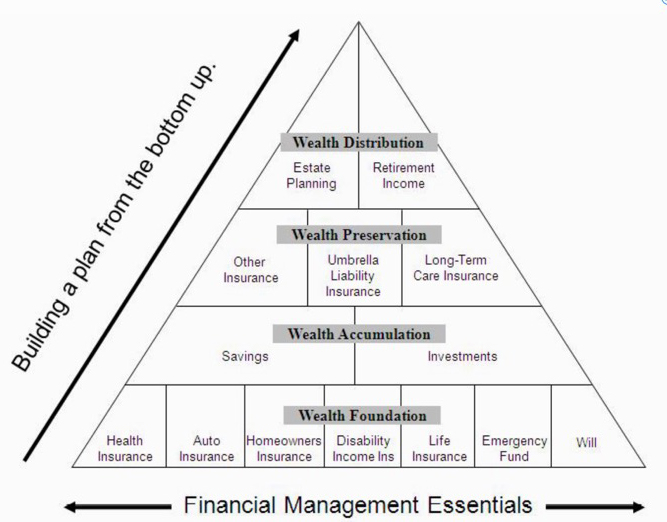
The Financial Planning Pyramid (3)

PlanningPyramid

Sources

  1. thesimpledollar.com/best-high-interest-savings-accounts/
  2. ftc.gov/faq/consumer-protection/get-my-free-credit-report
  3. The American College of Financial Services

This material was prepared by MarketingPro, Inc., and does not necessarily represent the views of the presenting party, nor their affiliates. This information has been derived from sources believed to be accurate. Please note – investing involves risk, and past performance is no guarantee of future results. The publisher is not engaged in rendering legal, accounting or other professional services. If assistance is needed, the reader is advised to engage the services of a competent professional. This information should not be construed as investment, tax or legal advice and may not be relied on for avoiding any Federal tax penalty. This is neither a solicitation nor recommendation to purchase or sell any investment or insurance product or service, and should not be relied upon as such. All indices are unmanaged and are not illustrative of any particular investment.

Smart Strategies for Coping With Student Loan Debt

design desk display eyewear

Photo by energepic.com on Pexels.com

Paying them down and managing their financial impact.

Is student loan debt weighing on the economy?

Probably. Total student loan debt in America is now around $1.5 trillion, having tripled since 2008. The average indebted college graduate leaves campus owing nearly $40,000, and the mean monthly student loan payment for borrowers aged 30 and younger is about $350. (1,2)

The latest Federal Reserve snapshot shows 44.2 million Americans dealing with lingering education loans. The housing sector feels the strain: in a recent National Association of Realtors survey, 85% of non-homeowners aged 22-35 cited education loans as their main obstacle to buying a house. Eight percent of student loan holders fail to get home loans because of their credit scores, the NAR notes; that percentage could rise because the Brookings Institution forecasts that 40% of student loan borrowers will default on their education debts by 2023. (1,3)

If you carry sizable education debt, how can you plan to pay it off?

If you are young (or not so young), budgeting is key. Even if you get a second job, a promotion, or an inheritance, you won’t be able to erase any debt if your expenses consistently exceed your income. Smartphone apps and other online budget tools can help you live within your budget day to day or even at the point of purchase for goods and services.

After that first step, you can use a few different strategies to whittle away at college loans.

  1. The local economy permitting, a couple can live on one salary and use the wages of the other earner to pay off the loan balance(s).
  2. You could use your tax refund to attack the debt.
  3. You can hold off on a major purchase or two. (Yes, this is a sad effect of college debt, but it could also help you reduce it by freeing up more cash to apply to the loan.)
  4. You can sell something of significant value – a car or truck, a motorbike, jewelry, collectibles – and turn the cash on the debt.

Now in the big picture of your budget.

You could try the “snowball method” where you focus on paying off your smallest debt first, then the next smallest, etc., on to the largest. Or, you could try the “debt ladder” tactic, where you attack the debt(s) with the highest interest rate(s) to start. That will permit you to gradually devote more and more money toward the goal of wiping out that existing student loan balance.

Even just paying more than the minimum each month on your loan will help.

Making payments every two weeks rather than every month can also have a big impact.

If a lender presents you with a choice of repayment plans, weigh the one you currently use against the others; the others might be better. Signing up for automatic payments can help, too. You avoid the risk of penalty for late payment, and student loan issuers commonly reward the move by lowering the interest rate on a loan by a quarter-point. (4)

What if you have multiple outstanding college loans?

If one of them has a variable interest rate, try addressing that one first. Why? The interest rate on it may rise with time.

Also, how about combining multiple federal student loan balances into one? That is another option. While this requires a consolidation fee, it also leaves you with one payment, perhaps at a lower interest rate than some of the old loans had. If you have multiple private-sector loans, refinancing is an option. Refinancing could lower the interest rate and trim the monthly payment. The downside is that you may end up with variable interest rates. (5)

Maybe your boss could help you pay down the loan.

Some companies are doing just that for their workers, simply to be competitive today. According to the Society for Human Resource Management, 4% of employers offer this perk. Six percent of firms with 500-10,000 workers now provide some form of student loan repayment assistance. (6)

To reduce your student debt, live within your means and use your financial creativity. It may disappear faster than you think.

Need Additional Help?

Visit the Student Loan Borrowers Assistance website. The National Consumer Law Center’s Student Loan Borrower Assistance Project is a resource for borrowers, their families, and advocates representing student loan borrowers.

Sources

  1. studentloanhero.com/student-loan-debt-statistics/
  2. cnbc.com/2018/05/24/students-would-drop-out-of-college-to-avoid-more-debt.html
  3. cnbc.com/2018/04/19/student-loan-debt-can-make-buying-a-home-almost-impossible.html
  4. nerdwallet.com/blog/loans/student-loans/auto-pay-student-loans/
  5. investorplace.com/2017/06/how-to-navigate-your-student-loan-debt/
  6. shrm.org/resourcesandtools/hr-topics/benefits/pages/student-loan-assistance-benefit.aspx

This material was prepared by MarketingPro, Inc., and does not necessarily represent the views of the presenting party, nor their affiliates. All information is believed to be from reliable sources; however we make no representation as to its completeness or accuracy. Please note – investing involves risk, and past performance is no guarantee of future results. The publisher is not engaged in rendering legal, accounting or other professional services. If assistance is needed, the reader is advised to engage the services of a competent professional. This information should not be construed as investment, tax or legal advice and may not be relied on for the purpose of avoiding any Federal tax penalty. This is neither a solicitation nor recommendation to purchase or sell any investment or insurance product or service, and should not be relied upon as such. All indices are unmanaged and are not illustrative of any particular investment.

Guide to Financing a College Education for Parents and Grandparents

johns-hopkins-university-1590925_1920

A primer for parents and grandparents.

A university education can often require financing and assuming debt.

If your student fills out the Free Application for Federal Student Aid (FAFSA) and does not qualify for a Pell Grant or other kinds of help, and has no scholarship offers, what do you do? You probably search for a student loan.

A federal loan may make much more sense than a private loan.

Federal student loans tend to offer kinder repayment terms and lower interest rates than private loans, so for many students, they are a clear first choice. The interest rate on a standard federal direct loan is 4.45%. Subsidized direct loans, which undergraduates who demonstrate financial need can arrange, have no interest so long as the student maintains at least half-time college enrollment. (1,2)

Still, federal loans have borrowing limits, and those limits may seem too low.

A freshman receiving financial support from parents may only borrow up to $5,500 via a federal student loan, and an undergrad getting no financial assistance may be lent a maximum of $57,500 before receiving a bachelor’s degree. (That ceiling falls to $23,000 for subsidized direct loans.) So, some families take out private loans as supplements to federal loans, even though it is hard to alter payment terms of private loans in a financial pinch. (1,2)

You can use a student loan calculator to gauge what the monthly payments may be.

There are dozens of them available online. A standard college loan has a 10-year repayment period, meaning 120 monthly payments. A 10-year, $30,000 federal direct loan with a 4% interest rate presents your student with a monthly payment of $304 and eventual total payments of $36,448 given interest. The same loan, at a 6% interest rate, leaves your student with a $333 monthly payment and total payments of $39,967. (The minimum monthly payment on a standard student loan, if you are wondering, is typically $50.) (3)

When must your student start repaying the loan?

Good question. Both federal and private student loans offer borrowers a 6-month grace period before the repayment phase begins. The grace period, however, does not necessarily start at graduation. If a student with a federal loan does not maintain at least half-time enrollment, the grace period for the loan will begin. (Perkins loans have a 9-month grace period; the grace period for Stafford loans resets once the student resumes half-time enrollment.) Grace periods on private loans begin once a student graduates or drops below half-time enrollment, with no reset permitted. (4)

What if your student cannot pay the money back once the grace period ends?

If you have a private student loan, you have a problem – and a very tough, and perhaps fruitless, negotiation ahead of you. If you have a federal student loan, you may have a chance to delay or lower those loan repayments. (3)

An unemployed borrower can request deferment of federal student loan payments.

A borrower can also request forbearance, a deferral due to financial emergencies or hardships. Interest keeps building up on the loan balance during a forbearance, though. (1)

At the moment, federal student loans can be forgiven through two avenues.

The first, the Public Service Loan Forgiveness (PLSF) program, requires at least 10 years of public service, government, or non-profit employment, or at least 120 student loan payments already made from the individual. The second avenue, income-driven repayment plans, first lowers the monthly payment and extends the payment timeline based on what the borrower earns. If the balance is finally forgiven, the loan forgiveness is seen by the Internal Revenue Service as taxable income. (If you have student loan debt forgiven via the PLSF, no taxes have to be paid on the amount.) (1,3)

Consult financial aid officers and high school guidance counselors before you borrow.

Get to know them; request their knowledge and insight. They have helped other families through the process, and they are ready to try and help yours.

Lastly, avoid draining the Bank of Mom & Dad.

If your student needs to finance a college education, remember that this financial need should come second to your need to save for retirement. Your student has a chance to arrange a college loan; you do not have a chance to arrange a retirement loan.

Sources:

  1. nbcnews.com/better/business/student-loan-debt-what-kids-their-parents-need-know-ncna865336
  2. www2.cuny.edu/financial-aid/student-loans/federal-direct-loans/
  3. credible.com/blog/refinance-student-loans/how-much-will-you-actually-pay-for-a-30k-student-loan/
  4. discover.com/student-loans/repayment/student-loans-semester-off.html

This material was prepared by MarketingPro, Inc., and does not necessarily represent the views of the presenting party, nor their affiliates. This information has been derived from sources believed to be accurate. Please note – investing involves risk, and past performance is no guarantee of future results. The publisher is not engaged in rendering legal, accounting or other professional services. If assistance is needed, the reader is advised to engage the services of a competent professional. This information should not be construed as investment, tax or legal advice and may not be relied on for the purpose of avoiding any Federal tax penalty. This is neither a solicitation nor recommendation to purchase or sell any investment or insurance product or service, and should not be relied upon as such. All indices are unmanaged and are not illustrative of any particular investment.

 

The Major 2018 Federal Tax Changes

1040

Comparing the old rules with the new.

The Tax Cuts and Jobs Act made dramatic changes to federal tax law.

It is worth reviewing some of these changes as 2019 approaches and households and businesses refine their income tax strategies.

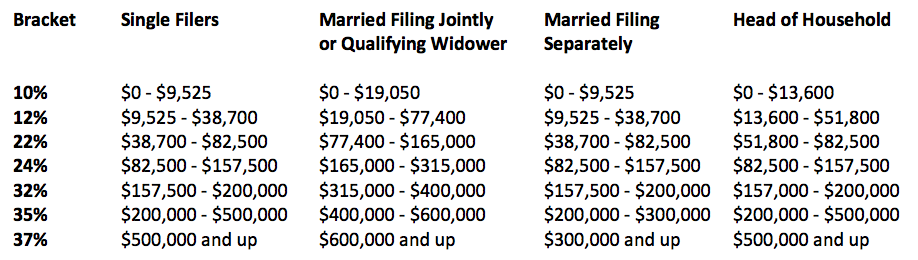
Income tax brackets have changed.

The old 10%, 15%, 25%, 28%, 33%, 35%, and 39.6% brackets have been restructured to 10%, 12%, 22%, 24%, 32%, 35%, and 37%. These new percentages are slated to apply through 2025. Here are the thresholds for these brackets in 2018.(1,2)

Screen Shot 2018-05-09 at 8.20.42 AM.png

The standard deduction has nearly doubled.

This compensates for the disappearance of the personal exemption, and it may reduce a taxpayer’s incentive to itemize. The new standard deductions, per filing status:

  • Single filer: $12,000 (instead of $6,500)
  • Married couples filing separately: $12,000 (instead of $6,500)
  • Head of household: $18,000 (instead of $9,350)
  • Married couples filing jointly & surviving spouses: $24,000 (instead of $13,000)

The additional standard deduction remains in place.

Single filers who are blind, disabled, or aged 65 or older can claim an additional standard deduction of $1,600 this year. Married joint filers are allowed to claim additional standard deductions of $1,300 each for a total additional standard deduction of $2,600 for 2018. (2,3)

The state and local tax (SALT) deduction now has a $10,000 ceiling.

If you live in a state that levies no income tax, or a state with high income tax, this is not a good development. You can now only deduct up to $10,000 of some combination of a) state and local property taxes or b) state and local income taxes or sales taxes per year. Taxes paid or accumulated as a result of business or trade activity are exempt from the $10,000 limit. Incidentally, the SALT deduction limit is just $5,000 for married taxpayers filing separately. (1,4)

The estate tax exemption is twice what it was.

Very few households will pay any death taxes during 2018-25. This year, the estate tax threshold is $11.2 million for individuals and $22.4 million for married couples; these amounts will be indexed for inflation. The top death tax rate stays at 40%. (2)

More taxpayers may find themselves exempt from Alternative Minimum Tax (AMT).

The Alternative Minimum Tax was never intended to apply to the middle class – but because it went decades without inflation adjustments, it sometimes did. Thanks to the tax reforms, the AMT exemption amounts are now permanently subject to inflation indexing.

AMT exemption amounts have risen considerably in 2018:

  • Single filer or head of household: $70,300 (was $54,300 in 2017)
  • Married couples filing separately: $54,700 (was $42,250 in 2017)
  • Married couples filing jointly & surviving spouses: $109,400 (was $84,500 in 2017)

These increases are certainly sizable, yet they pale in proportion to the increase in the phase-out thresholds. They are now at $500,000 for individuals and $1 million for joint filers as opposed to respective, prior thresholds of $120,700 and $160,900. (2)

The Child Tax Credit is now $2,000.

This year, as much as $1,400 of it is refundable. Phase-out thresholds for the credit have risen substantially. They are now set at the following modified adjusted gross income (MAGI) levels:

  • Single filer or head of household: $200,000 (was $75,000 in 2017)
  • Married couples filing separately: $400,000 (was $110,000 in 2017) (2)

Some itemized deductions are history.

The list of disappeared deductions is long and includes the following tax breaks:

  • Home equity loan interest deduction
  • Moving expenses deduction
  • Casualty and theft losses deduction (for most taxpayers)
  • Unreimbursed employee expenses deduction
  • Subsidized employee parking and transit deduction
  • Tax preparation fees deduction
  • Investment fees and expenses deduction
  • IRA trustee fees (if paid separately)
  • Convenience fees for debit and credit card use for federal tax payments
  • Home office deduction
  • Unreimbursed travel and mileage deduction

Under the conditions set by the reforms, many of these deductions could be absent through 2025. (5,6)

Many small businesses have the ability to deduct 20% of their earnings.

Some fine print accompanies this change. The basic benefit is that business owners whose firms are LLCs, partnerships, S corporations, or sole proprietorships can now deduct 20% of qualified business income*, promoting reduced tax liability. (Trusts, estates, and cooperatives are also eligible for the 20% pass-through deduction.) (4,7)

Not every pass-through business entity will qualify for this tax break in full, though.

Doctors, lawyers, consultants, and owners of other types of professional services businesses meeting the definition of a specified service business* may make enough to enter the phase-out range for the deduction; it starts above $157,500 for single filers and above $315,000 for joint filers. Above these business income thresholds, the deduction for a business other than a specified service business* is capped at 50% of total wages paid or at 25% of total wages paid, plus 2.5% of the cost of tangible depreciable property, whichever amount is larger. (4,7)

* See H.R. 1 – The Tax Cuts and Jobs Act, Part II—Deduction for Qualified Business Income of Pass-Thru Entities

We now have a 21% flat tax for corporations.

Last year, the corporate tax rate was marginally structured with a maximum rate of 35%. While corporations with taxable income of $75,000 or less looked at no more than a 25% marginal rate, more profitable corporations faced a rate of at least 34%. The new 21% flat rate aligns U.S. corporate taxation with the corporate tax treatment in numerous other countries. Only corporations with annual profits of less than $50,000 will see their taxes go up this year, as their rate will move north from 15% to 21%. (2,4)

The Section 179 deduction and the bonus depreciation allowance have doubled.

Business owners who want to deduct the whole cost of an asset in its first year of use will appreciate the new $1 million cap on the Section 179 deduction. In addition, the phaseout threshold rises by $500,000 this year to $2.5 million. The first-year “bonus depreciation deduction” is now set at 100% with a 5-year limit, so a company in 2018 can now write off 100% of qualified property costs through 2022 rather than through a longer period. Please note that bonus depreciation now applies for used equipment as well as new equipment. (1,7)

Like-kind exchanges are now restricted to real property.

Before 2018, 1031 exchanges of capital equipment, patents, domain names, private income contracts, ships, planes, and other miscellaneous forms of personal property were permitted under the Internal Revenue Code. Now, only like-kind exchanges of real property are permitted. (7)

This may be the final year for the individual health insurance requirement.

The Affordable Care Act instituted tax penalties for individual taxpayers who went without health coverage. As a condition of the 2018 tax reforms, no taxpayer will be penalized for a lack of health insurance next year. Adults who do not have qualifying health coverage will face an unchanged I.R.S. individual penalty of $695 this year. (1,8)

Sources

  1. cpapracticeadvisor.com/news/12388205/2018-tax-reform-law-new-tax-brackets-credits-and-deductions
  2. fool.com/taxes/2017/12/30/your-complete-guide-to-the-2018-tax-changes.aspx
  3. cnbc.com/2017/12/22/the-gop-tax-overhaul-kept-this-1300-tax-break-for-seniors.html
  4. investopedia.com/taxes/how-gop-tax-bill-affects-you/
  5. tinyurl.com/ycqrqwy7/
  6. forbes.com/sites/kellyphillipserb/2017/12/20/what-your-itemized-deductions-on-schedule-a-will-look-like-after-tax-reform/ 
  7. americanagriculturist.com/farm-policy/10-agricultural-improvements-new-tax-reform-bill
  8. irs.gov/newsroom/in-2018-some-tax-benefits-increase-slightly-due-to-inflation-adjustments-others-unchanged

This material was prepared by MarketingPro, Inc., and does not necessarily represent the views of the presenting party, nor their affiliates. This information has been derived from sources believed to be accurate. Please note – investing involves risk, and past performance is no guarantee of future results. The publisher is not engaged in rendering legal, accounting or other professional services. If assistance is needed, the reader is advised to engage the services of a competent professional. This information should not be construed as investment, tax or legal advice and may not be relied on for the purpose of avoiding any Federal tax penalty. This is neither a solicitation nor recommendation to purchase or sell any investment or insurance product or service, and should not be relied upon as such. All indices are unmanaged and are not illustrative of any particular investment.