Uncategorized

What Could the Impact of a Trump Reelection be on the Stock Market?

Photo by Library of Congress on Unsplash

In many ways, policies to expect would likely be similar to what’s in place today, and largely opposite of those proposed under a Biden administration. At the same time, Trump’s policies have not followed ‘traditional’ Republican ideologies from decades past in a variety of areas. The Senate Republicans have been far more predictable from a policy standpoint, as have the Congressional Democrats.

The practical factor for the election continues to be whether or not the Democrats are able to take the Senate from the Republicans, which, in addition to holding the House, would allow for the ability to push through a greater volume of progressive legislation. A split-party legislative and/or administrative branch could result in four years of gridlock, with little net change in policy. (That might be perceived as the ‘worst case’ or ‘best case’ depending on the observer.)

Little may change from a higher-level view if the first Trump term morphs into a second. But, it’s important to remember from a financial markets perspective that the President in power has been relatively unimportant in driving longer-term sentiment and returns. Attempting to time election results or moving out of markets to avoid volatility can result in sub-optimal results, even though the weeks prior to an election can become more volatile. Interestingly, in the cases where an incumbent is seeking re-election, one of the few consistent tendencies over the past century is based on U.S. stock market results in the three months prior to Election Day. Based on the S&P 500, a positive return for that stretch has proven favorable for an incumbent’s chances, while a negative return has favored the challenger. (For perspective’s sake, from the window starting Aug. 3, the market is up 0.75% through Fri., Sept. 18—with several more weeks to go until Nov. 3.)

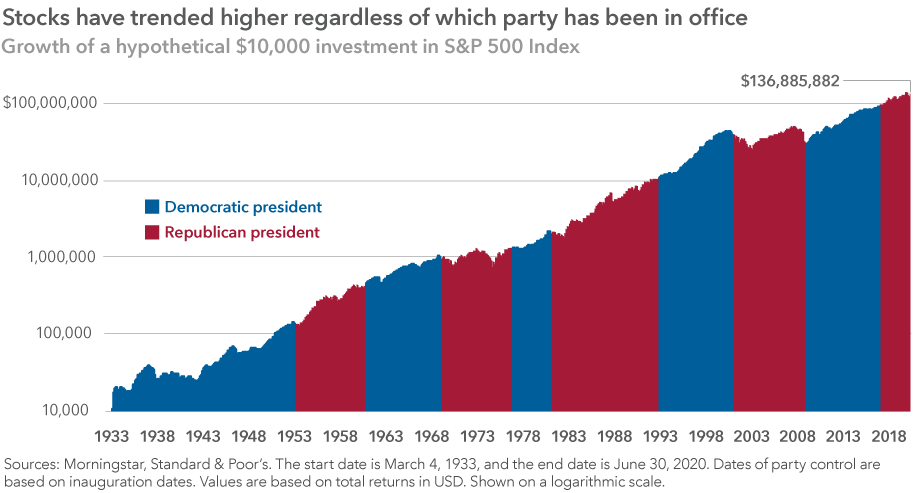
That said, while politics can coincide with day-to-day financial market movements at times, the two rarely correlate meaningfully over the long haul. The chart below bears this out fairly dramatically:
The following policy items assume that a Trump reelection is accompanied by Republicans retaining the Senate, which creates a ‘status quo’ situation. A newly Democratic senate majority would create more of a wildcard:

Taxes

It is probably safe to assume the tax cuts from 2017 would remain in place. These have served to benefit corporations, which receive an immediate boost to the bottom line, resulting in higher reported earnings. Consequently, this models out to higher multi-year growth and justifies higher equity valuations. Personal income tax rates would likely also remain low, along with capital gains rates. Traditional supply-side economists argue that stronger corporate performance and fewer hurdles (such as regulation and taxes) result in a larger ‘pot’ for everyone. However, this assumes that wealth trickles down proportionately to all workers, which has been debated in recent years as income equality between different groups has widened.

Environment

This would also be assumed to be status quo, which includes minimal promotion of green technologies. It would likely be coupled with a pushback on more stringent standards, such as those adopted by California (whose standards predate the EPA and are often stricter). While the energy sector has been struggling with low petroleum prices, due to weaker demand due to the pandemic, current policies would keep additional regulatory headwinds at bay. However, energy firms have been hurt far more by weaker demand from the pandemic than by other factors.
U.S.-China relations and trade. The geopolitical tension with China has been steadily growing, and a status quo result would assume more of the same. It’s been claimed by some China experts that the country is currently just playing a ‘waiting game’—for the Trump administration to eventually end, and to instead deal with the successor. As part of their 50- and 100-year national plans, such a delay is seen as just a temporary roadblock. The important component is that a tough U.S. stance on China has support across the aisle—it’s one of the few policy items both parties agree on. So, a longer-term decoupling is likely, although the public stances and negotiation styles could differ between administrations.

Antitrust Legislation

In years past, some Democratic platforms have been seen as anti-corporate (and conversely, pro-worker). This would have translated to a crackdown on large ‘oligopolies’ and a reining in of corporate power in the economy and society. In the current case, argued by some due to the more progressive political leanings of large tech companies, Democrats have appeared less interested in breaking up these firms. Republicans have certainly appeared more interested. Since it’s not quite clear where any ‘abuses’ lie and how consumers are adversely affected (many argue they’ve benefited greatly through both product variety and cost), this issue remains complex and path unclear.

Workers

In line with trends seen globally, not just in the U.S., both parties have taken on a more populist tone in recent years, largely in keeping with the larger societal income gaps. The polarization has taken place far more on the political side than the socioeconomic side, as all parties want to be seen as ‘pro-working class.’ This creates a conundrum, although no clear evolution in policy. Continued trade restrictions may help U.S. firms in the near term, although it’s not clear that benefits trickle down to workers longer-term and could hurt consumers through higher prices. Contrary to the Biden agenda, a second Trump administration would make more progressive items, such as a higher minimum wage and other benefits less likely—although these also depend on the Congressional makeup.

Healthcare

A Trump administration would likely continue to fight ‘Obamacare,’ and continue support for the current private insurance-based healthcare model. Despite the battles over universal coverage/single-payer format, there remains no constructed alternative to the current system for legislators to gravitate to. However, there is bi-partisan populist support for better regulation of high pharmaceutical prices and plugging some gaps to help reduce medical care costs for seniors. The industry has fought back on pharma prices, arguing that profits feed back into research and development for important new therapies, so this has largely resulted in a stalemate in recent years.

Defense

A traditional Republican policy platform has been a strong defense base. This is thought likely to persist, although the Trump administration has focused on far less global interventionism. This hasn’t manifested completely, but could continue to play a role in broader policy thinking. At the same time, China has been viewed as an increasing global military threat, which would necessitate further spending. The trend has been moving from conventional military spending towards new technologies, such as cyberwarfare, satellites, drones, etc.—all of which are technologically complex and expensive.

Immigration

The border ‘wall’ has largely been symbolic, as the Trump administration has clamped down on immigration mostly through policy, which would seem likely to continue in a second term. This has provided a seeming veil of protection for U.S. workers (championed by both candidates in different ways), but economists, who view labor in a global context, see increased restrictions of any kind as a hurdle to stronger economic performance. This is a complex issue, with outcomes the result of multi-decade trends, so the policy action of a single President may only provide a short-term impact on GDP growth. Demographics and business/worker competitiveness play a far more important role, with job training and education enhancements acting as a behind-the-scenes policy championed by many but not discussed as much by candidates in terms of specific plans.

Less stringent regulatory environment.

The President promised to rollback regulations imposed over the past administration, including the expanded use of executive orders, and that has certainly occurred. It’s likely another four years would continue regulation downsizing, in a generally pro-business way, including financial markets and their oversight.

Fiscal policy

The old stereotypes have been cast aside, as parties on both sides are in a spending mode. Republicans are a bit less in favor of direct stimulus to workers (at least in the same large amounts Democrats have been), and more in favor of corporate injections. During the pandemic, airlines and the travel industry have been lobbying especially hard for more aid. This pandemic will end up being expensive regardless of who ends up in the White House, with debt ramifications far beyond the next four years.
Monetary policy. As noted earlier, a central bank should be agnostic to political pressures, but that has been easier said than done. Pressure to lower rates or keep policy as ‘easy’ as possible is preferred, since it coincides with keeping the economy growing—which most administrations prefer under their watch. The U.S. Fed has sidestepped such pressure far better than in some countries, of course, but a continuation of the current administration and ‘tweeting’ about central bank decisions runs the risk of negatively influencing public opinion about the Fed and its functions. Politics can also appear in the nomination of certain new board members, such as the controversial Judy Shelton (who has favored revisiting the gold standard—a position rejected by many mainstream economists). Regardless, the Fed has continued to stay out of the political fray over the decades, despite a variety of administrations holding opposing views.

Judicial branch

The Supreme Court is typically not a top concern of financial markets, but with the passing of Justice Ruth Bader Ginsburg, a position on the bench has opened. Any new appointee’s political leanings can tilt the balance of key decisions toward either the conservative or progressive end of the spectrum. So, this can have ramifications for decisions involving business, regulations, or any other economically-relevant area.

Avoid Market Timing Around Politics

Sticking with a sound long-term investment plan based on individual investment objectives is usually the best course of action. Whether that strategy is to be fully invested throughout the year or to consistently invest through a vehicle such as a 401(k) plan, the bottom line is that investors should avoid market timing around politics. As is often the case with investing, the key is to put aside short-term noise and focus on long-term goals.

3 Tips for Successful Investing in an Election Year

  1. Don’t allow election predictions and outcomes to influence investment decisions. History shows that election results have very little impact on long-term returns.
  2. Expect volatility, especially during primary season, but don’t fear it. View it as a potential opportunity.
  3. Stick to a long-term investment strategy instead of trying to time markets around elections. Investors who were fully invested or made regular, monthly investments did better than those who stayed in cash in election years. (3)

Sources

  1. LSA Portfolio Analytics
  2. https://www.capitalgroup.com/ria/insights/articles/election-watch-2020.html
  3. https://www.capitalgroup.com/advisor/pdf/shareholder/MFGEBR-121-632421.pdf
  4. https://www.capitalgroup.com/ria/insights/articles/3-investor-mistakes-election-year.html

What the 2020 U.S. Election Means for Investors: 4 Potential Scenarios

Photo by Element5 Digital on Pexels.com

Heading into 2020, there was little doubt that the U.S. presidential election would be the biggest story of the year. The coronavirus pandemic drastically changed that narrative, pushing the election aside as a health care crisis triggered the worst economic downturn since the Great Depression.

With the election now less than 100 days away, however, investors are turning their attention back to the November 3 ballot. Amid rising COVID-19 infections, a battered economy and civil unrest in several U.S. cities, President Donald Trump is trailing former Vice President Joe Biden by a wide margin in major polls.

Many pundits are predicting defeat for the president, but it’s far too early for investors to anchor on that outcome, says Capital Group veteran political economist Matt Miller.

“We have more than three months to go before the election. That’s a lifetime in politics,” Miller says. “Given the rapid pace of developments and a compressed news cycle, we could have many turns of the wheel between now and November. In my view, the race will tighten as the Republican and Democratic campaigns shift into overdrive.”

Election Scenario Planning

For long-term investors, the outcome of U.S. presidential elections hasn’t mattered as much as staying invested and maintaining a diversified portfolio. Markets have tended to power through presidential elections — with some volatility along the way — regardless of whether a Democrat or Republican won the White House.

That said, election scenario planning plays a role in macroeconomic analysis, particularly in recent years as governments have increasingly intervened in the financial markets during times of crisis.

Excluding a contested election — which is certainly within the realm of possibility — here’s a brief look at four scenarios that could play out in November and potential implications for investors.

SCENARIO #1
Democratic Sweep

Democrats win the White House, the Senate and maintain control of the House — otherwise known as a “blue wave.” This scenario would produce the greatest degree of political change, starting with the likely reversal of Trump’s policy agenda on many fronts, including taxes, immigration and regulation.

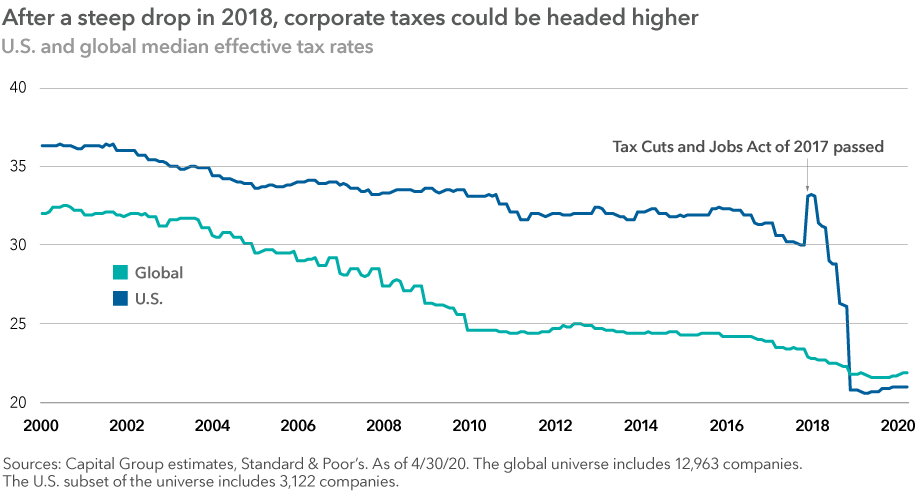
One result could be a full or partial rollback of the Tax Cuts and Jobs Act of 2017, which included significant tax reductions. Overall corporate tax rates declined from 35% to 21%, providing a major boost to corporate earnings. A full or partial reversal would have the opposite effect, prompting investors to take that into account when estimating the overall corporate earnings outlook.

“We would see a much bigger emphasis on taxation and regulation across the board, with significant implications for the energy sector, telecommunications and technology companies,” Miller explains. “We could also see the elimination of the filibuster in the Senate, which, unlike today, would allow legislation to pass with a simple majority vote.”

SCENARIO #2
Gridlock

Biden wins the White House; Republicans maintain control of the Senate. This outcome would likely result in a gridlock scenario where it could be difficult to pass major legislation. Senate Republicans could block major Democratic initiatives, much as they did during the second term of the Obama presidency.

“In this case, I think we would see Biden governing through executive orders,” says Clarke Camper, head of government relations in Capital Group’s Washington, D.C. office. “There would be a great deal of pent-up frustration on both sides of the aisle. That’s an easy outcome to predict, though, perhaps not as easy to live with.”

Under this scenario, federal regulatory agencies would also likely exercise more power. From a financial markets perspective, that could mean more aggressive enforcement by the Securities and Exchange Commission, as well as a renewed policy push by the Department of Labor in connection with its oversight of employee retirement plans.

SCENARIO #3
Status Quo

Trump wins reelection, and Republicans keep the Senate. This scenario involves the least amount of change since it is, indeed, where we are today. The House is likely to remain in Democratic hands, so the current environment of political confrontation would continue — along with the rancorous attempts to approve COVID-19 relief legislation, including the $2 trillion CARES Act.

“Regardless of who is in the White House in January, there’s going to be a lot of post-COVID cleanup work to do,” explains Reagan Anderson, a senior vice president with Capital’s government relations team. “Today we are in stabilization mode, and we will hopefully be moving into recovery mode by 2021.”

SCENARIO #4
Unlikely Split

Trump wins reelection, and Democrats take the Senate. This scenario could set the stage for even greater hostility than we’ve seen in the past two years. While such an outcome is theoretically possible, it’s unlikely given the political dynamics of key Senate races, which increasingly track the presidential vote in each state.

“For instance, if Republicans lose key Senate races in Arizona, Colorado, Maine and North Carolina, then that’s clearly indicative of a ‘blue wave,’” Miller explains. “It’s hard to imagine Trump winning the White House if that happens.”

Either scenario involving Trump’s reelection raises another risk: If he wins without a majority of the popular vote as he did in 2016, Miller warns, that could lead to more civil unrest and further demands to abolish the Electoral College.

Investment Implications

Election season can be a tough time for investors to maintain a long-term perspective, given the strong emotions often evoked by politics. Campaign rhetoric tends to amplify negative and divisive issues. This election, in particular, is unprecedented in modern times — marked by the combination of a deadly pandemic, a global economic recession, widespread civil unrest and extreme market volatility.

Moving to the sidelines would be an understandable approach for anxious investors who prefer to wait and see what happens. As history has shown, however, that is often a mistake. What matters most is not election results, but staying invested.

Consider the historical performance of the Standard & Poor’s 500 Composite Index over the past eight decades. In 18 of 19 presidential elections, a hypothetical $10,000 investment made at the beginning of each election year would have gained value 10 years later. That’s regardless of which party’s candidate won. In 15 of those 10-year periods, a $10,000 investment would have more than doubled. While past results do not guarantee future returns, election-year jitters should not deter investors from maintaining a long-term perspective.

The only negative 10-year period followed the election of George W. Bush in the year 2000. During that decade, the S&P 500 posted a negative return amid two seismic events: the 2000 dot-com crash and 2008 global financial crisis.

In contrast, the biggest election year return would have been in 1988, when George H. W. Bush won office, and $10,000 would have grown to $52,567 by the end of 1997.

By design, elections have winners and losers, but the real winners have been investors who stayed the course and avoided the temptation to time the market.

Sources

  1. https://www.capitalgroup.com/ria/insights/articles/election-watch-2020.html
  2. https://www.capitalgroup.com/advisor/pdf/shareholder/MFGEBR-121-632421.pdf

Matt Miller is a political economist at Capital Group and host of the Capital Ideas podcast. He was formerly a senior advisor at McKinsey, a Washington Post columnist and author, host of public radio’s “Left, Right & Center” program, and a Clinton White House aide. He holds a law degree from Columbia and a bachelor’s degree in economics from Brown.

Clarke Camper is head of government relations at Capital Group. Prior to joining Capital, he was head of government affairs and public advocacy at NYSE Euronext. Before that, he was a vice president of external affairs at GE Capital. He holds a law degree and a master’s degree in public policy from Harvard, and a bachelor’s degree in public policy from Stanford.

Reagan Anderson is a member of the government relations team at Capital Group. Prior to joining Capital, Reagan worked as a senior vice president for congressional affairs at the Consumers Bankers Association. Before that, she held various positions in government affairs for the New York Stock Exchange and the Private Equity Growth Capital Council. Reagan holds a journalism degree from Ohio University.

Investments are not FDIC-insured, nor are they deposits of or guaranteed by a bank or any other entity, so they may lose value.

Investors should carefully consider investment objectives, risks, charges and expenses. This and other important information is contained in the fund prospectuses and summary prospectuses, which can be obtained from a financial professional and should be read carefully before investing.

Statements attributed to an individual represent the opinions of that individual as of the date published and do not necessarily reflect the opinions of Capital Group or its affiliates. This information is intended to highlight issues and should not be considered advice, an endorsement or a recommendation.

All Capital Group trademarks mentioned are owned by The Capital Group Companies, Inc., an affiliated company or fund. All other company and product names mentioned are the property of their respective companies.

American Funds Distributors, Inc., member FINRA.

This content, developed by Capital Group, home of American Funds, should not be used as a primary basis for investment decisions and is not intended to serve as impartial investment or fiduciary advice.

Indexes are unmanaged and, therefore, have no expenses. Investors cannot invest directly in an index.

Standard & Poor’s 500 Composite Index is a market capitalization-weighted index based on the results of approximately 500 widely held common stocks. Standard & Poor’s 500 Composite Index (“Index”) is a product of S&P Dow Jones Indices LLC and/or its affiliates and has been licensed for use by Capital Group. Copyright © 2020 S&P Dow Jones Indices LLC, a division of S&P Global, and/or its affiliates. All rights reserved. Redistribution or reproduction in whole or in part is prohibited without written permission of S&P Dow Jones Indices LLC.

Roth IRA Conversion in the Era of COVID-19: Is Now the Right Time for You?

Image by Nattanan Kanchanaprat from Pixabay

The COVID-19 pandemic has shaken up nearly every aspect of American life. To say it’s been a difficult time would be an understatement.

However, difficult times may open doors to new possibilities. Businesses are changing their ways of operating, and individuals are exploring new avenues for investment. It may be time for you to consider some opportunities, as well.

What is a Roth Conversion?

A Roth conversion refers to the transfer of an Individual Retirement Account (IRA), either Traditional, SIMPLE, or SEP-IRA, into a Roth IRA. With Roth IRAs, you pay tax on the money before it transfers into the account.

One benefit to having your money in the Roth IRA is that, unlike a Traditional IRA, you currently are not obligated to take Required Minimum Distributions (RMDs) after you reach age 72 (RMDs would be required to any non-spousal beneficiaries, however).

Another benefit is that since the money was taxed before going into the Roth IRA, any distributions are tax-free. Keep in mind that tax rules are constantly changing, and there is no guarantee that Roth IRA distributions will remain tax-free. (1,2)

Why Go Roth in 2020?

In the face of the market downturn after the COVID-19 outbreak, you may be in a unique financial situation. For example, suppose you have an IRA account that was worth $1 million before the downturn, but it’s currently worth $800,000.

Perhaps your income has also decreased, potentially putting you in a lower tax bracket. Maybe you own one or more businesses, such as restaurants, that have been closed. You may not yet know if these businesses will be opening again in 2020. Your income could hypothetically be considerably lower this year than last year.

But: this may present an opportunity. Less earned income may mean lower total taxes due on a Roth conversion, especially if the overall account value has dropped.

Keep in mind, this article is for information purposes only and is making an assumption on an IRA account’s value and applying a hypothetical drop in earned income. We recommend you contact your tax or legal professional before modifying your retirement investment strategy.

No Turning Back.

While this may be a good time for you to consider converting to a Roth IRA, remember that there’s no turning back once you do. The Tax Cuts and Jobs Act of 2017 decreed that Roth conversions could no longer be undone. (3)

A Roth IRA conversion is a complicated process, and it’s wise to involve your trusted financial professional.

▲ Evaluate a Roth at different life stages

The decision to make a pre-tax/deductible contribution to a Traditional 401(k) or IRA or an after-tax contribution to a Roth 401(k) or Roth IRA is based on the income tax rate of the individual at the time of making the contribution, and his/her anticipated tax rate in the future. The difference in tax rates can be caused by an investor’s personal situation and/or tax policy over time. This chart shows a typical wage curve and the general “rule of thumb” about what type of contribution may be most appropriate based on current income and the bracket in retirement. An additional consideration is to maintain a healthy mix of taxable, tax-free (Roth) and tax-deferred accounts so that you can have greater flexibility to manage your income taxes. The numbers on the chart specify situations in which contributing to a Roth option should be carefully considered.

Sources

  1. Investopedia.com, November 26, 2019.
  2. Investopedia.com, January 17, 2020.
  3. Congress.gov, December 22, 2017.
  4. https://am.jpmorgan.com/us/en/asset-management/gim/adv/insights/guide-to-retirement

This material was prepared by MarketingPro, Inc., and does not necessarily represent the views of the presenting party, nor their affiliates. This information has been derived from sources believed to be accurate. Please note – investing involves risk, and past performance is no guarantee of future results. The publisher is not engaged in rendering legal, accounting or other professional services. If assistance is needed, the reader is advised to engage the services of a competent professional. This information should not be construed as investment, tax or legal advice and may not be relied on for the purpose of avoiding any Federal tax penalty. This is neither a solicitation nor recommendation to purchase or sell any investment or insurance product or service, and should not be relied upon as such. All indices are unmanaged and are not illustrative of any particular investment. To qualify for the tax-free and penalty-free withdrawal of earnings, Roth IRA distributions must meet a five-year holding requirement and occur after age 59½. Tax-free and penalty-free withdrawal also can be taken under certain other circumstances, such as a result of the owner’s death. The original Roth IRA owner is not required to take minimum annual withdrawals.

Getting Your Affairs in Order Amid the COVID-19 Pandemic and the Mistakes to Avoid

Photo by Pixabay on Pexels.com

In times like these thinking or talking about your will is often the least likely thing we’d want to discuss. However, having one in place is important, especially now. As you review your situation here are some common and not-so-common estate planning mistakes to avoid:

Doing it all yourself.

While you could write your own will or create a will, it can be risky to do so. Sometimes simplicity has a price. Look at the example of Aretha Franklin. The “Queen of Soul’s” estate, valued at $80 million, was divided under a handwritten or “holographic” will. Her wills were discovered among her personal effects. Provided that the will was authenticated, it would be probated under Michigan law, but such unwitnessed documents are not necessarily legally binding. (1)

Failing to update your will or trust after a life event.

Relatively few estate plans are reviewed over time. Any major life event should prompt you to review your will, trust, or other estate planning documents. So should a major life event that affects one of your beneficiaries.

Appointing a co-trustee.

Trust administration is not for everyone. Some people lack the interest, the time, or the understanding it requires, and others balk at the responsibility and potential liability involved. A co-trustee also introduces the potential for conflict.

Being too vague with your heirs about your estate plan.

While you may not want to explicitly reveal who will get what prior to your passing, your heirs should understand the purpose and intentions at the heart of your estate planning. If you want to distribute more of your wealth to one child than another, write a letter to be presented after your death that explains your reasoning. Make a list of which heirs will receive collectibles or heirlooms. If your family has some issues, this may go a long way toward reducing squabbles as well as the possibility of legal costs eating up some of this-or-that heir’s inheritance.

Leaving a trust unfunded (or underfunded).

Through a simple, one-sentence title change, a married couple can fund a revocable trust with their primary residence. As an example, if a couple retitles their home from “Heather and Michael Smith, Joint Tenants with Rights of Survivorship” to “Heather and Michael Smith, Trustees of the Smith Revocable Trust dated (month)(day), (year).” They are free to retitle myriad other assets in the trust’s name. (1)

Ignoring a Caregiver with Ulterior Motives.

Very few people consider this possibility when creating a will or trust, but it does happen. A caregiver harboring a hidden agenda may exploit a loved one to the point where they revise estate planning documents for the caregiver’s financial benefit.

The best estate plans are clear in their language, clear in their intentions, and updated as life events demand. They are overseen through the years with care and scrutiny, reflecting the magnitude of the transfer of significant wealth.

▲ Use this checklist to help you create an estate plan or update your existing estate plan.

Sources

  1. detroitnews.com/story/news/local/oakland-county/2019/05/20/lawyer-says-3-handwritten-wills-found-aretha-franklin-home/3747674002/

This material was prepared by MarketingPro, Inc., and does not necessarily represent the views of the presenting party, nor their affiliates. This information has been derived from sources believed to be accurate. Please note – investing involves risk, and past performance is no guarantee of future results. The publisher is not engaged in rendering legal, accounting or other professional services. If assistance is needed, the reader is advised to engage the services of a competent professional. This information should not be construed as investment, tax or legal advice and may not be relied on for the purpose of avoiding any Federal tax penalty. This is neither a solicitation nor recommendation to purchase or sell any investment or insurance product or service, and should not be relied upon as such. All indices are unmanaged and are not illustrative of any particular investment.

Key Provisions of the Coronavirus Aid, Relief, and Economic Security (CARES) Act

Image by travis1776 from Pixabay

Recently, the $2 trillion “Coronavirus Aid, Relief, and Economic Security” (“CARES”) Act was signed into law. The CARES Act is designed to help those most impacted by the COVID-19 pandemic, while also providing key provisions that may benefit retirees. (1)

To put this monumental legislation in perspective, Congress earmarked $800 billion for the Economic Stimulus Act of 2008 during the financial crisis. (1)

The CARES Act has far-reaching implications for many. Here are the most important provisions to keep in mind:

Stimulus Check Details

Americans can expect a one-time direct payment of up to $1,200 for individuals (or $2,400 for married couples) with an additional $500 per child under age 17. These payments are based on the 2019 tax returns for those who have filed them and 2018 information if they have not. The amount is reduced if an individual makes more than $75,000 or a couple makes more than $150,000. Those who make more than $99,000 as an individual (or $198,000 as a couple) will not receive a payment. (1)

Business Owner Relief

The act also allocates $500 billion for loans, loan guarantees, or investments to businesses, states, and municipalities. (1)

Your Inherited 401(k)s

People who have inherited 401(k)s or Individual Retirement Accounts can suspend distributions in 2020. Required distributions don’t apply to people with Roth IRAs; although, they do apply to investors who inherit Roth accounts. (2)

RMDs Suspended

The CARES Act suspends the minimum required distributions most people must take from 401(k)s and IRAs in 2020. In 2009, Congress passed a similar rule, which gave retirees some flexibility when considering distributions. (2,3)

Withdrawal Penalties

Account owners can take a distribution of up to $100,000 from their retirement plan or IRA in 2020, without the 10-percent early withdrawal penalty that normally applies to money taken out before age 59½. But remember, you still owe the tax. (4)

Many businesses and individuals are struggling with the realities that COVID-19 has brought to our communities. The CARES Act, however, may provide some much-needed relief. Contact your financial professional today to see if these special 2020 distribution rules are appropriate for your situation.

Sources

  1. CNBC.com, March 25, 2020.
  2. The Wall Street Journal, March 25, 2020.
  3. The Wall Street Journal, March 25, 2020.
  4. The Wall Street Journal, March 25, 2020.

This material was prepared by MarketingPro, Inc., and does not necessarily represent the views of the presenting party, nor their affiliates. This information has been derived from sources believed to be accurate. Please note – investing involves risk, and past performance is no guarantee of future results. The publisher is not engaged in rendering legal, accounting or other professional services. If assistance is needed, the reader is advised to engage the services of a competent professional. This information should not be construed as investment, tax or legal advice and may not be relied on for the purpose of avoiding any Federal tax penalty. This is neither a solicitation nor recommendation to purchase or sell any investment or insurance product or service, and should not be relied upon as such. All indices are unmanaged and are not illustrative of any particular investment.

Under the CARES act, an accountholder who already took a 2020 distribution has up to 60 days to return the distribution without owing taxes on it. This material is not intended as tax or legal advice. Please consult legal or tax professionals for specific information regarding your individual situation. Under the SECURE Act, your required minimum distribution (RMD) must be distributed by the end of the 10th calendar year following the year of the Individual Retirement Account (IRA) owner’s death. Penalties may occur for missed RMDs. Any RMDs due for the original owner must be taken by their deadlines to avoid penalties. A surviving spouse of the IRA owner, disabled or chronically ill individuals, individuals who are not more than 10 years younger than the IRA owner, and children of the IRA owner who have not reached the age of majority may have other minimum distribution requirements.

Under the CARES act, an accountholder who already took a 2020 distribution has up to 60 days to return the distribution without owing taxes on it. This material is not intended as tax or legal advice. Please consult legal or tax professionals for specific information regarding your individual situation. Under the SECURE Act, in most circumstances, once you reach age 72, you must begin taking required minimum distributions from a Traditional Individual Retirement Account (IRA). Withdrawals from Traditional IRAs are taxed as ordinary income, and if taken before age 59½, may be subject to a 10% federal income tax penalty. You may continue to contribute to a Traditional IRA past age 70½ under the SECURE Act, as long as you meet the earned-income requirement.

Account holders can always withdraw more. But if they take less than the minimum required, they could be subject to a 50% penalty on the amount they should have withdrawn – except for 2020.

A Smart Investor’s Antidote to Corona Virus Fears: Diversified Asset Allocation

Image by Thomas Gerlach from Pixabay

Financial markets have been especially hard-hit, with reports of new coronavirus (COVID-19) cases appearing in South Korea, Italy, and Iran. The uncertainty over transmission and fears of a global pandemic—and resulting slowdown in economic/financial activity—has led to the sharp negative response in risk markets.

Of course, there is still much about the medical side of this that is unknown, related to level of contagion, transmission mechanisms, incubation periods, and development of a vaccine. Commentary on these issues would only speculation at this point. Financial markets, as we have said many times, can adapt when conditions are certain (even if the news is terrible, prices will sharply discount themselves accordingly). However, higher levels of uncertainty create a wider path of probabilistic outcomes, which make it more difficult to pinpoint what various assets are worth at a single moment. This process of market price discovery is important, and can be thrown off-track temporarily by events like this.

As seen in the chart below, equity market indexes have typically experienced an average of a half-dozen to a dozen or more days per year when prices rise or fall by at least +/- 2%. But, we haven’t experienced such a day since last August, and the last several years have been far less volatile than average. So, we’ve likely become far more sensitive to ‘normal’ market volatility. As in the past, these uncertainties have tended to pass, problems are solved, the current worry moves on to a new one (as global trade fears have moved to this), and human conditions generally improve over time. This results in economic growth, rather than decline, and also explains why risk assets like equities have tended to win more than lose over history.

In the near term, how unpleasant this hiccup becomes is yet to be determined, and perhaps we’ll have to endure more down days. In a global environment already suffering from slower growth and looking for catalysts for improvement, the timing of a one-off event like a virus is far from optimal. China has already been impacted through quarantines, and by store/factory closures that have a direct impact on shutting down economic activity. If this spreads further, other regions could also be similarly affected. But, at some point, normal business and consumer activity will resume.

The best course, as we believe is always the case, is an adequately diversified asset allocation.

It’s an important reminder, that while segments such as bonds do not look exciting from a forward-looking return perspective, especially considering the high correlation between starting bond yields (currently low) and forward-looking multi-year total returns, these prove their worth during times of crisis. Over time, periodic equity ‘resets’ also help keep equity valuations in check, potentially preventing excess exuberance that could eventually result in worse outcomes down the road if the most optimistic predictions prove unsustainable. A skeptical market is likely a healthier one.

Corona Virus Fears Hit the Market

Financial markets have fallen sharply on concerns of the coronavirus, a respiratory illness first identified in Wuhan, China, spreading globally. While the headlines have been worrying, and no loss of human life is insignificant, it is important to understand the facts. The framework we have adopted for discussing this virus is to consider the three components of a pandemic—contagion, severity and treatment—and how the evolution of those components can shift the market narrative.

The Three Components of a Pandemic:

1. CONTAGION

As of January 30, there are approximately 9,776 confirmed cases. While China is the epicenter of the virus, there have been 118 confirmed cases outside of China in 22 different countries and regions. As a point of comparison, the SARS (severe acute respiratory syndrome) outbreak in 2003 lasted about 9 months, from November 2002 to July 2003, with cases spanning 29 countries. While Chinese authorities have responded by placing over a dozen cities on lockdown, there have been a number of challenges in preventing the spread of the virus:

  • Chinese New Year: Inception of the illness occurred just before Chinese New Year, when an estimated 400 million Chinese take approximately 3 billion trips over the 40-day festival period.
  • Incubation: The virus could have an incubation period of up to 14 days, meaning it could take up to 2 weeks before an infected individual presents symptoms, making policing the spread of the virus challenging.
  • Airborne nature: The virus spreads via droplet transmission (coughs, sneezes etc.)

The rising contagion level is what seems to have triggered uncertainty among investors.

2. SEVERITY

There is no clear information on the actual severity of the virus. As of January 30, there are 213 confirmed deaths related to coronavirus; however, there are few details related to these deaths (e.g. age of patients, additional complications, how quickly they sought medical help). Historically, severity levels have varied dramatically. According to the World Health Organization (WHO), of the 8,098 global cases of probable SARS reported, there were 774 deaths, or a 9.6% fatality rate; meanwhile, the Swine Flu outbreak in 2009 had a much lower level of just 0.03%. Historical analysis related to pandemics is somewhat limited as each illness has its own unique components and considerations.

One promising sign is that there are 187 reported cases of patients who have recovered and were discharged from the hospital. If severity does begin to rise along with contagion, then investor concerns may mount further as potential loss of life and economic damage rises.

3. TREATMENT

Viruses, such as the coronavirus, are difficult to treat. It is possible to vaccinate against many viruses, but the development and roll-out of a potential vaccine can take time. At this stage, treatment options are relatively unknown, adding to investor uncertainty.

Economic and Market Implications

At this point, the market is reacting to contagion, as we have seen identified cases rapidly increase. What may exacerbate or alleviate the market reaction is how treatment and severity evolve.

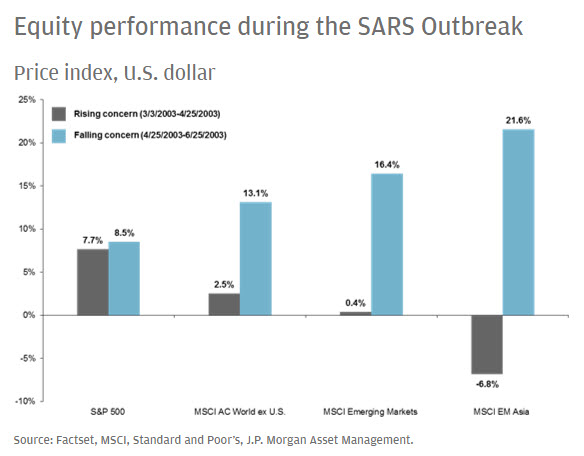
What we saw back in 2003 with the SARS outbreak was that it had the most significant impact on air travel, tourism, and domestic demand in Asia. Hong Kong, for example, experienced some of the most severe economic impacts, with its GDP growth falling by -0.5% y/y in 2Q 2003, and its retail sales declining by -7.7% y/y that quarter. China’s growth slowed to 9.1% y/y, and its retail sales, industrial production, and fixed asset investment suffered. However, these rebounded quickly as the new cases dropped and the Chinese government offered supportive economic measures. As highlighted in the chart below, U.S. equities fared better than stocks in EM Asia when concerns over SARS were rising. However, Asian stocks rebounded once concerns about SARS abated. This indicates that prevailing market conditions and fundamentals have a more prominent influence on returns. Unfortunately, the current environment is one of slowing global growth and earnings.

The coronavirus is likely to impact the economy and markets in similar ways, although perhaps to a greater extent. In China, for example, the nature of its economy has changed materially since the SARS outbreak, shifting from an industrializing economy to a more consumer and service-oriented economy. To complicate matters, this outbreak coincides with the Lunar New Year in China, the most important holiday for travel and consumption. As mentioned above, the estimated 3 billion trips taken over this period are likely to be negatively impacted by travel restrictions for 35 million people, and others canceling their plans. Already, travel was down -28.8% on the first day of Lunar New Year compared to the first day last year, according to the Ministry of Transport. Additionally, last year Chinese consumers spent nearly $150 billion in just the first week of Chinese New Year according to the Ministry of Commerce, but this year, with many confined to their homes, consumption may also drop. A few major multinational companies are temporarily closing factories in the region or re-routing supply chains.

Impacts to the Chinese economy, which has already faced headwinds from slowing global and domestic demand and external trade pressures, are likely to be the most pronounced, and are likely to elicit a policy response from the Chinese government. However, for U.S. investors, markets may be more likely to stabilize, as we have seen few protracted market declines due to health crises, geopolitical risks, natural disasters or political turmoil.

How Might the Coronavirus Impact the Global Economy and Markets?

Image by skeeze from Pixabay

The spread of the new coronavirus has taken over the headlines and hijacked market sentiment in recent weeks. Thus far, through available medical data, it appears that while the virus appears more contagious than the similar SARS epidemic in 2003, it is less lethal. The fatality rate for the coronavirus has been 3% or so thus far, relative to 9% for SARS at its peak.

Current Impact

The idiosyncratic elements included in such events—such as the World Health Organization declaring China’s surging infections a global public health emergency, the Russians closing their land border, and drastically reduced air travel—all added to market worries. The week ended with more questions about the level of contagion, and lethality, as a few hundred travelers from the Wuhan epicenter were quarantined in California, which is the first such domestic action in decades.

From an economic standpoint, it appears that the global economic growth pace could be reduced by as much as 0.5-1.5% for Q1, based on best estimates, if conditions peak and recover similar to past experience. In the worst case, this may lengthen the period of global growth slowdown experienced and defer a recovery into mid-year or a bit beyond, as opposed to earlier 2020. This growth impact mostly impacts China, due to reduced travel, but also a slowdown or stoppage of domestic consumption, including entertainment, such as restaurants and consumer goods. This could affect large multi-national brands, but also any company sensitive to general business conditions, as well as energy commodities.

Previous Epidemics

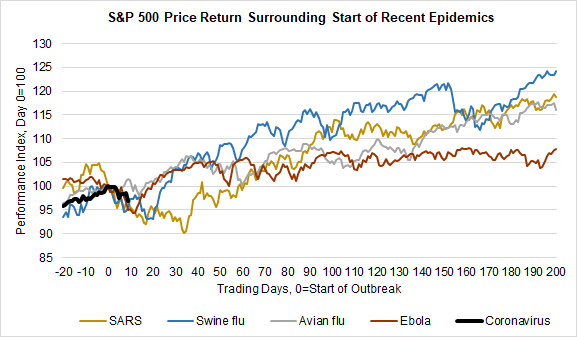
In reviewing several previous episodes of epidemics, including SARS (2003), Swine flu (2009), Avian flu (2013), and Ebola (2014), financial markets reacted negatively in a similar way. On average, equities troughed about four weeks after the initial panic. In each of these cases, they recovered back to around where they started before the panic in the subsequent few weeks (and moved higher than that in several cases) by two months after the initial event. History doesn’t always repeat, and every contagion is a bit different, but such similar epidemics were proven to have been short-lived blips on the financial radar screen.

Sources

  1. LSA PortfolioAnalytics
  2. FocusPoint Solutions calculations, based on index returns from Yahoo Finance. Epidemic start dates: SARS (1/21/03), Swine flu (6/11/09), Avian flu (3/31/13), Ebola (9/30/14), as defined by Goldman Sachs Investment Research. Coronavirus start date set as 1/17/20, with returns through 1/31/20.

2019 IRA Deadlines Are Approaching: Here’s What You Need to Know

Photo by Pixabay on Pexels.com

Financially, many of us associate April with taxes – but we should also associate April with important IRA deadlines.

April 1, 2020

The deadline to take your Required Minimum Distribution (RMD) from certain individual retirement accounts.

A New Federal Law

The Setting Every Community Up for Retirement Enhancement (SECURE) ACT, passed late in 2019, changed the age for the initial RMD for traditional IRAs and traditional workplace retirement plans. It lifted this age from 70½ to 72, effective as of 2020.1

So, if you were not 70½ or older when 2019 ended, you can wait to take your first RMD until age 72. If you were 70½ at the end of 2019, the old rules still apply, and your initial RMD deadline is April 1, 2020. Your second RMD will be due on December 31, 2020.1,2

Keep in mind that withdrawals from traditional, SIMPLE, and SEP-IRAs are taxed as ordinary income, and if taken before age 59½, may be subject to a 10% federal income tax penalty.

To qualify for the tax-free and penalty-free withdrawal of earnings from a Roth IRA, your Roth IRA distributions must meet a five-year holding requirement and occur after age 59½. Tax-free and penalty-free withdrawals can also be taken under certain other circumstances, such as a result of the owner’s death. The original Roth IRA owner is not required to take minimum annual withdrawals.

April 15, 2020

The deadline for making annual contributions to a traditional IRA, Roth IRA, and certain other retirement accounts. (3)

The earlier you make your annual IRA contribution, the better. You can make a yearly IRA contribution any time between January 1 of the current year and April 15 of the next year. So, the contribution window for 2019 started on January 1, 2019 and ends on April 15, 2020. Accordingly, you can make your IRA contribution for 2020 any time from January 1, 2020 to April 15, 2021. (4)

You may help manage your income tax bill if you are eligible to contribute to a traditional IRA. To get the full tax deduction for your 2019 traditional IRA contribution, you have to meet one or more of these financial conditions:

  • You aren’t eligible to participate in a workplace retirement plan.
  • You are eligible to participate in a workplace retirement plan, but you are a single filer or head of household with Modified Adjusted Gross Income (MAGI) of $64,000 or less. (Or if you file jointly with your spouse, your combined MAGI is $103,000 or less.) (5)
  • You aren’t eligible to participate in a workplace retirement plan, but your spouse is eligible and your combined 2019 gross income is $193,000 or less. (6)

Thanks to the SECURE Act, both traditional and Roth IRA owners now have the chance to contribute to their IRAs as long as they have taxable compensation (and in the case of Roth IRAs, MAGI below a certain level; see below). (1,4)

If you are making a 2019 IRA contribution in early 2020, you must tell the investment company hosting the IRA account which year the contribution is for. If you fail to indicate the tax year that the contribution applies to, the custodian firm may make a default assumption that the contribution is for the current year (and note exactly that to the I.R.S.).

So, write “2020 IRA contribution” or “2019 IRA contribution,” as applicable, in the memo area of your check, plainly and simply. Be sure to write your account number on the check. If you make your contribution electronically, double-check that these details are communicated.

How Much Can You Put Into an IRA This Year?

You can contribute up to $6,000 to a Roth or traditional IRA for the 2020 tax year; $7,000, if you will be 50 or older this year. (The same applies for the 2019 tax year). Should you make an IRA contribution exceeding these limits, you have until the following April 15 to correct the contribution with the help of an I.R.S. form. If you don’t, the amount of the excess contribution will be taxed at 6% each year the correction is avoided.3,4

The maximum contribution to a Roth IRA may be reduced because of Modified Adjusted Gross Income (MAGI) phaseouts, which kick in as follows.

2019 Tax Year

  • Single/head of household: $122,000 – $137,000
  • Married filing jointly: $193,000 – $203,000 (7)

2020 Tax Year

  • Single/head of household: $124,000 – $139,000
  • Married filing jointly: $196,000 – $206,000 (8)

The I.R.S. has other rules for other income brackets. If your MAGI falls within the applicable phase-out range, you may be eligible to make a partial contribution. (7,8)

A last reminder for those who turned 70½ in 2019: you need to take your first traditional IRA RMD by April 1, 2020 at the latest. The investment company that serves as custodian (host) of your IRA should have alerted you to this deadline; in fact, they have probably calculated the RMD amount for you. Your subsequent RMD deadlines will all fall on December 31. (2)

Sources

  1. marketwatch.com/story/with-president-trumps-signature-the-secure-act-is-passed-here-are-the-most-important-things-to-know-2019-12-21
  2. kiplinger.com/article/retirement/T045-C000-S001-the-deadline-for-your-first-rmd-is-april-1.html
  3. irs.gov/retirement-plans/ira-year-end-reminders
  4. irs.gov/retirement-plans/traditional-and-roth-iras
  5. irs.gov/retirement-plans/2019-ira-deduction-limits-effect-of-modified-agi-on-deduction-if-you-are-covered-by-a-retirement-plan-at-work
  6. irs.gov/retirement-plans/2019-ira-deduction-limits-effect-of-modified-agi-on-deduction-if-you-are-not-covered-by-a-retirement-plan-at-work
  7. irs.gov/retirement-plans/amount-of-roth-ira-contributions-that-you-can-make-for-2019
  8. irs.gov/retirement-plans/plan-participant-employee/amount-of-roth-ira-contributions-that-you-can-make-for-2020

This material was prepared by MarketingPro, Inc., and does not necessarily represent the views of the presenting party, nor their affiliates. This information has been derived from sources believed to be accurate. Please note – investing involves risk, and past performance is no guarantee of future results. The publisher is not engaged in rendering legal, accounting or other professional services. If assistance is needed, the reader is advised to engage the services of a competent professional. This information should not be construed as investment, tax or legal advice and may not be relied on for the purpose of avoiding any Federal tax penalty. This is neither a solicitation nor recommendation to purchase or sell any investment or insurance product or service, and should not be relied upon as such. All indices are unmanaged and are not illustrative of any particular investment.

8 Key Issues Facing Investors in 2020

Photo by Pixabay on Pexels.com

The term ‘outlook’ can be misleading, as most forecasts tend to be partially to very off-base in hindsight. So, this question is best answered as a summary of whatever is currently top of mind going into the New Year. Some of these change from year-to-year, while others have been ongoing.

1) Presidential Impeachment Proceedings

Now that this has escalated to a full trial in the Senate, expectations for an acquittal or lighter ‘censure’ appear the highest-probability outcome. Of course, anything that throws these expectations off track could affect financial markets, as would any implications for the upcoming Presidential race (see below). Despite all this, polls have shown Americans are relatively steadfast in their support one way or the other following the high-profile and contentious proceedings so far.

2) Trade Between the U.S. and China

While ‘phase one’ of a deal has technically been agreed to, it remains under legal review and has yet to be finalized. While the process of achieving further agreement remains likely a long one, the hope is that further tariffs can be paused and/or coupled with an easing of existing restrictions. Following the various announcements, which financial markets have tended to view optimistically, follow-through is also an issue, as details have been vague and implementation has been spotty historically.

3) Trade Between the U.S. and Other Countries

While the issues between the U.S. and China have taken most of the headlines, increasingly protectionist policies affect other relationships around the globe. This has been highlighted (and possibly solved) by the U.S.-Mexico-Canada trade agreement (USMCA) replacement for NAFTA, assuming final approval is just a formality. Also, there are a variety of other skirmishes with Europe, notably with France over their imposition of a ‘digital tax’, which affects a disproportionate number of U.S. tech firms, and was countered with a symbolic severe 100% tariff on items of French cultural significance, such as Champagne, cheese, etc. Other export-heavy nations, such as Germany (especially with autos and industrial equipment), are also sensitive to these protectionist pressures.

4) The Presidential Election

This is potentially volatility-inducing, based on polling results and sentiment. Politics aside, the key financial market issues here are:

  1. A Republican administration (Trump) would retain the current pro-corporate policies, such as a low tax regime and reduced regulatory burdens.
  2. A Democratic regime (especially Warren or Sanders) could raise fears of anti-competitive review of certain behemoth companies, such as in technology, attempt a rollback in tax cuts or reestablish a more restrictive regulatory environment.

There are sector concerns here as well, which we’ve discussed previously. Overall, an incumbent president has a lot to lose by the economy going into recession just prior to an election—it’s almost a sure-fire formula for a regime change.

5) Economic Growth/Stage of the Business Cycle

How long will this already-long cycle continue? That is the key question, and may continue to be so until we eventually have a recession. A decade of recovery since the financial crisis is already a record in the modern era (last 100+ years, at least), but we have experienced several mid-cycle slowdowns over that time (which can look like a recession is beginning, even when it doesn’t end up unfolding). Growth has been slow throughout, though, which has reduced the amount of ‘excess’ in the economy, and possibly, the damage from a recession, if one were to occur in the near-term.

6) Yields and Fed Policy

The U.S. Federal Reserve has effectively announced that the three rate cuts in 2019 are it for the time being, the certainty about which the market seems to appreciate. However, the bar for raising rates has been raised, due to concerns over a lack of broad inflation. The Fed’s predictions for the future, though, similar to other economists, have shown mixed accuracy. Other central banks around the globe, such as the ECB and Bank of Japan, have remained steadfastly accommodative, keeping interest rates at negative levels, in addition to other stimulus, in response to very low inflation and economic growth. Looking at the long-term drivers of demographics/labor force growth and productivity, such meager conditions do not appear likely to abate soon.

7) Equity Earnings and Valuations

One concern is about U.S. markets, following a strong period of above-average absolute returns and relative out-performance over foreign equities—how long can it go on? Valuation has tended to be a poor predictor of near-term performance, but can be useful in looking at upcoming multi-year performance. In this framework, a period of lower returns following a decade of high returns compared to historical norms wouldn’t be surprising. But markets continue to surprise in the meantime, so those who have moved to more defensive positioning too early can miss out on continued strength. Earnings growth has tended to be the primary driver of long-term equity results, however, which is a reason stocks often decline prior to recessions and perform well during periods of economic expansion. At the same time, the world has become more convoluted, with U.S. companies earning increasing amounts of revenue from abroad, and vice versa, so, aside from currency impacts, company domicile outright is less useful in broad brush equity market evaluations than in the past.

8) The Wildcards

They are always there, whether it be geopolitical flare-ups, weather disasters, political regime changes, or other surprises. As always, portfolio diversification can help ease the volatility of these.

▲Consumer confidence by political affiliation

This chart looks at consumer confidence by political affiliation. The grey line shows the percentage of all individuals polled who feel that economic conditions are good or excellent while the blue and red lines show how Democrats and Republicans feel about economic conditions, respectively. While there has been a large surge in consumer confidence for Republicans and a decrease in confidence for Democrats more recently, the bottom line is investors should not let politics dictate their investment strategies.

Sources

  1. LSA Portfolio Analytics
  2. https://am.jpmorgan.com/us/en/asset-management/gim/protected/adv/insights/guide-to-the-markets/viewer

The 2020 Contribution Limit Increases for your IRA, 401(k) and 403(b) accounts

Photo by cottonbro on Pexels.com

The I.R.S. increased the annual contribution limits on IRAs, 401(k)s, and other widely used retirement plan accounts for 2020. Here’s a quick look at the changes.

IRAs

Next year, you can put up to $6,000 in any type of IRA. The limit is $7,000 if you will be 50 or older at any time in 2020. (1,2)

401(k)s, 403(b)s, 457s, and Thrift Savings Plans

Annual contribution limits for 401(k)s, 403(b)s, the federal Thrift Savings Plan, and most 457 plans also get a $500 boost for 2020. The new annual limit on contributions is $19,500. If you are 50 or older at any time in 2020, your yearly contribution limit for one of these accounts is $26,000. (1,2)

Solo 401(k)s and SEP IRAs

Are you self-employed, or do you own a small business? You may have a solo 401(k) or a SEP IRA, which allows you to make both an employer and employee contribution. The ceiling on total solo 401(k) and SEP IRA contributions rises $1,000 in 2020, reaching $57,000. (3)

SIMPLE IRA

If you have a SIMPLE retirement account, next year’s contribution limit is $13,500, up $500 from the 2019 level. If you are 50 or older in 2020, your annual SIMPLE plan contribution cap is $16,500. (3)

HSAs

Yearly contribution limits have also been set a bit higher for Health Savings Accounts (which may be used to save for retirement medical expenses). The 2020 limits: $3,550 for individuals with single medical coverage and $7,100 for those covered under qualifying family plans. If you are 55 or older next year, those respective limits are $1,000 higher. (4)

Sources

  1. irs.gov/retirement-plans/plan-participant-employee/retirement-topics-ira-contribution-limits
  2. irs.gov/newsroom/401k-contribution-limit-increases-to-19500-for-2020-catch-up-limit-rises-to-6500
  3. forbes.com/sites/ashleaebeling/2019/11/06/irs-announces-higher-2020-retirement-plan-contribution-limits-for-401ks-and-more/
  4. cnbc.com/2019/06/03/these-are-the-new-hsa-limits-for-2020.html

This material was prepared by MarketingPro, Inc., and does not necessarily represent the views of the presenting party, nor their affiliates. This information has been derived from sources believed to be accurate. Please note – investing involves risk, and past performance is no guarantee of future results. The publisher is not engaged in rendering legal, accounting or other professional services. If assistance is needed, the reader is advised to engage the services of a competent professional. This information should not be construed as investment, tax or legal advice and may not be relied on for the purpose of avoiding any Federal tax penalty. This is neither a solicitation nor recommendation to purchase or sell any investment or insurance product or service, and should not be relied upon as such. All indices are unmanaged and are not illustrative of any particular investment.